 Popular
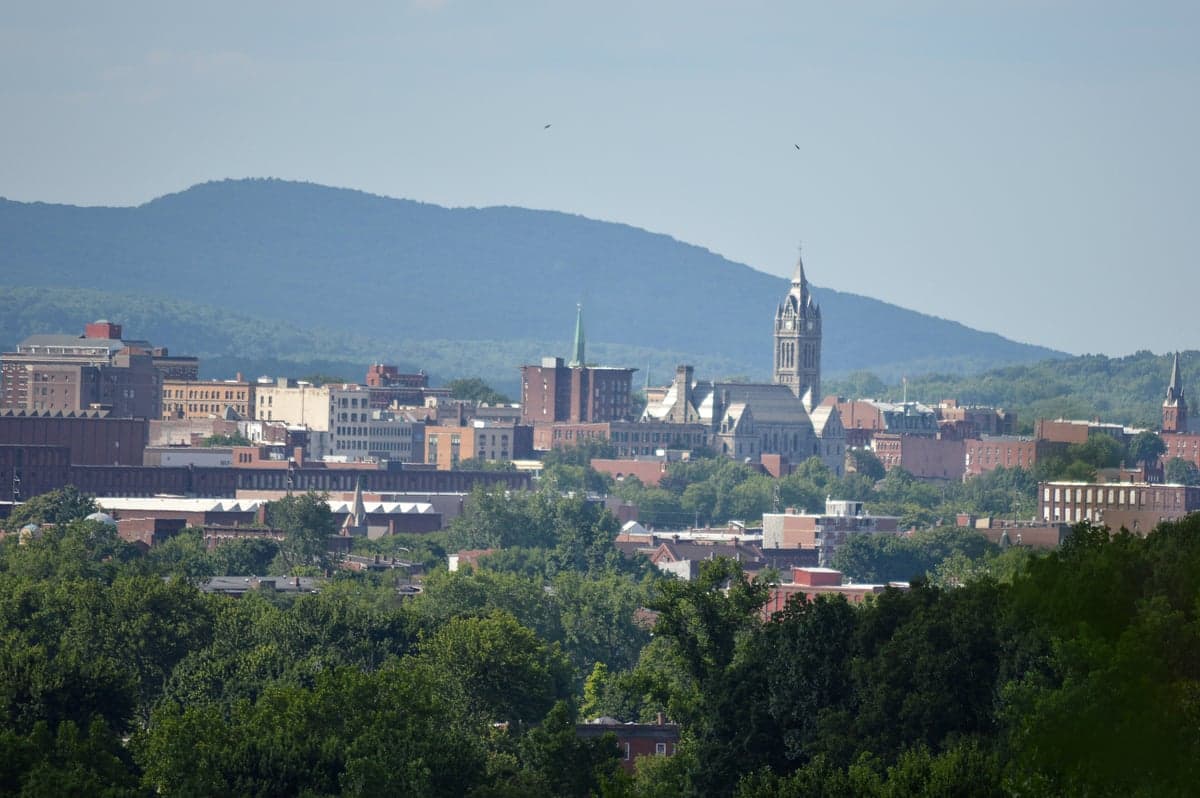
Photo: Wikipedia
Demographics of Holyoke, MA
Affluence Level in Holyoke, MA
A below-average socioeconomic profile. Incomes, home values, and educational attainment trail the U.S., with higher poverty and unemployment.
People of Holyoke, MA
The people of Holyoke, Massachusetts today form a predominantly Hispanic (51.6%) and white (43.5%) city of 37,949 residents, with a small Black (2.5%), East/Southeast Asian (0.3%), and Indian-subcontinent (0.3%) presence. Only 2.4% of residents are foreign-born, a figure well below the Massachusetts state average of 17%, indicating a population shaped more by domestic migration and generational settlement than by recent international arrivals. The city is notably less college-educated than the state average (24.3% vs. 45%), and its identity is rooted in a working-class, industrial past that has given way to a majority-Hispanic present, concentrated in distinct neighborhoods that trace their origins to specific immigrant waves.
How the city was settled and grew
Holyoke was founded in the 1850s as a planned industrial city, built around the Hadley Falls dam and a network of canals designed to harness the Connecticut River for textile manufacturing. The original population was overwhelmingly Irish, recruited to dig the canals and build the mills. They settled in the Flats neighborhood, the low-lying area near the canals, where tenements and boarding houses sprang up. By the 1870s, French-Canadian families arrived, fleeing Quebec’s agricultural depression, and established a strong presence in the Highlands and Whiting Farms areas, building churches and parochial schools that anchored the community for generations. A smaller wave of Polish and German immigrants followed in the 1880s-1900s, clustering in the South Holyoke and Springdale neighborhoods. By 1920, Holyoke was a thriving mill city of over 60,000, overwhelmingly white and European-born, with Irish and French-Canadian identities dominating its civic and religious life.
Modern era (post-1965)
The post-1965 era brought dramatic demographic change. As textile mills closed from the 1950s through the 1970s, Holyoke’s white population began a steady exodus to surrounding suburbs like South Hadley and Chicopee. Into this vacuum came Puerto Rican migrants, initially recruited for remaining factory and agricultural work in the Connecticut River valley. They settled heavily in South Holyoke and the Flats, neighborhoods that had lost population and housing stock. By 1990, the Hispanic share had risen to roughly 30%; by 2020, it had crossed 50%. The white population, once nearly universal, dropped to 43.5% by the 2020 census. The French-Canadian and Irish enclaves in the Highlands and Whiting Farms remain predominantly white, while South Holyoke and the Flats are now overwhelmingly Hispanic. The small Black and East/Southeast Asian populations are scattered, with no single dominant neighborhood. The Indian-subcontinent community, at 0.3%, is negligible and largely professional, residing in the Highlands near the Holyoke Medical Center and the nearby University of Massachusetts Amherst.
The future
Holyoke’s population is trending toward further Hispanic majority, driven by higher birth rates and continued domestic in-migration from other parts of Massachusetts and Puerto Rico. The white population is aging and declining, while the Hispanic population is younger and growing. The city is not homogenizing, however; it is tribalizing into distinct enclaves. The Highlands and Whiting Farms remain solidly white and older, while South Holyoke and the Flats are young and Hispanic. The foreign-born share (2.4%) is low and unlikely to rise significantly, as Holyoke lacks the job base or immigrant networks of gateway cities like Boston or Springfield. The next 10-20 years will likely see the Hispanic share approach 60-65%, with white population continuing to shrink. The small Black and Asian communities are expected to remain stable but small, as Holyoke does not attract the professional-class immigration that drives growth in other Massachusetts cities.
For someone moving in now, Holyoke is a city in transition: majority-Hispanic, working-class, and increasingly defined by its Puerto Rican cultural identity, while older white ethnic neighborhoods persist in the Highlands and Whiting Farms. The city offers affordable housing and a strong sense of neighborhood identity, but its demographic trajectory means that newcomers should expect a community that is becoming more homogeneous by ethnicity and age, with limited diversity beyond the Hispanic-white binary.

* Values derived from national, state, county, city and local statistics and may differ in a specific area. Last updated: 2026-05-01T09:07:15.000Z
Narrative content on this page is AI-generated and may contain mistakes. Verify any details that matter before acting on them.
ReloMaps may earn a commission from affiliate links at no extra cost to you.

