Photo: Wikipedia
Demographics of Hialeah, FL
Affluence Level in Hialeah, FL
A middle-class area roughly in line with national averages across income, home values, education, and employment.
People of Hialeah, FL
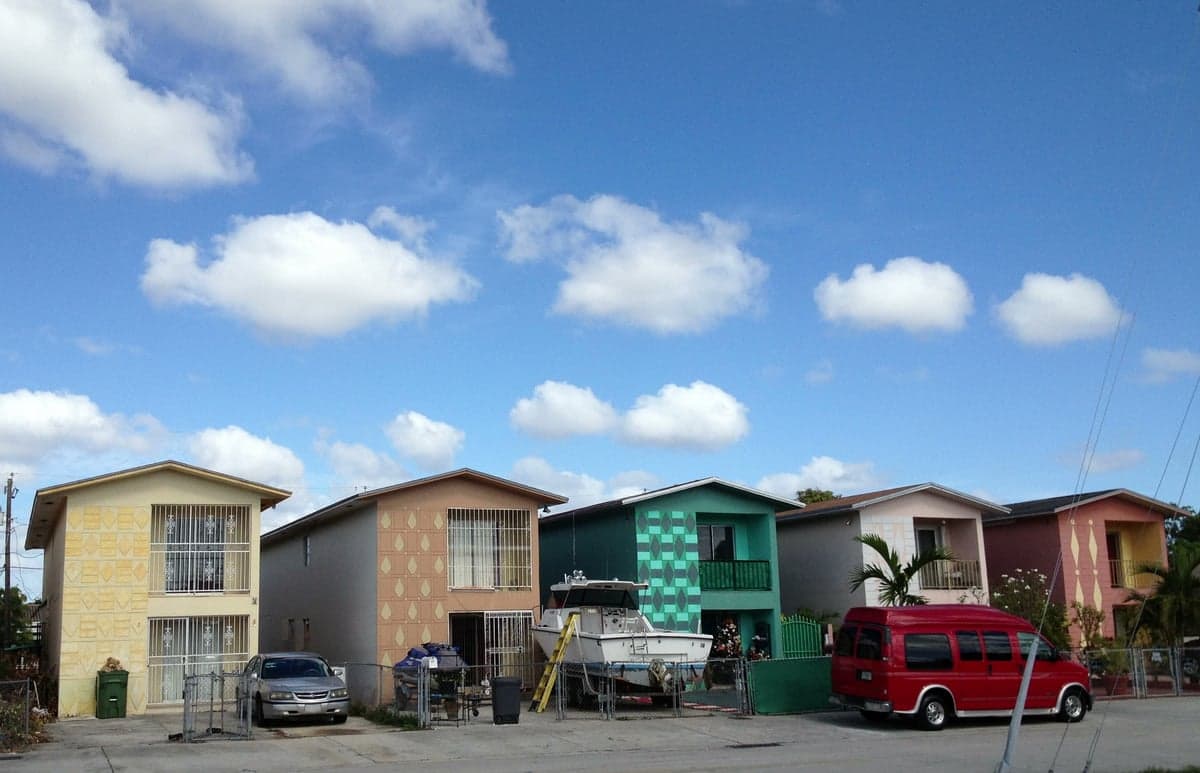
The people of Hialeah, Florida form one of the most demographically concentrated major cities in the United States: 95.2% of its 221,901 residents identify as Hispanic, with a foreign-born population of 31.1%. The city is overwhelmingly Cuban-American in character, a legacy of successive waves of migration that began in the 1960s, though newer arrivals from Central and South America are gradually diversifying the mix. With only 3.0% of the population identifying as non-Hispanic White and minuscule shares of Black (0.7%), East/Southeast Asian (0.4%), and Indian-subcontinent (0.2%) residents, Hialeah remains a uniquely insular, Spanish-dominant enclave where English is often a second language and local politics, commerce, and daily life reflect a deeply rooted exile identity.
How the city was settled and grew
Hialeah was not a colonial-era settlement but a 20th-century creation, incorporated in 1925 as a speculative real estate venture during the Florida land boom. The city's name is derived from Seminole language, but its early population was overwhelmingly white and native-born, drawn by the promise of suburban lots and jobs tied to the Hialeah Park Race Track, which opened in 1925 and became a national horse-racing destination. The original residential core, now known as Hialeah Heights and the area around Palm Avenue, was built by middle-class Anglo families who worked in Miami's growing service economy. The Great Depression and World War II slowed growth, but by 1950 Hialeah had roughly 10,000 residents, still predominantly non-Hispanic white. The city's character changed permanently after the Cuban Revolution of 1959. The first wave of Cuban exiles—largely upper- and middle-class professionals fleeing Castro—settled in the West Hialeah neighborhoods near West 4th Avenue and along the Gratigny Parkway corridor, establishing the Spanish-language businesses, Catholic parishes, and civic clubs that would define the city for decades.
Modern era (post-1965)
The 1965 Hart-Cellar Act and subsequent U.S. policies toward Cuban refugees triggered a second, much larger wave of migration. Between 1965 and 1973, the so-called "Freedom Flights" brought hundreds of thousands of Cubans to South Florida, and Hialeah absorbed a disproportionate share. These later arrivals—more working-class and less educated than the first wave—settled in the Hialeah Lakes district and the dense grid of streets around East 8th Avenue, where small homes and duplexes were built to accommodate extended families. By 1980, Hialeah was over 75% Hispanic, and the Mariel boatlift of 1980 added another 20,000–30,000 residents, many of whom moved into the Miami Lakes Estates area near the Palmetto Expressway. The 1990s and 2000s saw a third wave: Cuban-Americans from the older neighborhoods began moving to suburban Broward and Palm Beach counties, while their places were taken by newer immigrants from Nicaragua, Honduras, Colombia, and Venezuela. Today, the Hialeah-Miami Springs border area and the neighborhoods along West 68th Street show the highest concentrations of non-Cuban Hispanics, though Cuban surnames still dominate voter rolls and business directories. The city's 0.7% Black population is concentrated in a small pocket near the Hialeah Housing Authority complexes off East 4th Avenue, a legacy of public housing policies rather than organic settlement patterns.
The future
Hialeah's population is slowly diversifying within the Hispanic umbrella, but the overall demographic picture is one of consolidation rather than fragmentation. The Cuban-American share of the Hispanic population has declined from roughly 85% in 1990 to an estimated 65–70% today, as Central American and Venezuelan arrivals have grown. However, the city remains overwhelmingly Spanish-speaking and culturally conservative—a trend reinforced by the fact that only 21.2% of adults hold a college degree, one of the lowest rates among Florida cities of comparable size. Younger Cuban-Americans are increasingly leaving for more affordable suburbs in western Miami-Dade and central Florida, while new immigrants from Nicaragua and Venezuela fill the vacancies in older neighborhoods like Hialeah Heights and the Palm Avenue corridor. The next 10–20 years will likely see Hialeah remain a Hispanic-majority city with a shrinking Cuban plurality, but the city's identity as a Spanish-dominant, working-class enclave is unlikely to change. The non-Hispanic White population, already at 3.0%, will continue to decline as retirees age out and are not replaced.
For someone moving in now, Hialeah offers a dense, affordable, and intensely community-oriented environment where Spanish fluency is a practical necessity and the pace of life is shaped by family networks, Catholic traditions, and a political culture that leans heavily conservative. It is not a melting pot but a layered ethnic enclave—Cuban at its core, increasingly Central American at its edges, and unlikely to become meaningfully multiracial or multiethnic in the foreseeable future. New residents should expect a city where the public square, the local economy, and the school system all operate primarily in Spanish, and where the demographic trends point toward stability rather than transformation.

* Values derived from national, state, county, city and local statistics and may differ in a specific area. Last updated: 2026-04-24T03:53:53.000Z
Narrative content on this page is AI-generated and may contain mistakes. Verify any details that matter before acting on them.
ReloMaps may earn a commission from affiliate links at no extra cost to you.

