Photo: Wikipedia
Demographics of Hays, KS
Affluence Level in Hays, KS
A middle-class area roughly in line with national averages across income, home values, education, and employment.
People of Hays, KS
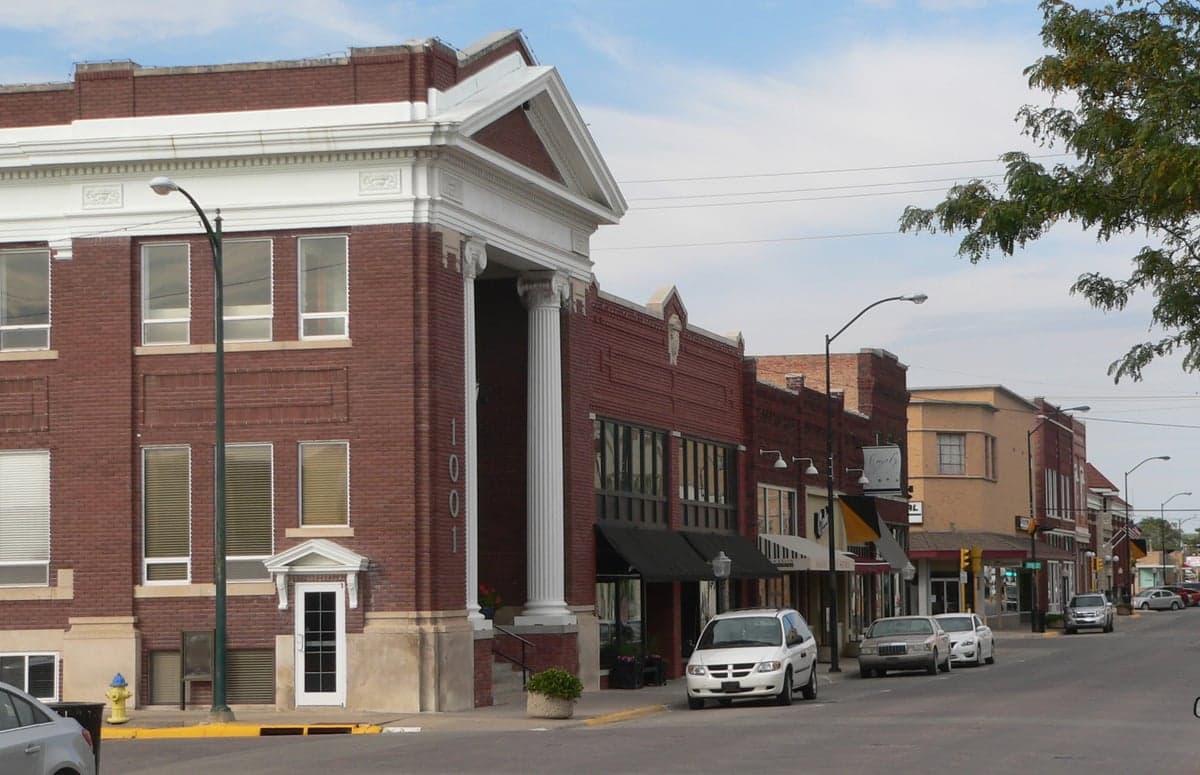
The people of Hays, Kansas, today number 21,078, forming a predominantly white (87.0%) and college-educated (43.9%) community with a distinctly German-Catholic heritage that still shapes local identity. The city is notably less diverse than the national average, with a Hispanic population of 7.0%, a small Black community at 1.2%, and East/Southeast Asian and Indian-subcontinent residents each accounting for 1.2% and 0.6% respectively. Only 2.1% of residents are foreign-born, reflecting a population that is overwhelmingly native-born and deeply rooted in the region’s agricultural and railroad history. This is a place where generational continuity is strong, and newcomers—whether from other parts of Kansas or abroad—tend to integrate into established social and civic structures rather than forming distinct ethnic enclaves.
How the city was settled and grew
Hays was founded in 1867 as a frontier outpost of the Union Pacific Railroad, which drove the first major population wave of railroad workers, merchants, and soldiers stationed at Fort Hays. The city’s early growth was fueled by the railroad’s westward expansion and the subsequent agricultural boom, drawing a predominantly German-Catholic population from the Midwest and directly from Germany. These settlers built the Cathedral of the Immaculate Conception neighborhood, centered around the historic church at 13th and Main, which remains a core of the German-Catholic community. The North Hill area, developed in the early 1900s, became home to many railroad employees and their families, while Southside (south of 10th Street) attracted farmers and small business owners. By 1900, Hays had grown to roughly 2,000 residents, and the population doubled by 1920 as the Volga German community—ethnic Germans who had lived in Russia—arrived and settled in the East Hays district, bringing distinct traditions in farming and food preservation. The city’s population reached 11,000 by 1960, driven by the expansion of Fort Hays State University (founded 1902) and the growth of regional healthcare at Hays Medical Center.
Modern era (post-1965)
After the 1965 Immigration and Nationality Act, Hays saw only modest demographic change compared to larger Kansas cities. The Hispanic population grew from under 1% in 1970 to 7.0% today, with most families settling in the West Hays area near the I-70 corridor, where newer housing developments and service-sector jobs are concentrated. The East/Southeast Asian community (1.2%) arrived primarily through university and medical professional recruitment, with many faculty and medical staff living in the University Hills neighborhood near Fort Hays State. The Indian-subcontinent population (0.6%) is similarly tied to the university and medical center, with families dispersed rather than clustered. The Black population (1.2%) has remained stable since the 1970s, with most residents living in the Downtown area and working in education or healthcare. Suburbanization has been limited: the Pine Hills subdivision, developed in the 1990s, attracted middle-class families of all backgrounds, but the city’s overall residential pattern remains one of older, walkable neighborhoods near the core and newer, car-dependent subdivisions on the periphery.
The future
Hays is likely to remain a predominantly white, college-educated community over the next 10–20 years, with gradual diversification driven by university enrollment and healthcare recruitment rather than large-scale immigration. The Hispanic population is expected to grow slowly, possibly reaching 10–12% by 2040, as younger families move into the West Hays area for affordable housing and service jobs. The East/Southeast Asian and Indian-subcontinent populations will likely plateau or grow only slightly, as Fort Hays State University’s international enrollment has been stable. The city is not tribalizing into distinct ethnic enclaves; instead, new residents tend to assimilate into existing neighborhoods, with the strongest cultural identity remaining the German-Catholic heritage of the Cathedral and North Hill areas. The biggest demographic shift may be an aging population—the median age is already 33.5—as younger adults leave for larger cities and retirees move into the Hays Medical Center area for healthcare access.
For someone moving to Hays now, the city offers a stable, family-oriented community where generational roots run deep and newcomers are welcomed into established civic and religious networks. The population is not rapidly diversifying, but it is not stagnating either—steady growth through university and healthcare employment ensures a modest influx of educated professionals. The key trade-off is between the strong social cohesion of a historically German-Catholic town and the limited ethnic and cultural variety that comes with that homogeneity. If you value tight-knit neighborhoods, low crime, and a clear sense of place, Hays delivers; if you seek a truly multicultural environment, you will find it more in Kansas City or Wichita.

* Values derived from national, state, county, city and local statistics and may differ in a specific area. Last updated: 2026-04-30T04:32:43.000Z
Narrative content on this page is AI-generated and may contain mistakes. Verify any details that matter before acting on them.
ReloMaps may earn a commission from affiliate links at no extra cost to you.

