Photo: Wikipedia
Demographics of Havre De Grace, MD
Affluence Level in Havre De Grace, MD
A middle-class area roughly in line with national averages across income, home values, education, and employment.
People of Havre De Grace, MD
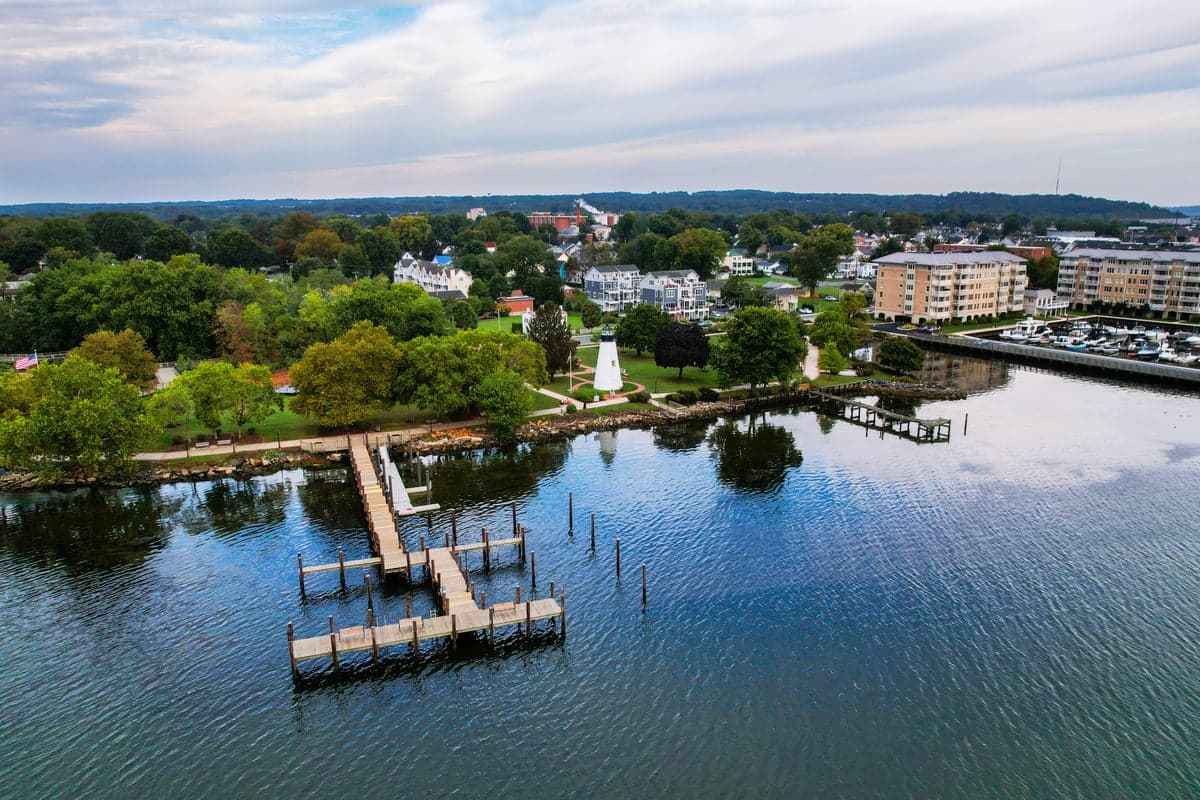
Today, Havre de Grace is a small, historically rooted city of 14,857 residents that retains a distinctly old-school Chesapeake character, with a population that is 74.0% white, 12.9% black, and 5.8% Hispanic. The city’s identity is shaped by its compact historic core, a working waterfront, and a sense of civic pride that leans traditional and family-oriented. With 41.3% of adults holding a college degree, it draws a mix of professionals commuting to Aberdeen Proving Ground and Baltimore, alongside multi-generational local families who value its small-town feel and low crime relative to the broader region.
How the city was settled and grew
Havre de Grace was founded in the late 18th century at the mouth of the Susquehanna River, originally a ferry and trading post. Its early population was overwhelmingly English and Scottish, drawn by the promise of land grants and the strategic port location. The War of 1812 nearly destroyed the town, but it rebuilt as a fishing and oystering hub, attracting a wave of German and Irish immigrants in the mid-1800s who settled in the working-class Concord Point neighborhood, near the lighthouse and waterfront. By the late 19th century, the city’s role as a railroad and steamboat terminus brought a small but established black community, many of whom worked on the docks and in domestic service, settling in the Strawberry Hill area along Juniata Street. The early 20th century saw a modest influx of Italian immigrants, who clustered around Market Street and opened grocery stores and barbershops, while the city’s white Protestant elite built homes on the higher ground of Bourbon Street and Green Street.
Modern era (post-1965)
After the 1965 Immigration and Nationality Act, Havre de Grace did not experience the large-scale immigration seen in larger Maryland cities. The foreign-born population today is just 1.9%, one of the lowest rates in the state. Instead, the city’s modern demographic story is one of domestic in-migration and suburbanization. The expansion of Aberdeen Proving Ground in the 1970s and 1980s brought a wave of white-collar defense workers and military retirees, many of whom bought homes in the newer subdivisions of Bulle Rock and Oakwood Hills on the city’s western edge. These neighborhoods are predominantly white and upper-middle-class, with larger lots and newer construction. Meanwhile, the city’s black population, which had historically been concentrated in Strawberry Hill and the Old Town area near the waterfront, began to spread into other parts of the city as housing discrimination eased, though these neighborhoods remain the cultural heart of the black community. The Hispanic share (5.8%) is a recent and modest growth, driven largely by service-industry workers and some agricultural labor in surrounding Harford County; they have no single concentrated neighborhood but are scattered, with a small cluster near the Route 40 corridor. East/Southeast Asian residents (1.4%) and Indian-subcontinent residents (0.8%) are very small populations, mostly professionals associated with the military base or regional hospitals, living in the newer subdivisions rather than the historic core.
The future
Havre de Grace is not homogenizing into a single demographic bloc, but it is slowly diversifying at the margins. The white share has declined from over 85% in 1990 to 74.0% today, while the Hispanic and Asian shares have ticked up from near zero. The black population has remained stable at roughly 12-13% for decades, suggesting a settled community rather than a rapidly growing one. The city’s future population trajectory is likely to be one of slow, steady growth, constrained by limited developable land and strict historic preservation rules in the downtown core. New housing is mostly infill and small subdivisions on the western edge, which will continue to attract middle-class families and retirees. The immigrant communities are too small to drive major change, but the Hispanic share may grow to 8-10% over the next decade as service-sector jobs expand. The city is not tribalizing into distinct ethnic enclaves; rather, it remains a predominantly white, native-born town with a stable black minority and a small but growing Hispanic presence, all living in largely integrated neighborhoods.
For someone moving in now, Havre de Grace offers a stable, low-crime, historically conscious community where the population is aging slightly but remains family-oriented. The city is not a melting pot of new arrivals, but a place where multi-generational locals and incoming professionals coexist around shared values of tradition, waterfront life, and civic engagement. The demographic future is one of gradual, modest diversification, not rapid transformation.

* Values derived from national, state, county, city and local statistics and may differ in a specific area. Last updated: 2026-04-19T06:59:54.000Z
Narrative content on this page is AI-generated and may contain mistakes. Verify any details that matter before acting on them.
ReloMaps may earn a commission from affiliate links at no extra cost to you.

