
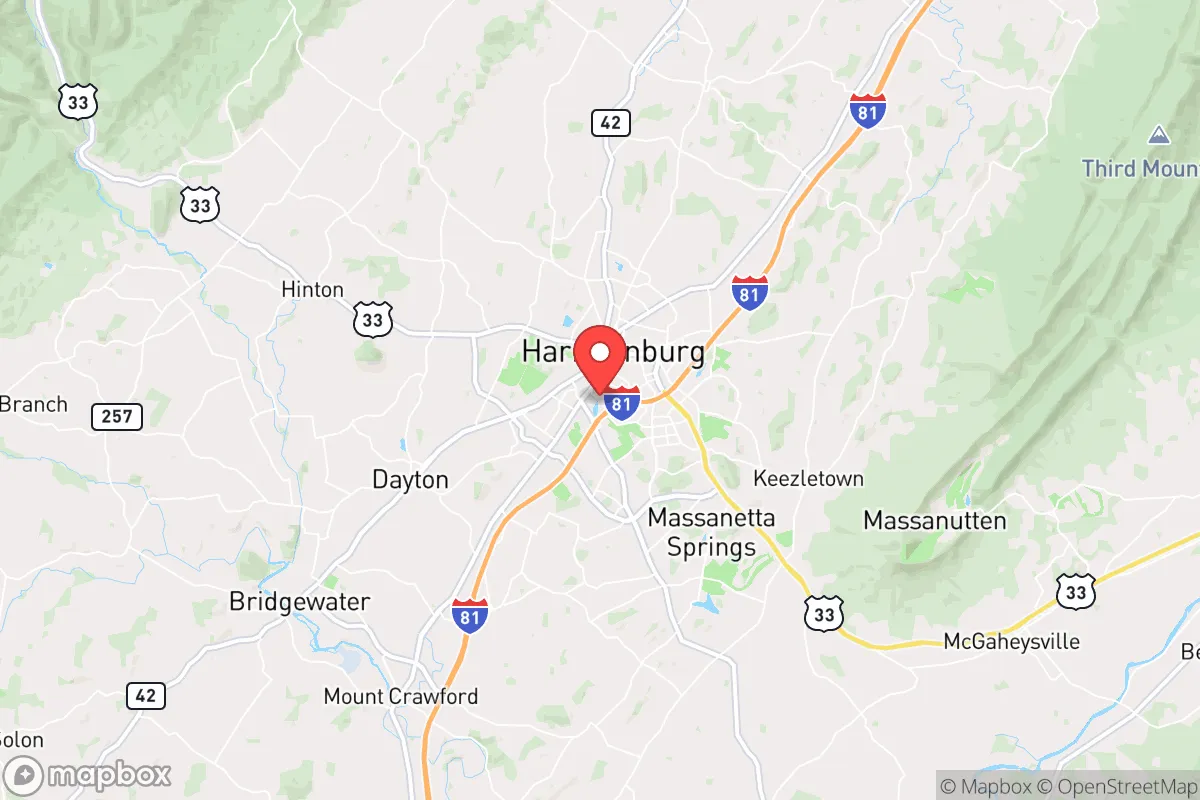
Photo by Anthony Chiado on Unsplash
Personal Sovereignty in Harrisonburg, VA
Viable for self-reliance. Generally workable, though some barriers may limit total independence.
What does Personal Sovereignty tell us?
Personal Sovereignty measures your capacity for self-reliance and independence with minimal government friction. Higher scores mean fewer barriers between you and the way you want to live... but it assumes you have the space you need and good neighbors.
What does this tell us?
Personal Sovereignty measures your capacity for self-reliance and independence with minimal government friction. Higher scores mean fewer barriers between you and the way you want to live... but it assumes you have the space you need and good neighbors.
State Policy
Energy independence: Importer (20% of energy produced in-state)
Personal Liberty
Homesteading

Personal Liberty Analysis
Harrisonburg, Virginia, offers a mixed bag for those prioritizing personal sovereignty, with the city’s Blue-leaning local governance often clashing with the state’s more moderate-to-conservative legal framework. While Virginia as a whole has seen a leftward drift on taxes and regulation, Harrisonburg’s specific ordinances and cultural climate can create friction for those seeking maximum autonomy. For a survivalist or prepper mindset, the key is understanding where the city’s rules end and where state-level protections—like gun rights and property laws—still hold firm, allowing you to carve out a self-reliant life if you choose your neighborhood and county wisely.
Tax burden and regulatory climate in Harrisonburg vs. surrounding counties
Harrisonburg’s tax burden is moderate but noticeably higher than in the surrounding rural counties like Rockingham or Augusta. The city levies a combined real estate tax rate of $1.10 per $100 of assessed value, while Rockingham County sits around $0.65—a significant difference for anyone looking to minimize government extraction. Virginia’s state income tax is a flat 5.75%, and sales tax in Harrisonburg is 6.3% (5.3% state plus 1% local option), which is standard for the region. The regulatory posture in the city is more interventionist than in the county: Harrisonburg has stricter zoning codes, noise ordinances, and business licensing requirements. For a prepper, this means that homesteading or running a small-scale operation is far easier just outside city limits, where county officials are less inclined to enforce burdensome rules. The state’s overall regulatory environment is middle-of-the-pack nationally, but the city’s local bureaucracy can feel like a thumb on the scale for anyone wanting to operate without permits or inspections.
Self-defense rights and gun law specifics in Harrisonburg and Virginia
Virginia is a “shall-issue” state for concealed carry permits, and Harrisonburg does not impose its own additional restrictions beyond state law. This means no permit is required to open carry a handgun (for those 18 and older), and concealed carry permits are issued by the local circuit court with a straightforward process—typically a background check and a $50 fee. The state does not have a “red flag” law as of 2026, though such legislation has been proposed repeatedly. Harrisonburg’s city council has passed symbolic resolutions supporting gun control, but these carry no legal weight. For preppers, the critical detail is that Virginia law preempts local governments from banning firearms in most public places, so city parks and streets remain accessible. However, private property owners, including businesses and universities (James Madison University), can prohibit firearms on their premises. The state also has a 10-round magazine limit for handguns passed in 2020, but this is widely ignored in practice and faces ongoing legal challenges. For long guns, no magazine restrictions apply. Overall, Harrisonburg offers a solid baseline for self-defense rights, but the political climate means you should expect occasional local pushback against those rights.
Self-reliance and homesteading viability: lot sizes, zoning, and off-grid feasibility
Within Harrisonburg city limits, homesteading is constrained by typical suburban zoning. Most residential lots are 0.1 to 0.25 acres, and the city’s zoning code prohibits keeping livestock (chickens are allowed only with a special permit, and no roosters). Gardening is permitted, but front-yard vegetable gardens may face HOA restrictions in planned communities. For serious self-reliance, the surrounding Rockingham County is far more accommodating: agricultural zoning allows lots as small as 1 acre for livestock, and many properties in the county have no HOA at all. Off-grid feasibility is limited by Virginia’s building codes, which require connection to the electrical grid for new construction in most areas, though solar panels with battery storage are legal and increasingly common. Rainwater collection is unrestricted for non-potable uses, and well water is standard on rural properties. The county also has fewer restrictions on composting toilets and alternative waste systems. For a prepper, the smart play is to buy land in Rockingham County within a 15-minute drive of Harrisonburg—you get the city’s amenities (hospitals, hardware stores) without the city’s zoning handcuffs.
Personal liberties: parental rights, medical autonomy, speech, and property
Virginia’s legal framework provides moderate protections for personal liberties, but Harrisonburg’s local culture can be more progressive. Parental rights are generally strong: Virginia law requires parental consent for minors’ medical procedures, and the state has not adopted broad “shield laws” for gender-related care that override parental authority. However, Harrisonburg Public Schools have implemented policies that some parents view as overreaching, including LGBTQ+ inclusive curricula and mental health screenings without explicit opt-in consent. Medical autonomy is a mixed bag: Virginia does not have a state-level vaccine mandate for adults, but during public health emergencies, the governor can impose restrictions—a concern for those wary of future overreach. The state also has a right-to-try law for terminally ill patients, allowing access to experimental treatments. Free speech is protected under the First Amendment, but Harrisonburg has a “disorderly conduct” ordinance that has been used to target protesters, raising concerns about selective enforcement. Property rights are solid: Virginia is a “Dillon’s Rule” state, meaning local governments have only the powers explicitly granted by the state, which limits Harrisonburg’s ability to impose rent control or aggressive eminent domain. For a prepper, the key takeaway is that your property is relatively secure from government seizure, but you should expect local schools and public spaces to reflect a more collectivist ethos.
Overall, Harrisonburg ranks as a moderate-to-low sovereignty environment compared to rural Virginia or states like Texas or Idaho. The city’s tax burden, zoning restrictions, and cultural leanings create friction for those seeking maximum autonomy, but the surrounding county offers a release valve. For a strategic relocation, the best approach is to live just outside city limits—where property taxes are lower, zoning is looser, and local government is less intrusive—while still having access to Harrisonburg’s infrastructure. If you’re willing to navigate the local political headwinds and choose your location carefully, you can build a self-reliant life here, but it’s not a place where sovereignty comes easy. The state’s preemption laws and property protections provide a floor, not a ceiling, and the ceiling is set by your willingness to vote with your feet and your wallet.

* Values derived from national, state, county, city and local statistics and may differ in a specific area. Last updated: 2026-05-01T18:37:16.000Z
Narrative content on this page is AI-generated and may contain mistakes. Verify any details that matter before acting on them.
ReloMaps may earn a commission from affiliate links at no extra cost to you.

