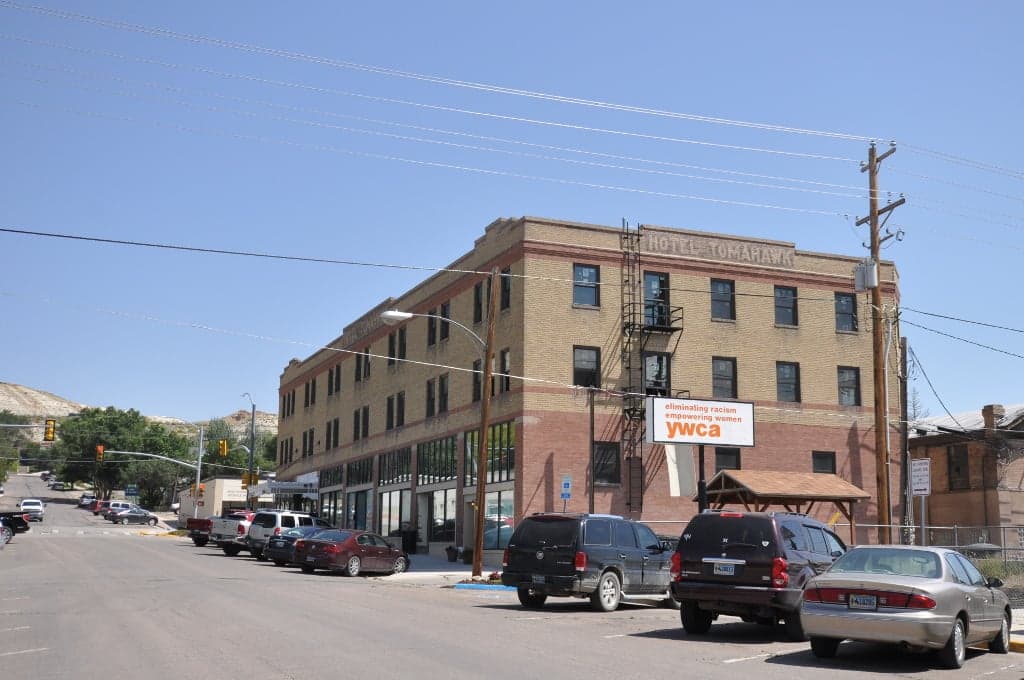
Photo: Wikipedia
Demographics of Green River, WY
Affluence Level in Green River, WY
A middle-class area roughly in line with national averages across income, home values, education, and employment.
People of Green River, WY
The people of Green River, Wyoming, today number 11,679 and form a predominantly white (83.3%) and Hispanic (12.9%) community with a very small foreign-born population (2.1%). The city is characterized by a blue-collar, family-oriented identity rooted in railroad and trona mining industries, with a notably low college attainment rate of 23.1%. Residents are concentrated in established neighborhoods like the historic downtown core, the Eastside, and the newer Westview subdivision, reflecting a population that has remained remarkably stable in ethnic composition over recent decades.
How the city was settled and grew
Green River was founded in 1868 as a railroad town along the Union Pacific line, which drew the first permanent population of Irish, German, and Scandinavian laborers who built and maintained the tracks. These early settlers established the Old Town district near the river, where modest worker cottages and boarding houses still stand. The arrival of the railroad spurred a second wave of homesteaders and ranchers in the 1880s and 1890s, who settled the Southside area along the Green River bottoms. A third significant wave came during the trona mining boom of the 1950s and 1960s, when companies like FMC Corporation and Solvay Chemicals recruited workers from the Midwest and Rocky Mountain states. These mining families built the Eastside neighborhood, a grid of post-war ranch homes and split-levels that remains the city's largest residential area. By 1970, Green River's population had grown to roughly 4,000, nearly all white, with a small Hispanic minority of railroad and agricultural workers concentrated in the Riverbend area near the old stockyards.
Modern era (post-1965)
After the 1965 Hart-Cellar Act, Green River saw only minimal immigration from outside the United States. The foreign-born share today is just 2.1%, far below the national average. Instead, the city's modern demographic story is one of domestic in-migration from other parts of Wyoming and neighboring states, driven by the trona industry's expansion. The Westview subdivision, developed in the 1980s and 1990s, absorbed many of these new arrivals—mostly white families from Rock Springs, Rawlins, and rural Utah. The Hispanic population grew from roughly 5% in 1990 to 12.9% today, primarily through natural increase and internal migration from the Southwest, not new immigration. These Hispanic residents are concentrated in the Old Town and Riverbend neighborhoods, where older, more affordable housing stock is available. The East/Southeast Asian population is negligible at 0.2%, and the Indian-subcontinent population is 0.3%, reflecting no significant enclave formation. The Black population is 0.0%, and there is no measurable Arab community. The city's racial and ethnic landscape has thus remained overwhelmingly white and Hispanic, with no major diversification from other groups.
The future
Green River's population is projected to remain stable or decline slightly over the next decade, as the trona industry faces automation and environmental pressures. The Hispanic share is likely to continue growing slowly through natural increase, potentially reaching 15-18% by 2035, but the city is not experiencing rapid diversification. The white population is aging, with a median age of 38.5, and younger residents often leave for college or jobs in larger cities like Salt Lake City or Denver. No new immigrant communities are forming, and the existing Hispanic population is assimilating into the broader community, with English becoming the dominant language among second-generation residents. The Eastside and Westview neighborhoods are likely to remain predominantly white, while Old Town and Riverbend will see continued Hispanic presence. The city is not tribalizing into distinct ethnic enclaves but rather homogenizing around a shared blue-collar, family-oriented identity.
For someone moving to Green River now, the city offers a stable, predominantly white and Hispanic community with a strong sense of place rooted in railroad and mining history. The population is not diversifying rapidly, and the small foreign-born share means newcomers will find a culturally homogeneous environment. The key neighborhoods—Old Town, Eastside, Westview, and Riverbend—each offer distinct housing stock and character, but all reflect the city's working-class roots. This is a place where demographic change is slow and assimilation is the norm, making it a predictable choice for those seeking a traditional, family-oriented community in the Intermountain West.

* Values derived from national, state, county, city and local statistics and may differ in a specific area. Last updated: 2026-04-21T11:23:41.000Z
Narrative content on this page is AI-generated and may contain mistakes. Verify any details that matter before acting on them.
ReloMaps may earn a commission from affiliate links at no extra cost to you.

