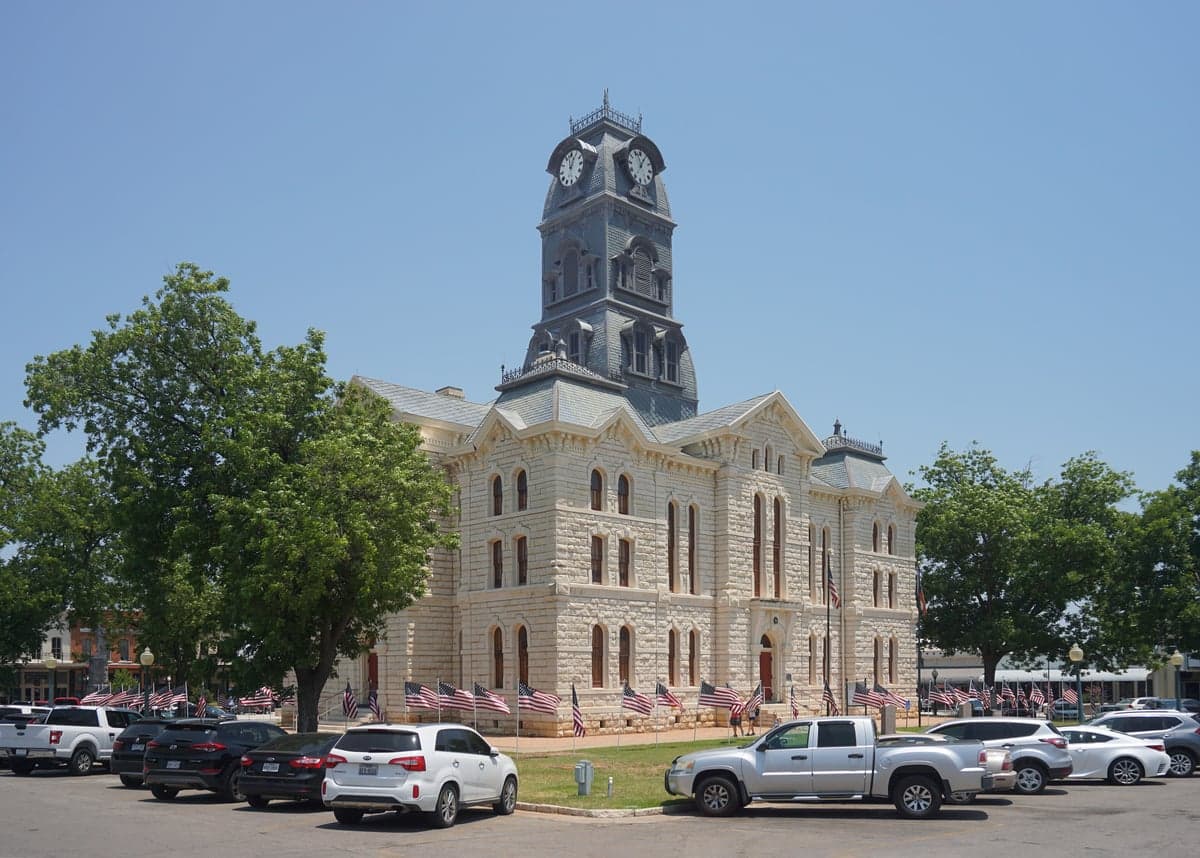


Photo: Wikipedia
Political ClimatePolitical Climate in Granbury, TX
District shown is the primary district for this city’s centroid. Cities may span multiple districts.
Local Political AnalysisPolitical Analysis of Granbury, TX
Granbury is one of those places where the political needle doesn’t just lean right—it’s pinned there. The Cook Partisan Voting Index (PVI) for the area sits at R+18, meaning the district votes about 18 points more Republican than the national average. That’s a deep red, and it’s been getting redder over the last decade. When I moved here in the early 2010s, you’d still see a fair number of split-ticket voters—folks who’d vote for a conservative sheriff but a moderate Democrat for county judge. Those days are mostly gone. The local Republican Party has consolidated power, and precinct-level turnout data shows that even in the 2022 midterms, which were supposed to be a “blue wave” nationally, Hood County went about 78% for the GOP candidate. The trajectory is clear: Granbury is becoming more uniformly conservative, driven by an influx of retirees from the Dallas-Fort Worth metroplex who are explicitly seeking a smaller-government, lower-tax environment.
How it compares
Compared to Texas as a whole, Granbury is significantly more conservative. The state’s overall PVI is unknown in the data I have, but looking at the 2024 presidential results, Texas voted about R+9 nationally—so Granbury’s R+18 is roughly twice as Republican-leaning as the state average. The contrast with nearby cities is even starker. Drive 30 minutes east to Cleburne, and you’ll find a similar but slightly more moderate vibe—Johnson County went about 72% Republican in 2024. Head 45 minutes south to Stephenville, and you’re in Erath County, which is also deep red but with a younger, college-town energy from Tarleton State University. The real political contrast is with Fort Worth, about an hour northeast. Tarrant County has been trending purple for years—it went for Trump by only 2 points in 2020 and flipped to Biden in 2024 by a narrow margin. So Granbury feels like a political island of deep red in a sea of increasingly competitive North Texas suburbs. The local Democratic Party is essentially non-existent in terms of elected office; the last Democrat to hold a countywide position here was a constable in the 1990s.
What this means for residents
For conservative residents, Granbury is about as comfortable as it gets. You’ll see Trump signs year-round, the local school board is solidly conservative, and the county commissioners court has a unified Republican majority that keeps property tax rates among the lowest in the region. The local Chamber of Commerce is heavily aligned with the GOP, and most civic events—like the annual Granbury Day parade—have a distinctly patriotic, red-white-and-blue flavor. For liberal residents, the reality is more isolating. There’s no visible Democratic club or progressive meetup that I’m aware of. If you’re left-leaning, you’ll likely keep your politics private to avoid awkward conversations at the grocery store or your kid’s soccer game. That said, the area is not hostile in a confrontational way—most people are polite, and the “live and let live” Texas ethos still applies. But you won’t find many allies, and local policy decisions—like the county’s refusal to accept certain federal grants for housing or the school board’s emphasis on “patriotic education”—will feel like a constant reminder that you’re in the minority.
Culturally, Granbury’s political lean shows up in a few distinct ways. The city council has been debating whether to allow short-term rentals near the historic square, and the conversation has split along property-rights lines—most conservatives want minimal regulation, while a handful of moderate voices push for zoning. The local newspaper, the Hood County News, runs editorials that are reliably conservative, and the county’s legislative priorities in Austin focus on border security and school choice. For a newcomer, the biggest surprise might be how little political diversity there is in daily life—even the local coffee shop’s tip jar has a “Don’t Tread on Me” sticker. If you’re looking for a place where your vote truly counts in a primary, Granbury is it. If you’re looking for a place where you’ll hear a range of political opinions, you’ll need to drive to Fort Worth.

State Political ClimatePolitical Climate in Texas
State Political AnalysisPolitical Environment in the State
Texas has been a reliably Republican state for the past three decades, but the margin has been shrinking. In 2024, Donald Trump carried the state by about 14 points, down from 19 points in 2016. The dominant coalition remains a mix of rural and suburban conservatives, evangelical Christians, and business-oriented fiscal conservatives, but explosive growth in the urban crescent—from Dallas-Fort Worth down through Austin to San Antonio and Houston—is steadily shifting the electorate. Over the last 10-20 years, the state has moved from deep red to lean red, with Democrats now competitive in statewide races for the first time since the 1990s.
Urban vs. rural divide
The political map of Texas is a study in extremes. The big metros—Houston, Dallas, San Antonio, and Austin—are solidly Democratic, with Austin being one of the most liberal cities in the South. Harris County (Houston) alone delivers roughly 1 million Democratic votes per cycle. Meanwhile, the vast rural and exurban areas—places like Lubbock, Midland, and Tyler—vote Republican by margins of 60-80%. The real battleground is the suburbs: Collin County (north of Dallas) and Fort Bend County (southwest of Houston) have been trending blue, while Tarrant County (Fort Worth) flipped to Biden in 2020 and then back to Trump in 2024. The Rio Grande Valley, once reliably Democratic, has swung sharply right in recent cycles, with counties like Starr and Zapata flipping to Trump in 2024.
Policy environment
Texas has no state income tax, which is the single biggest policy draw for relocators. Property taxes are high—averaging about 1.6% of assessed value—but the state caps annual appraisal increases for homesteads at 10%. The regulatory posture is famously business-friendly: no state-level minimum wage above the federal $7.25, no state-level collective bargaining for public employees, and a right-to-work law. On education, the state funds schools primarily through local property taxes, leading to wide disparities between wealthy and poor districts. School choice is a live issue: in 2023, Governor Greg Abbott pushed a universal education savings account (ESA) bill that failed in the House, but the 2025 session is expected to revisit it. Healthcare policy is largely hands-off: Texas did not expand Medicaid under the ACA, leaving about 1.5 million uninsured adults in the coverage gap. Election laws were tightened in 2021 with SB 1, which added ID requirements for mail-in ballots, banned 24-hour and drive-through voting, and gave partisan poll watchers more access.
Recent policy direction
The 2023 and 2025 legislative sessions have pushed Texas decisively to the right on multiple fronts. On gun and self-defense law, Texas became a permitless carry state in 2021 (HB 1927), allowing anyone over 21 who can legally possess a firearm to carry it openly or concealed without a license. On parental and education rights, the 2023 session passed HB 900, which requires book vendors to rate materials for "sexual content" and bans "sexually explicit" books from school libraries—a law currently blocked by a federal court. The state also passed SB 14, banning gender-affirming care for minors, and SB 12, restricting drag performances in public. On speech and privacy, Texas passed HB 20 in 2021, which prohibits social media platforms from moderating content based on "viewpoint," though it's been tied up in litigation. On medical and bodily autonomy, Texas has one of the strictest abortion bans in the nation (SB 8, 2021, and the trigger law that took effect in 2022), with no exceptions for rape or incest. On property rights, the state has strong eminent domain protections and no state-level rent control. On taxation, the 2023 session passed a $18 billion property tax cut package, largely through compression of school district tax rates. On voting and ballot access, SB 1 (2021) remains the baseline, and the state has not moved to expand early voting or mail-in options.
Civil unrest & political movements
Texas has seen significant political activism from both sides. The 2020 Black Lives Matter protests in Austin were among the largest in the country, leading to the city council defunding the police by $150 million—a decision partially reversed the following year. On the right, the "constitutional carry" movement successfully pushed permitless carry through the legislature, and the "Save Our Children" movement mobilized thousands around school library content and drag shows. Immigration politics are a constant flashpoint: Governor Abbott's Operation Lone Star, launched in 2021, has deployed state troopers and National Guard to the border, bused migrants to Democratic-led cities, and installed razor wire and buoys in the Rio Grande—actions currently facing multiple federal lawsuits. Secession rhetoric, while not mainstream, has a vocal fringe: the Texas Nationalist Movement claims tens of thousands of supporters, though no serious political figure has endorsed it. Election integrity remains a live controversy: after 2020, Texas conducted a forensic audit of four counties (including Harris and Dallas) that found no evidence of widespread fraud, but the issue continues to animate grassroots Republican activism.
Projection
Over the next 5-10 years, Texas will likely remain Republican-controlled at the state level, but the margin will continue to narrow. The state is adding roughly 1,000 new residents per day, most of them moving to the Democratic-leaning urban and suburban counties. The 2030 redistricting cycle will be critical: if Democrats can flip the state House and elect a governor in 2026 or 2030, the entire policy landscape could shift. However, the Republican legislature has shown it can pass aggressive conservative legislation even with narrow majorities, and the state's political culture—individualistic, anti-tax, pro-business—is deeply entrenched. A relocator moving in now should expect the current policy direction to continue for at least the next 4-6 years, with potential for a more competitive two-party system by the early 2030s.
For a new resident, the practical takeaway is this: Texas offers a low-tax, low-regulation environment that appeals strongly to conservatives, with a growing Democratic counterweight in the cities. If you're conservative, you'll find your values reflected in state law and local governance in most suburbs and rural areas. If you're liberal, you'll find your community in the urban cores, but you'll be living under a state government that is actively hostile to many of your priorities. The state's trajectory is toward a purple future, but that future is still a decade or more away. For now, Texas is what it has been for a generation: a red state with blue islands, governed by a Republican supermajority that shows no signs of moderating.
* Values derived from national, state, county, city and local statistics and may differ in a specific area. Last updated: 2026-10-07T18:19:38.000Z
Narrative content on this page is AI-generated and may contain mistakes. Verify any details that matter before acting on them.
ReloMaps may earn a commission from affiliate links at no extra cost to you.

