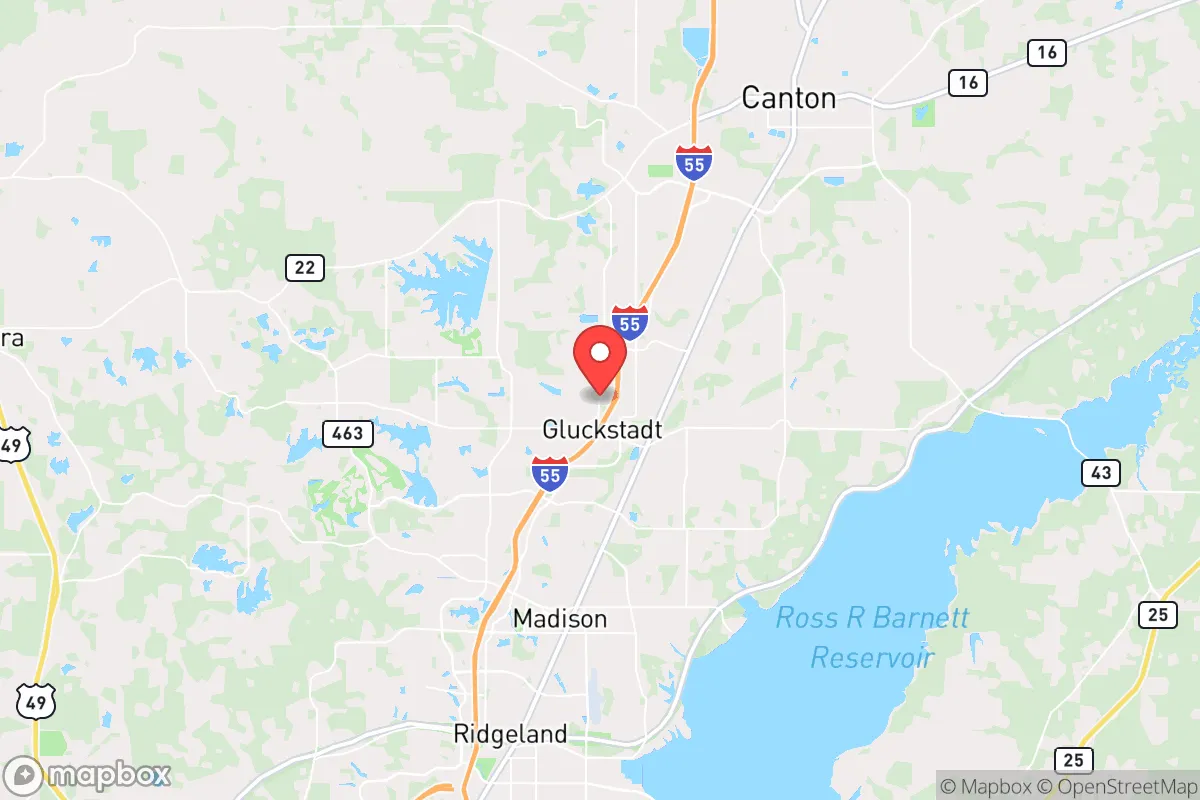

Political ClimatePolitical Climate in Gluckstadt, MS
District shown is the primary district for this city’s centroid. Cities may span multiple districts.
Inherited from parent county — no local data available.
* Lean and PVI are calculated from the surrounding county’s 2020 and 2024 presidential results, Cook-style — a finer measure here than its congressional district (MS-3).
Political rankings in Mississippi
- Most Conservative Cities in Mississippi
- Most Liberal Cities in Mississippi
- Best Liberal-Leaning Towns in the South
- Best Liberal-Leaning Towns in the Deep South
- Safest Liberal-Leaning Towns in the South
- Safest Conservative-Leaning Towns in the South
- Affordable Small Towns for Conservatives
- Safest Conservative-Leaning Cities in the U.S.
- Most Conservative Counties in Mississippi
- Most Liberal Counties in Mississippi
Local Political AnalysisPolitical Analysis of Gluckstadt, MS
Gluckstadt’s political landscape leans reliably Republican, but it’s a bit more moderate than the deep-red state average. The area carries a Cook PVI of R+8, meaning it votes about 8 points more Republican than the nation as a whole, while Mississippi as a state sits at R+11. That three-point gap might sound small, but it reflects real differences in how folks here approach local issues compared to the rest of the state. Over the past decade, Gluckstadt’s growth—fueled by new subdivisions and families moving from the Jackson metro—has nudged the electorate slightly toward the center, especially on economic and development questions.
How it compares
Drive 15 minutes south into downtown Madison, and you’ll find a similar Republican tilt, but with a more established, old-money conservative flavor. Head west toward Canton or north toward Yazoo City, and the politics shift noticeably: those areas lean Democratic in local races, reflecting a rural, largely African-American electorate that votes differently from Gluckstadt’s predominantly white, suburban base. The contrast is sharpest in state legislative districts: Gluckstadt sits in a district that has sent Republicans to Jackson for years, while neighboring districts in Hinds County often elect Democrats. What sets Gluckstadt apart from the statewide R+11 average is its mix of young professionals and retirees who prioritize schools and infrastructure over the cultural wedge issues that dominate politics in more rural parts of Mississippi. You’ll see more “Local Schools Matter” yard signs here than “Don’t Tread on Me” flags.
What this means for residents
For conservative residents, Gluckstadt feels like home: local officials are reliably Republican, tax policy is business-friendly, and the city council rarely debates gun restrictions or abortion ordinances because those aren’t on the table. For liberal residents, the reality is more nuanced. You won’t find a progressive caucus at city hall, but you also won’t face open hostility in daily life—most folks keep politics to themselves at the grocery store or soccer game. The practical effect of the R+8 lean is that zoning decisions, school funding, and road projects get fast-tracked without the partisan gridlock you’d see in a swing district. On the flip side, social services and affordable housing initiatives get less traction than they might in a more mixed political environment. If you’re a conservative, you’ll appreciate the low-tax, low-regulation vibe; if you’re a liberal, you’ll find a polite but firm resistance to expanding government programs.
Culturally, Gluckstadt stands out for its emphasis on new development and community amenities—things like the planned downtown district and the Gluckstadt Community Center—rather than the Confederate monument debates that still simmer in older Mississippi towns. The city’s rapid growth has attracted a younger, more diverse population than the state average, which keeps the political conversation focused on schools, parks, and traffic rather than the culture wars that dominate state-level politics. In practice, this means a Republican-leaning suburb where the biggest political fights are about whether to widen a road or build a new roundabout, not about national hot-button issues. For anyone moving here, the takeaway is simple: Gluckstadt is a comfortable, pragmatic conservative place where the politics are predictable and the pace of life is steady, with just enough moderation to keep things civil.

State Political ClimatePolitical Climate in Mississippi
State Political AnalysisPolitical Environment in the State
Mississippi is one of the most reliably Republican states in the country, with a Cook Partisan Voting Index of R+11, meaning it votes about 11 points more Republican than the national average in presidential elections. The state hasn't voted for a Democratic presidential candidate since Jimmy Carter in 1976, and the GOP now holds every statewide office, both U.S. Senate seats, and supermajorities in the state legislature. Over the last 20 years, the shift has been dramatic — as recently as the 1990s, Democrats controlled the legislature and most local offices, but the realignment of white conservative voters, especially in rural areas and the Delta, has turned Mississippi into a deep-red stronghold where Democratic strength is now almost entirely concentrated in the Black-majority population and a handful of urban centers.
Urban vs. rural divide
The political map of Mississippi is a study in stark geographic contrast. The state's two largest metro areas — Jackson and the Gulf Coast — are the primary Democratic anchors. Jackson, the capital and largest city, is over 80% Black and consistently votes 85-90% Democratic in statewide races. Hinds County, which contains most of Jackson, is the state's Democratic stronghold. On the Gulf Coast, Harrison County (Biloxi, Gulfport) is more competitive but still leans Republican, though the coastal cities themselves trend more moderate. The real engine of Republican dominance is the sprawling rural and suburban territory. DeSoto County, just south of Memphis, is the state's most populous Republican county and a classic example of suburban sprawl driving GOP margins — it voted +35 for Trump in 2020. The northeastern hill counties like Tishomingo and Prentiss, along with the Pine Belt around Hattiesburg, are reliably red. The Mississippi Delta, once a Democratic bastion due to its large Black population, has seen white voters flee the party; counties like Bolivar and Washington still vote Democratic due to Black turnout, but the margins have shrunk as rural white voters have consolidated behind the GOP. A notable flip: Rankin County, a Jackson suburb, was competitive in the 1990s but is now solidly Republican (+40 in 2020), reflecting the broader suburban realignment.
Policy environment
Mississippi's policy environment is shaped by a low-tax, limited-government philosophy that appeals strongly to conservative relocators. The state has no individual income tax on wages — it was phased out entirely by 2026 after a 2022 law signed by Governor Tate Reeves — and the corporate income tax rate is a flat 4%. Sales tax is 7% on most goods, with local add-ons. Property taxes are among the lowest in the nation, with a median effective rate around 0.8%. The regulatory posture is business-friendly: Mississippi is a right-to-work state with weak unions and minimal occupational licensing hurdles. Education policy is a flashpoint: the state has a school choice program (the Mississippi Education Scholarship Account) that allows families to use public funds for private school tuition, but public school funding remains a perennial issue, with per-pupil spending near the bottom nationally. Healthcare is a major concern — Mississippi did not expand Medicaid under the Affordable Care Act, leaving roughly 75,000 low-income adults in the coverage gap. The state has some of the strictest abortion laws in the country, with a near-total ban in effect since the Dobbs decision. Election laws are restrictive: voter ID is required, no-excuse absentee voting is not allowed, and early voting was only introduced in 2024 after years of legislative resistance.
Recent policy direction
The last five years have seen Mississippi accelerate its conservative policy agenda across multiple fronts. On gun rights, the state passed permitless carry (constitutional carry) in 2016, and in 2023 expanded stand-your-ground protections to include any place a person has a legal right to be. Parental rights in education were strengthened by the 2022 "Parents' Bill of Rights," which requires schools to notify parents of any changes to a child's mental or physical health and prohibits classroom instruction on sexual orientation or gender identity in K-3. On speech and privacy, the state passed a law in 2023 banning TikTok on government devices and restricting public library content deemed "harmful to minors." Medical and bodily autonomy is tightly controlled: Mississippi bans nearly all abortions, restricts gender-affirming care for minors (2023 law), and has a strict medical marijuana program (2018) that is among the most limited in the country. Property rights are strong — the state has no statewide zoning, and eminent domain for private economic development was restricted after the Kelo decision. Taxation has moved sharply downward: the income tax phase-out was the biggest policy shift, but the state also cut the grocery tax from 7% to 4.5% in 2024. Voting access remains a battleground: the 2024 early voting law was a compromise, allowing in-person absentee voting for 10 days before an election, but same-day registration and no-excuse mail voting remain illegal.
Civil unrest & political movements
Mississippi's political landscape has seen relatively low levels of civil unrest compared to other Southern states, but there have been notable flashpoints. The removal of the Confederate battle emblem from the state flag in 2020 — a decision driven by business pressure and legislative action after the George Floyd protests — was a major cultural shift, though it remains controversial in rural areas. The Black Lives Matter protests in Jackson and Oxford in 2020 were largely peaceful, but they highlighted ongoing tensions over policing and Confederate monuments. On the right, the "Mississippi Freedom Caucus" in the legislature, a group of hardline conservatives, has pushed for further restrictions on abortion, immigration enforcement, and election integrity. Immigration politics are less visible than in border states, but the 2023 law requiring local law enforcement to cooperate with ICE was a priority for the GOP. Election integrity has been a recurring theme: the 2020 election saw no major controversies in Mississippi, but the legislature passed a law in 2021 banning private funding of election administration (a response to Zuckerberg-funded grants in other states). Secession or nullification rhetoric is rare and fringe, though some local GOP groups have floated "constitutional carry" expansions as a form of resistance to federal gun laws. A new resident would notice the strong presence of evangelical churches in public life — prayer at government meetings and religious signage on private property are common and uncontroversial.
Projection
Over the next 5-10 years, Mississippi is likely to remain deeply Republican, but demographic shifts could slowly moderate the edges. The state's population is aging and growing slowly — it lost a congressional seat after the 2020 census — and in-migration from other states is modest compared to Texas or Florida. The Black population, about 38% of the state, is growing in political influence, especially in Jackson and the Delta, but turnout remains lower than white voters. The biggest wildcard is the suburban shift: DeSoto County and the Gulf Coast are attracting younger, more diverse families from Memphis and New Orleans, which could nudge those areas toward the center over time. The income tax phase-out will continue to make Mississippi attractive to retirees and remote workers, but the lack of Medicaid expansion and poor healthcare outcomes could deter families with chronic health needs. The political trajectory is toward further consolidation of GOP control — the Democratic Party has no clear path to statewide victory without a major realignment of white voters. A relocator moving in now should expect a state where conservative policy is the default, where gun rights and low taxes are sacrosanct, and where social issues like abortion and LGBTQ rights will remain tightly restricted. The practical reality is that Mississippi offers a predictable, stable political environment for conservatives, while liberals will find themselves in a clear minority with limited influence outside of Jackson and a few college towns like Oxford and Hattiesburg.
For a new resident, the bottom line is straightforward: Mississippi delivers on its conservative promises — low taxes, strong gun rights, limited government, and a culture that values religious and family traditions. If you align with those priorities, you'll find a welcoming, affordable state where your vote counts in Republican primaries. If you don't, you'll be in the minority, but the state is generally polite and non-confrontational in daily life — the political divisions are real but rarely spill into personal interactions. The key is to know which county you're moving to: DeSoto County for suburban Memphis commuters, the Coast for a more moderate vibe, or the rural counties for deep-red comfort. Either way, Mississippi's political climate is stable, predictable, and unlikely to surprise you in the next decade.
* Values derived from national, state, county, city and local statistics and may differ in a specific area. Last updated: 2026-11-17T03:39:21.000Z
Narrative content on this page is AI-generated and may contain mistakes. Verify any details that matter before acting on them.
ReloMaps may earn a commission from affiliate links at no extra cost to you.

