Demographics of Gluckstadt, MS
Historical data isn't available for Gluckstadt, MS. Trends shown are for Madison County, MS.
Affluence Level in Gluckstadt, MS
An upper-middle-class area. Household wealth, education levels, and homeownership run ahead of national benchmarks.
People of Gluckstadt, MS
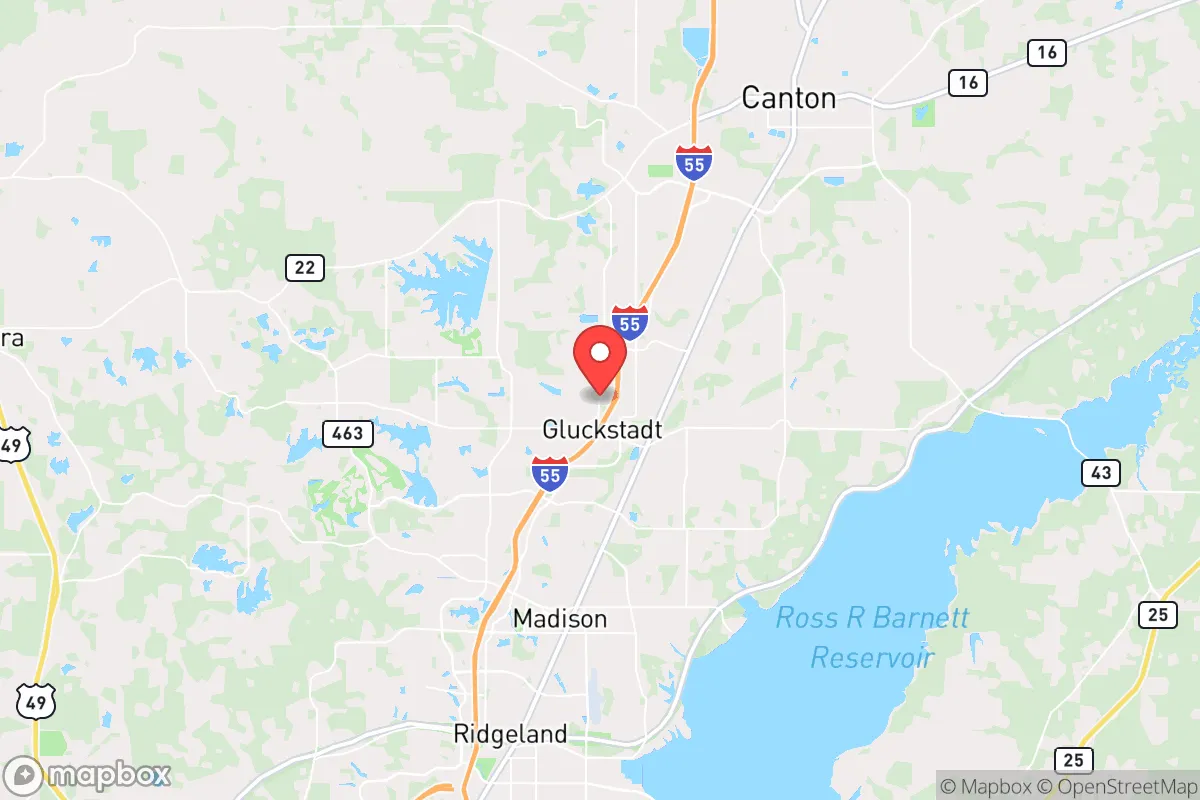
The people of Gluckstadt, Mississippi, today form a compact, rapidly diversifying community of 2,791 residents, distinguished by a strikingly high college-educated rate of 69.1% and a near-even racial balance between White (45.9%) and Black (38.0%) populations. This small Madison County city, located just north of Ridgeland, has emerged as a magnet for educated professionals and families seeking newer housing stock and a quieter suburban lifestyle while remaining within commuting distance of Jackson. Its identity is shaped by a blend of historic Black landowning families, recent East/Southeast Asian and Indian subcontinent professionals, and a growing number of young White families drawn to its top-rated school district.
How the city was settled and grew
Gluckstadt’s human history begins not with a grand founding but with a railroad stop. The Illinois Central Railroad established a flag station here in the late 19th century, named for a German immigrant family, the Glucks, who owned the surrounding farmland. The original population was overwhelmingly White and rural, composed of German and Scots-Irish farmers who worked cotton and timber land. The historic Old Gluckstadt district, centered around the intersection of Gluckstadt Road and Mannsdale Road, contains the earliest surviving homes and the original St. Joseph Catholic Church, built by German Catholic families in the 1880s. A second, smaller wave of Black families settled as sharecroppers and tenant farmers on the periphery, forming the roots of what is now the Gluckstadt Estates area, a historically Black neighborhood that remains a core of the African American community. For most of the 20th century, Gluckstadt remained a tiny crossroads hamlet, bypassed by the post-war suburban boom that transformed neighboring Madison and Ridgeland.
Modern era (post-1965)
The modern transformation of Gluckstadt began in earnest after 2000, driven by two forces: the expansion of the Madison County School District and the construction of large-lot subdivisions on former farmland. The 1965 Hart-Cellar Act had little direct effect on this rural area, but its long-term impact—the growth of Jackson’s medical and professional sectors—created demand for housing in unincorporated Madison County. The first major suburban wave was domestic: White families from Jackson and Ridgeland moved into Mannsdale Farms and Gluckstadt Station, attracted by the newly built Mannsdale Elementary and the promise of Germantown High School. A second wave, beginning around 2010, brought a significant influx of Black professionals, many of them second- and third-generation college graduates from Jackson State University and Tougaloo College, who settled in Bridlewood and St. Catherine’s Village. The most recent wave, accelerating after 2018, has been the arrival of East/Southeast Asian and Indian subcontinent families—many employed at the University of Mississippi Medical Center, Nissan Canton, and the region’s growing healthcare and technology sectors. These groups have concentrated in newer subdivisions such as The Preserve at Gluckstadt and Mannsdale Crossing, where homes built after 2015 dominate the housing stock. Today, the city’s foreign-born population stands at 5.2%, with East/Southeast Asian residents making up 7.5% and Indian subcontinent residents 4.5%—shares that are roughly double the state averages.
The future
Gluckstadt’s population is heading toward greater racial and ethnic diversity, though the pace of change will depend on housing availability. The city is nearly built out within its current 2.5 square miles, with few undeveloped parcels remaining. Future growth will likely occur through annexation of adjacent land in northern Madison County, where several large tracts are zoned for residential development. The demographic trajectory suggests a continued increase in the East/Southeast Asian and Indian subcontinent shares, as these groups are disproportionately represented among the college-educated professionals who can afford the area’s median home price of roughly $380,000. The Black population share is likely to stabilize or grow modestly, while the White share may decline slightly as older residents age in place and younger White families face affordability constraints. Culturally, the city is evolving from a historically White, rural enclave into a multi-ethnic, highly educated suburb where the public schools—already among the top in Mississippi—serve as the primary unifying institution. The Hispanic population, at just 3.2%, remains small but is expected to grow as service-sector employment expands in the broader Madison County economy.
For someone moving in now, Gluckstadt offers a rare combination in Mississippi: a small-town feel with a genuinely diverse, college-educated population and excellent public schools. The city is becoming a place where racial and ethnic diversity is not just tolerated but normalized, driven by shared priorities of education, safety, and property values. The trade-off is limited rental housing, few apartment complexes, and a housing market that increasingly prices out lower-income families. New residents should expect a community that is still defining its identity—one where the old German Catholic families, the historic Black landowners, and the new Asian and Indian professionals are all learning to share a small town that is growing up fast.

* Values derived from national, state, county, city and local statistics and may differ in a specific area. Last updated: 2026-11-17T03:39:21.000Z
Narrative content on this page is AI-generated and may contain mistakes. Verify any details that matter before acting on them.
ReloMaps may earn a commission from affiliate links at no extra cost to you.

