Strategic Assessment of Glenbrook, NV
Strong survivability profile. Good buffer from population centers, with manageable environmental and tactical risks.
What does the Strategic Assessment tell us?
Our Strategic Assessment grades tactical survivability of an area. Major population centers, military targets, fallout zones, natural disasters, and border exposure all drive risk — lower exposure means a more defensible position in a crisis.
This is heavily inspired by Joel Skousen's Strategic Relocation book. Highly recommended you checkout the book ($)What does this tell us?
Our Strategic Assessment grades tactical survivability of an area. Major population centers, military targets, fallout zones, natural disasters, and border exposure all drive risk — lower exposure means a more defensible position in a crisis.
This is heavily inspired by Joel Skousen's Strategic Relocation book. Highly recommended you checkout the book ($)Strategic Pillars

Key Distances
Regional Safe Places
Below is our recommended "safe zones" in Nevada and the surrounding area based on our strategic heuristics. For most people, it's unrealistic to live in a “safe zone” full-time due to work, family or other personal reasons. They tend to be more rural. However, many of these areas are perfect for second homes and retreat properties that double as a vacation home or even a short-term rental.
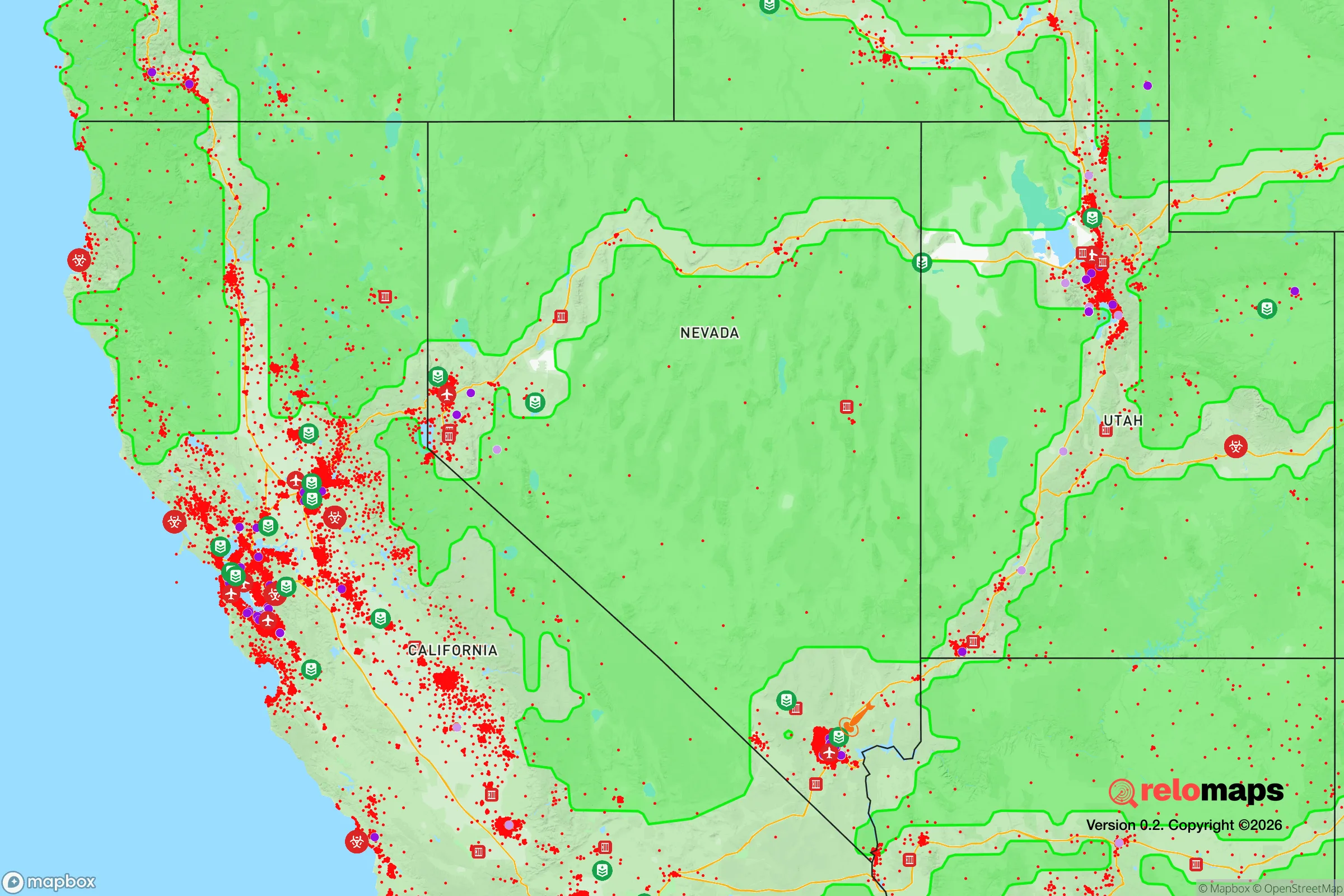
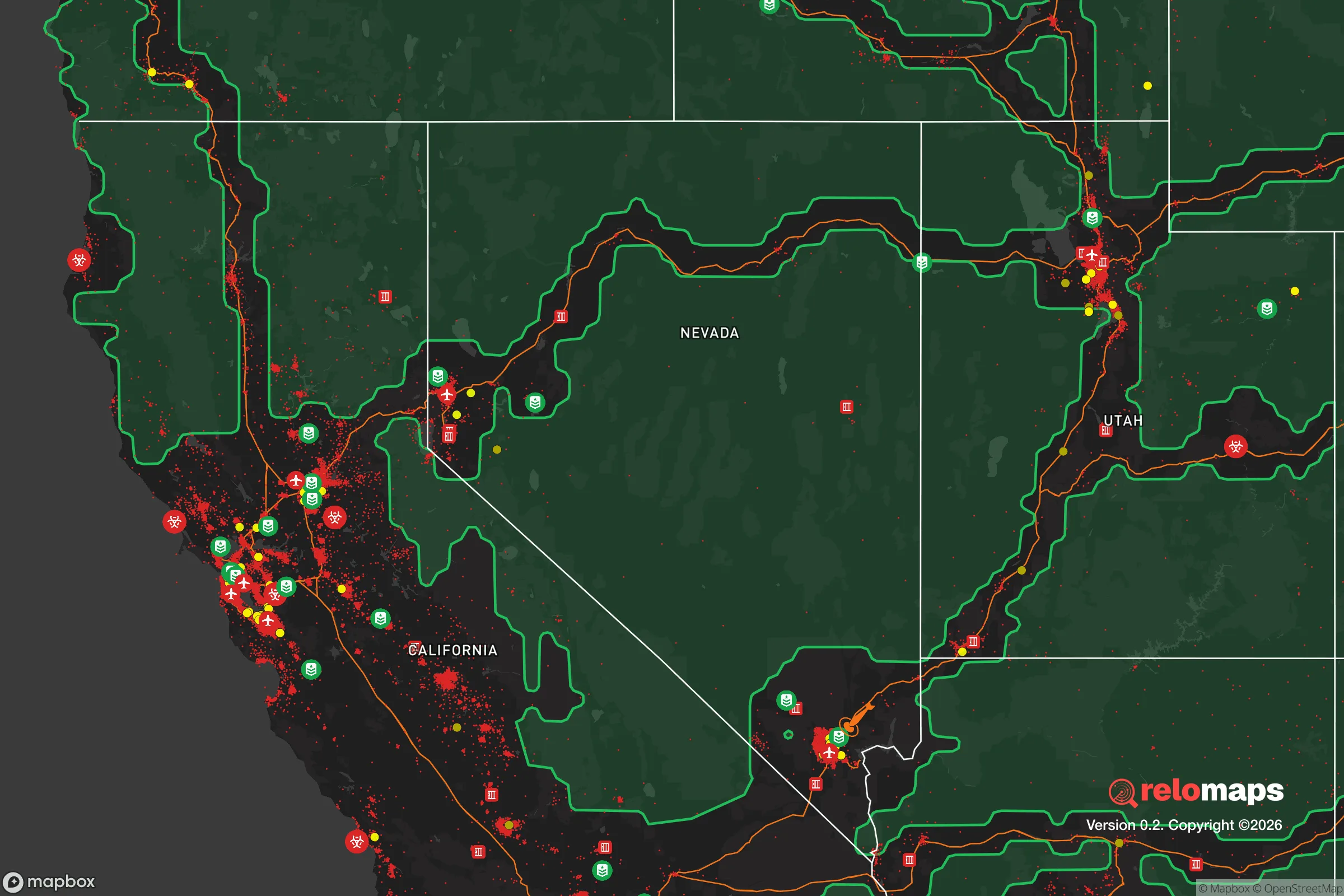


Important Note: For informational purposes only. This does not mean nothing bad ever happens in the green zones. Please use common sense. This is based on public data and modeled with AI. We tried to take a conservative approach but mistakes happen. We update this regularly as new information becomes available.
Solar Generator Recommendations
Backup power matters more here than in safer locations. We've picked three solar generators across budgets and capacity tiers — start with the budget unit if you only need a few essentials, or step up if you want to run a fridge and HVAC for days at a time.

Jackery Portable Power Station Explorer 300
Budget OptionPower on the Go: Weighing only 11 lbs, it's convenient to set up and store with book-sized foldable solar panels

BLUETTI Portable Power Station AC180
Designed for both indoor and outdoor scenarios, AC180 is highly capable as it has a robost capacity and continuous output power.

EF ECOFLOW DELTA Pro Ultra Power Station
Upgraded PickEcoFlow DELTA Pro Ultra is a whole-home energy system designed to grow with your family. Integrated with the Smart Home Panel 2, it scales to meet your evolving energy needs — keeping your home powered, intelligent, and secure through every stage of life.
We earn a commission, at no additional cost to you.
Strategic Assessment Analysis
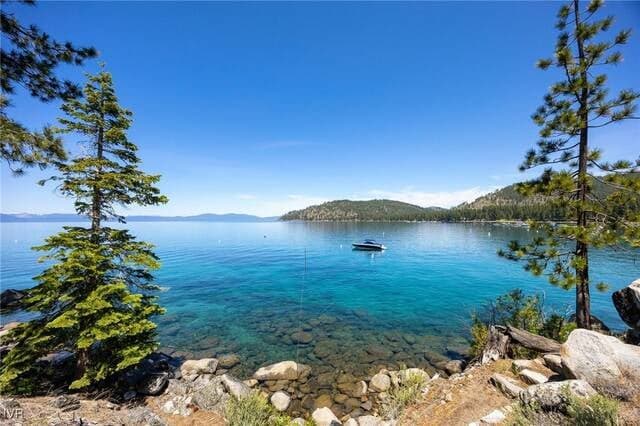
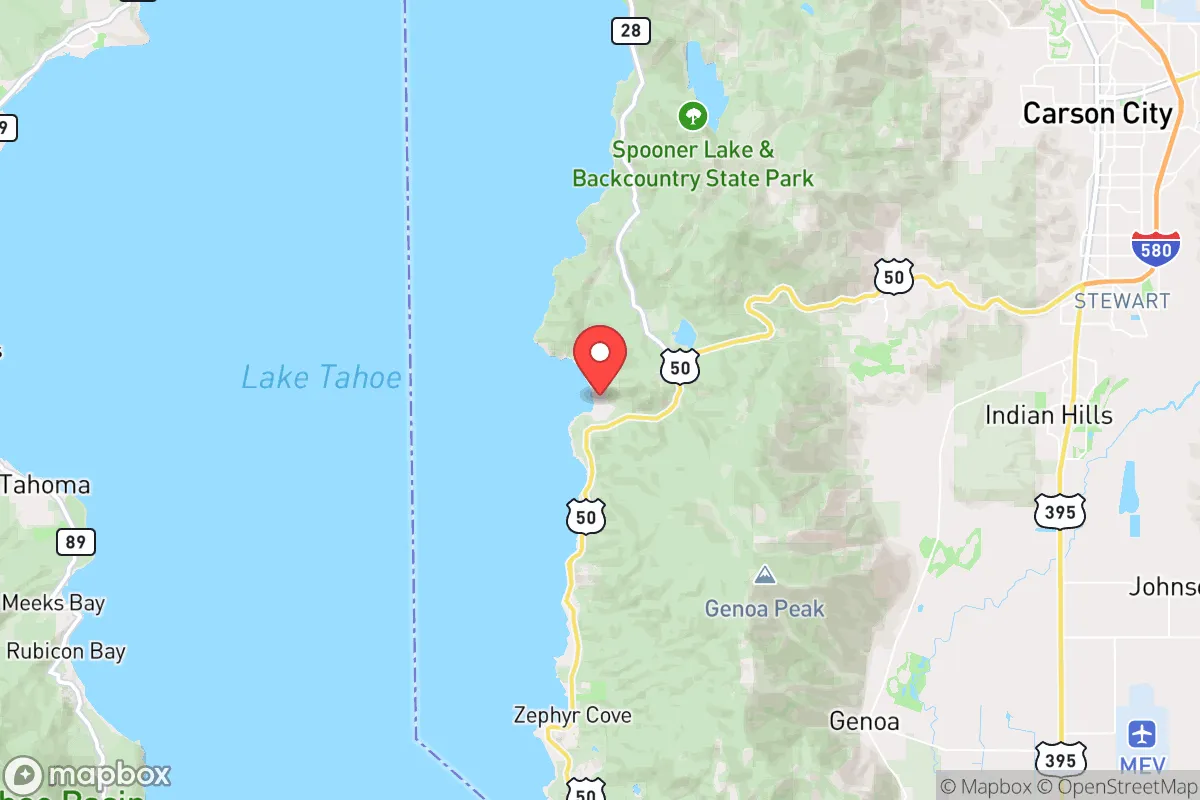
Glenbrook, Nevada, sits on the eastern shore of Lake Tahoe at roughly 6,200 feet elevation, offering a rare combination of natural defensibility and resource abundance that makes it a serious contender for a strategic relocation. Its position in Douglas County places it roughly 20 miles south of Carson City and 30 miles southwest of Reno, but the terrain—steep forested slopes, limited road access, and the lake itself—creates a natural buffer against the chaos that would likely engulf those urban centers during a major disruption. For a relocator focused on resilience, Glenbrook’s primary advantage is that it is not a through-town: Highway 50 runs along the lake’s south shore, but Glenbrook sits on a dead-end spur road off that highway, meaning any traffic or threat must deliberately come to you, not pass through. This geographic isolation, combined with the area’s existing infrastructure and proximity to the Sierra Nevada’s water and timber resources, makes it a viable long-term holdout location for those who prioritize self-sufficiency and security over convenience.
Geographic position and natural advantages for long-term survival
Glenbrook’s location is defined by the Lake Tahoe Basin, a high-altitude bowl ringed by mountain passes that are frequently closed by snow in winter, effectively sealing the area off from the outside world for days or weeks at a time. This seasonal isolation is a double-edged sword—it complicates resupply but also makes the area nearly impossible to approach in force during winter months. The lake itself is the obvious water source: Lake Tahoe holds roughly 39 trillion gallons of water, and Glenbrook sits directly on its shore, meaning a relocator with a simple hand pump or gravity-fed system has access to one of the cleanest natural reservoirs on the continent. The surrounding Toiyabe National Forest provides ample firewood, building materials, and game (mule deer, black bear, and small game), though hunting pressure would spike quickly in a collapse scenario. Elevation is a factor—at 6,200 feet, winters are harsh, with average snowfall around 120 inches per year—but that same snowpack acts as a natural refrigerator and a slow-release water source in spring. For a prepared individual or family, the trade-off is clear: you trade mild winters for a fortress-like position that most unprepared people will avoid entirely.
Risks, exposures, and proximity to fallout-relevant landmarks
No location is without vulnerabilities, and Glenbrook has several that a strategic relocator must account for. The most immediate risk is wildfire: the 2021 Caldor Fire came within a few miles of the lake’s south shore, and the entire Tahoe Basin is classified as a high-risk fire zone. A major fire event could force evacuation down a single two-lane road (Highway 50), which would become a parking lot in a panic scenario. That said, Glenbrook’s position on the lake provides a natural firebreak and a potential water-source refuge if you have a boat or shoreline access. The second risk is proximity to Reno and Carson City, which are roughly 30 and 20 miles away respectively. In a mass casualty event or civil unrest scenario, those cities would become sources of desperate refugees. The good news is that the terrain funnels movement along Highway 50 and Highway 395, and Glenbrook is off the main drag—but you should plan for the possibility of people filtering into the basin. On the fallout front, there are no major nuclear power plants within 100 miles, but the Naval Air Station Fallon (about 70 miles northeast) and the Nevada National Security Site (about 150 miles southeast) are both potential targets in a large-scale conflict. Fallout from a strike on Fallon would likely drift east or southeast given prevailing winds, meaning Glenbrook is probably safe from direct contamination, but you should still have a radiation detection kit and a basement or interior shelter plan. The bigger concern is that the Tahoe Basin itself is a tourist destination—in a crisis, thousands of people would try to flee into the mountains, and Glenbrook’s limited road access could become a chokepoint for both threats and resources.
Practical resilience for a relocator: food, water, energy, and defensibility
For a relocator serious about self-sufficiency, Glenbrook offers a strong baseline but requires significant preparation. Water is the easy win: Lake Tahoe is drinkable with basic filtration (a Sawyer or Berkey system will handle the cold, clear water), and you can gravity-feed from the lake if you’re within a few hundred feet of the shore. The bigger challenge is food production. The growing season at 6,200 feet is short—roughly 60 to 90 frost-free days—so traditional gardening is limited to cold-hardy crops like kale, potatoes, and root vegetables. A greenhouse with thermal mass or a heated hoop house extends the season, but you’ll need to stockpile dry goods (grains, beans, canned proteins) for the 6-8 month winter. Hunting and fishing are viable: Lake Tahoe has Mackinaw and rainbow trout, and the surrounding forest has deer and grouse, but you’ll be competing with other survivors. Energy is manageable: the area gets over 300 sunny days per year, so solar panels with a battery bank (e.g., a 5-10 kW system) can run a modest cabin year-round, though snow cover on panels is a real issue in winter—plan for ground-mounted panels or a manual cleaning system. Wood heat is the primary backup, and the national forest provides ample deadfall for harvesting, but you’ll need a chainsaw, a splitter, and a dry storage shed. Defensibility is Glenbrook’s strongest card: the dead-end road means you only have one approach to monitor, and the forested terrain allows for early warning via game cameras or simple observation posts. Neighbors are sparse—the area is zoned for low-density residential—so you won’t have the herd dynamics of a subdivision. The downside is that you’re on your own; there’s no community militia or organized defense, so you need to be self-reliant with firearms, ammunition, and medical training.
The overall strategic picture for Glenbrook is one of high potential with clear trade-offs. It is not a bug-out location for the unprepared—the winter alone will filter out 90% of casual preppers. But for a disciplined individual or family willing to invest in a well-insulated cabin, a solar array, a wood stove, and a year’s worth of supplies, it offers a defensible, water-rich, and naturally isolated position that most urban refugees will never reach. The proximity to Reno and Carson City is a liability, but the terrain and road network work in your favor if you’re already in place before the crisis hits. If you’re looking for a location that balances resource availability with natural barriers, and you can handle the altitude and snow, Glenbrook deserves a serious look. Just don’t expect to walk in unprepared and thrive—this is a location that rewards advance planning and punishes complacency.

* Values derived from national, state, county, city and local statistics and may differ in a specific area. Last updated: 2026-04-23T04:14:55.000Z
Narrative content on this page is AI-generated and may contain mistakes. Verify any details that matter before acting on them.
ReloMaps may earn a commission from affiliate links at no extra cost to you.

