
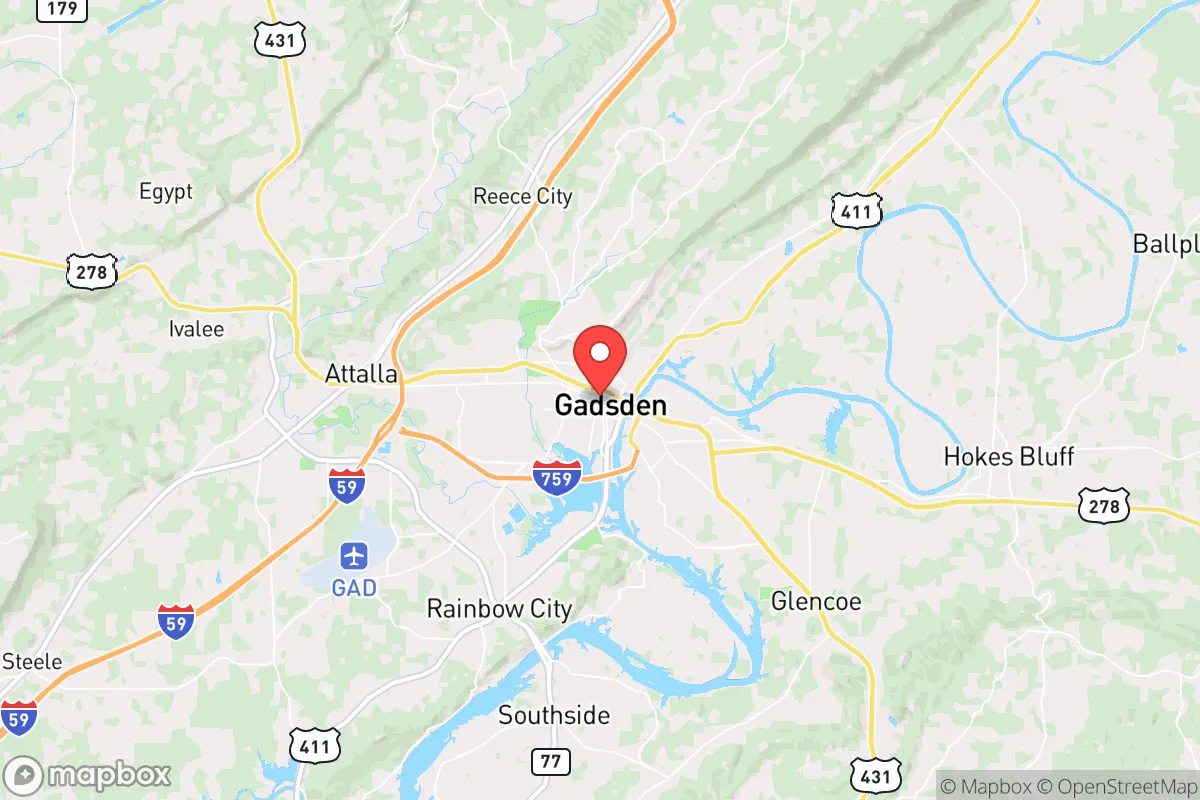
Photo: Wikipedia
Personal Sovereignty in Gadsden, AL
Viable for self-reliance. Generally workable, though some barriers may limit total independence.
What does Personal Sovereignty tell us?
Personal Sovereignty measures your capacity for self-reliance and independence with minimal government friction. Higher scores mean fewer barriers between you and the way you want to live... but it assumes you have the space you need and good neighbors.
What does this tell us?
Personal Sovereignty measures your capacity for self-reliance and independence with minimal government friction. Higher scores mean fewer barriers between you and the way you want to live... but it assumes you have the space you need and good neighbors.
State Policy
Energy independence: Importer (45% of energy produced in-state)
Personal Liberty
Homesteading

Personal Liberty Analysis
Gadsden, Alabama offers a personal sovereignty environment that stands in stark contrast to the restrictive policies found in many coastal and urban jurisdictions, making it a serious consideration for those prioritizing autonomy over convenience. Located in Etowah County within a state that consistently ranks among the most constitutionally protective in the nation, Gadsden provides a legal and cultural framework where individual decision-making—on matters of self-defense, family, property, and livelihood—remains largely unencumbered by government overreach. For the survivalist or prepper mindset, this isn't just about politics; it's about the practical, day-to-day ability to live without asking permission for fundamental aspects of life.
Tax burden and regulatory posture in Etowah County
Alabama's tax structure is deliberately designed to minimize the state's footprint on personal income and property, and Gadsden benefits directly from this philosophy. There is no state-level tax on groceries or prescription medication, and the state income tax is a flat 5% on taxable income over $3,000—a rate that hasn't increased in decades. Property taxes in Etowah County are among the lowest in the nation, typically ranging from 0.35% to 0.45% of assessed value, meaning a $200,000 home carries an annual tax bill of roughly $700 to $900. This low burden directly supports self-reliance by leaving more capital in private hands for land acquisition, supplies, and infrastructure. The regulatory posture at the county and city level is equally restrained. Etowah County operates with minimal zoning outside the city limits, and even within Gadsden proper, the permitting process for residential improvements is straightforward and inexpensive. There are no county-level building codes for unincorporated areas, allowing property owners to construct sheds, workshops, or auxiliary dwellings without bureaucratic delays. For those concerned about creeping regulatory control, Gadsden's local government has consistently resisted adopting the kind of environmental or land-use ordinances that choke personal projects in more progressive states.
Self-defense and gun law specifics in Alabama
Alabama is a constitutional carry state, meaning no permit is required to carry a concealed firearm for anyone legally allowed to possess one. This right is enshrined in the state constitution and reinforced by statute, with no local municipality—including Gadsden—able to preempt or override it. The state also maintains strong Stand Your Ground and Castle Doctrine laws, which remove any duty to retreat before using deadly force in self-defense, both inside the home and in any place where a person has a legal right to be. For the prepper, this legal environment is foundational: the ability to defend oneself, one's family, and one's property is not subject to the whims of local politicians. Additionally, Alabama has no firearm registration, no magazine capacity restrictions, and no waiting periods for purchase. The state also prohibits any local government from maintaining a database of gun owners. For those building a long-term survival strategy, the legal framework in Gadsden allows for the acquisition, storage, and use of firearms and ammunition without the surveillance and paperwork burdens that characterize states like New York, California, or Illinois.
Self-reliance and homesteading viability in Gadsden
Gadsden's geography and land-use policies make it a viable location for serious self-reliance efforts. Within the city limits, standard residential lots range from one-quarter to one-half acre, but the real opportunity lies in the surrounding unincorporated areas of Etowah County, where parcels of 1 to 10 acres are common and affordable, often priced between $3,000 and $8,000 per acre. Zoning in these areas is minimal to nonexistent, allowing for livestock, large gardens, and workshops without the nuisance complaints or HOA restrictions that plague suburban developments. Off-grid feasibility is high: the region receives adequate rainfall for rainwater catchment systems, and the local soil is suitable for vegetable production and small orchards. While the city does require connection to municipal water and sewer for new construction within its limits, properties outside city limits can legally use wells and septic systems. Solar panel installation is unregulated at the county level, and there are no net-metering restrictions that would prevent a homeowner from disconnecting from the grid entirely. For those seeking to reduce dependence on supply chains and municipal infrastructure, Gadsden's regulatory environment offers a path that is both legal and practical.
Personal liberties: parental rights, medical autonomy, and property
Alabama has been a national leader in codifying parental rights, with state law explicitly affirming that parents have the fundamental right to direct the upbringing, education, and healthcare of their children. This means no mask mandates for children in schools, no vaccine requirements beyond the standard childhood immunizations (which have broad religious and philosophical exemptions), and no government interference in a parent's decision to opt out of any medical procedure. Medical autonomy for adults is similarly protected: there is no state-level vaccine passport system, no mandatory reporting of private medical decisions to centralized databases, and no restrictions on purchasing or using dietary supplements, herbal remedies, or alternative treatments. Property rights are equally robust. Alabama is a "right to farm" state, meaning agricultural operations—including small homesteads—are protected from nuisance lawsuits by newcomers who move in and then complain about normal farming activities. Eminent domain abuse is limited by state law, and property owners have strong legal recourse against regulatory takings. For the individual who views government overreach as the primary threat to liberty, Gadsden's legal environment provides a firewall against the kind of mandates and surveillance that have become common in other parts of the country.
In the broader context of American personal sovereignty, Gadsden represents a stronghold of the older, constitutionalist tradition of limited government. Compared to areas like the Pacific Northwest, the Northeast corridor, or even parts of the Mountain West that have seen rapid regulatory expansion, Gadsden offers a legal and cultural environment where the default answer to most personal decisions is "yes, as long as you aren't harming others." The combination of low taxes, minimal zoning, constitutional carry, strong parental rights, and medical autonomy creates a package that is increasingly rare. For the survivalist or prepper who values the ability to prepare, defend, and live according to their own judgment, Gadsden is not just a place to live—it is a place where the government still largely stays out of the way.

* Values derived from national, state, county, city and local statistics and may differ in a specific area. Last updated: 2026-04-19T18:52:08.000Z
Narrative content on this page is AI-generated and may contain mistakes. Verify any details that matter before acting on them.
ReloMaps may earn a commission from affiliate links at no extra cost to you.

