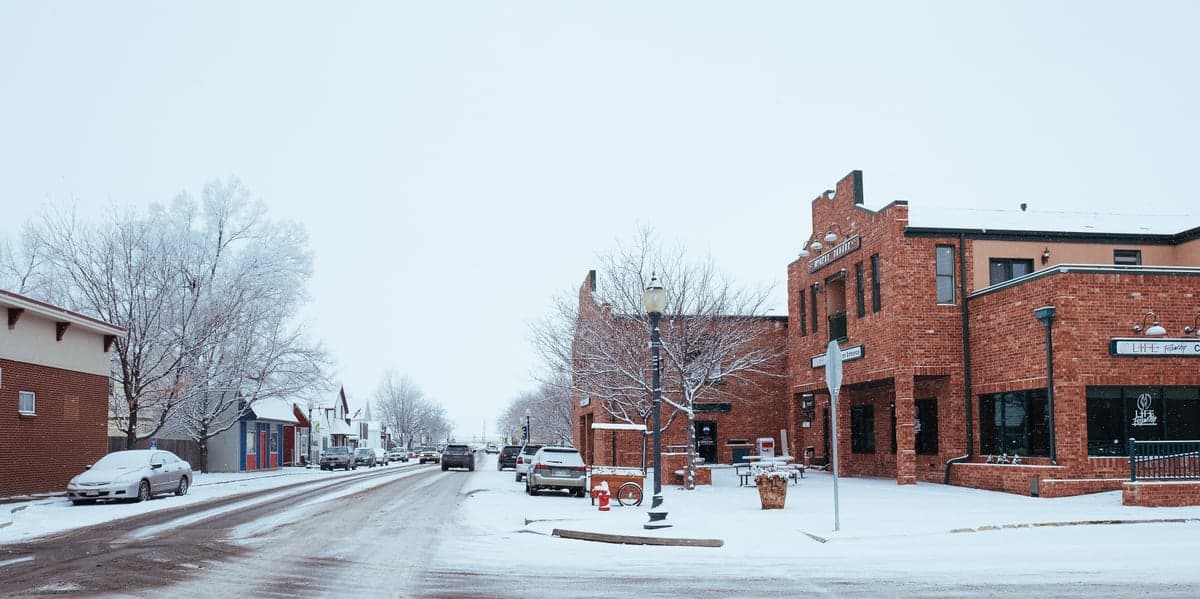
Photo: Wikipedia
Demographics of Frederick, CO
Affluence Level in Frederick, CO
An upper-middle-class area. Household wealth, education levels, and homeownership run ahead of national benchmarks.
People of Frederick, CO
The people of Frederick, Colorado today number roughly 15,893, forming a predominantly white (74.4%) and Hispanic (17.5%) community with a notably low foreign-born share of just 0.9%. This is a family-oriented, middle-class population concentrated in newer subdivisions like Coal Ridge Village and Prairie Star, where the median age hovers around 34 and over a third of adults hold a college degree (36.5%). Distinctively, Frederick feels more like a self-contained small town than a commuter suburb, with residents strongly identifying with the town's agricultural roots and its rapid transformation into a bedroom community for Denver and Boulder.
How the city was settled and grew
Frederick was founded in 1907 as a coal-mining camp, drawing its first wave of settlers—mostly European immigrants from Italy, Austria, and Germany—to work the Frederick Mine and surrounding coal seams. The town was named after Frederick A. Clark, a local mine official, and the original population clustered in what is now Historic Downtown Frederick, a compact grid of modest homes and commercial buildings along 5th Street. These early miners and their families lived in company-owned housing, and the town's character was shaped by the dangerous, labor-intensive work of coal extraction. By the 1920s, the mine employed over 400 men, and the population peaked near 1,500 before the industry declined. The Great Depression and the eventual closure of the Frederick Mine in the 1950s led to a prolonged stagnation, with the town shrinking to fewer than 800 residents by 1960. The descendants of these original mining families still form a small but proud core in the historic district, where century-old homes and the Frederick Historical Museum preserve that legacy.
Modern era (post-1965)
Frederick's modern population boom began in the late 1990s and accelerated through the 2000s, driven by Denver's suburban sprawl and the construction of Interstate 25. Unlike many Colorado towns that saw significant post-1965 immigration from Asia or Latin America, Frederick's growth has been overwhelmingly domestic: the foreign-born share sits at just 0.9%, far below the state average of 9.8%. The Hispanic population, now 17.5%, grew primarily through internal migration from other Colorado communities and the Southwest, not through recent immigration. These families settled heavily in the Coal Ridge Village and Prairie Star subdivisions, which were built out between 2000 and 2015 with affordable single-family homes on larger lots. The East/Southeast Asian population (2.8%) and Indian subcontinent population (0.9%) are small but visible in newer developments like Wyndham Hill and Mountain View Estates, where tech and healthcare professionals from Boulder and Longmont have bought homes. The Black population remains negligible at 0.1%, reflecting Frederick's historical homogeneity and the broader Front Range pattern of racial clustering in larger cities. The town's college-educated share (36.5%) is below the state average of 42%, indicating a workforce tilted toward trades, construction, and service jobs rather than the knowledge economy.
The future
Frederick's population trajectory points toward continued moderate growth, likely reaching 20,000–22,000 by 2035, driven by annexation of agricultural land and new master-planned communities. The town is not homogenizing into a single demographic bloc; instead, it is tribalizing into distinct enclaves. Historic Downtown remains the domain of older, white, long-term residents, while Coal Ridge Village and Prairie Star are becoming more Hispanic and younger. The newer Wyndham Hill and Mountain View Estates subdivisions are attracting a slightly more diverse mix of white professionals and Asian/Indian families. The immigrant communities are not growing significantly—the foreign-born share is projected to remain below 2%—but the Hispanic population will likely rise to 22–25% through higher birth rates and continued domestic in-migration. The East/Southeast Asian and Indian populations will grow slowly, probably reaching 4–5% combined, as Boulder County's housing costs push more families eastward. The town's political character, currently conservative-leaning in a county that voted +14 R in 2024, may moderate slightly as new residents arrive from more liberal areas, but Frederick is unlikely to become a progressive enclave.
For someone moving in now, Frederick is becoming a stable, family-oriented community where demographic change is gradual and neighborhood-based rather than disruptive. The low foreign-born share and high homeownership rate (estimated above 70%) mean that newcomers will find a population that is culturally homogeneous by Colorado standards, with the main dividing line being between longtime residents and recent arrivals from the Front Range. The town offers a middle ground between rural Colorado and Denver's suburbs, with a population that values schools, safety, and space over urban amenities or ethnic diversity.

* Values derived from national, state, county, city and local statistics and may differ in a specific area. Last updated: 2026-05-01T00:51:00.000Z
Narrative content on this page is AI-generated and may contain mistakes. Verify any details that matter before acting on them.
ReloMaps may earn a commission from affiliate links at no extra cost to you.

