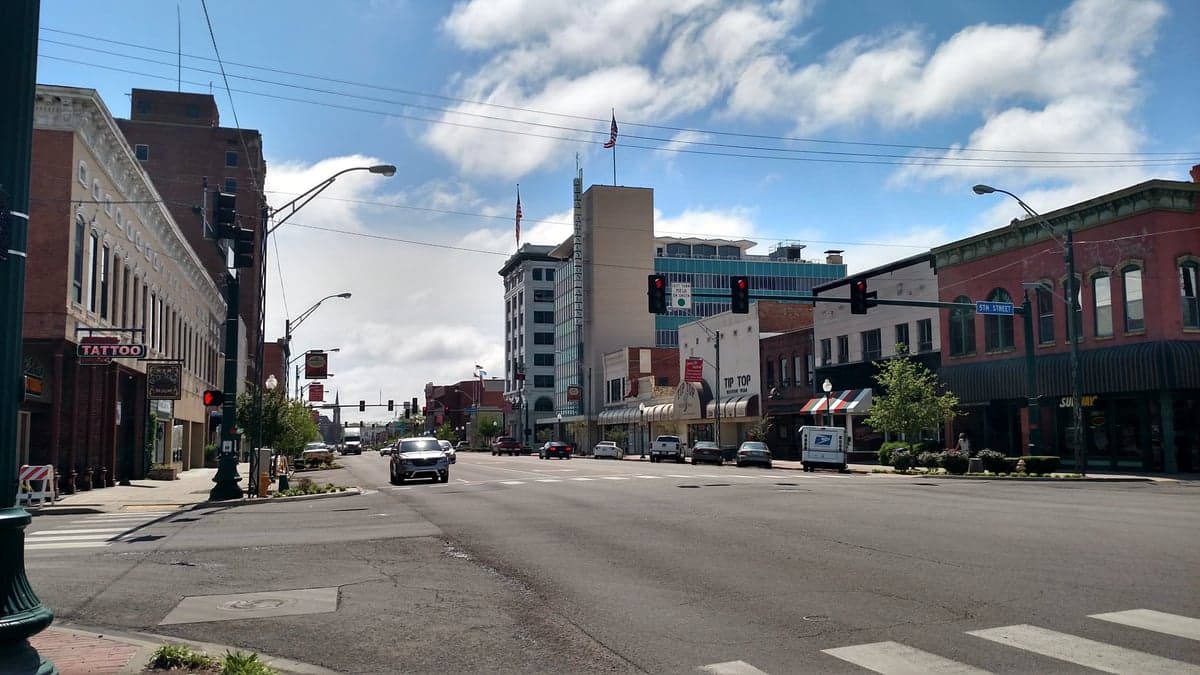
Photo: Wikipedia
Strategic Assessment of Fort Smith, AR
Workable tactical position. Some exposure to population density or targets, but generally defensible in a crisis.
What does the Strategic Assessment tell us?
Our Strategic Assessment grades tactical survivability of an area. Major population centers, military targets, fallout zones, natural disasters, and border exposure all drive risk — lower exposure means a more defensible position in a crisis.
This is heavily inspired by Joel Skousen's Strategic Relocation book. Highly recommended you checkout the book ($)What does this tell us?
Our Strategic Assessment grades tactical survivability of an area. Major population centers, military targets, fallout zones, natural disasters, and border exposure all drive risk — lower exposure means a more defensible position in a crisis.
This is heavily inspired by Joel Skousen's Strategic Relocation book. Highly recommended you checkout the book ($)Strategic Pillars

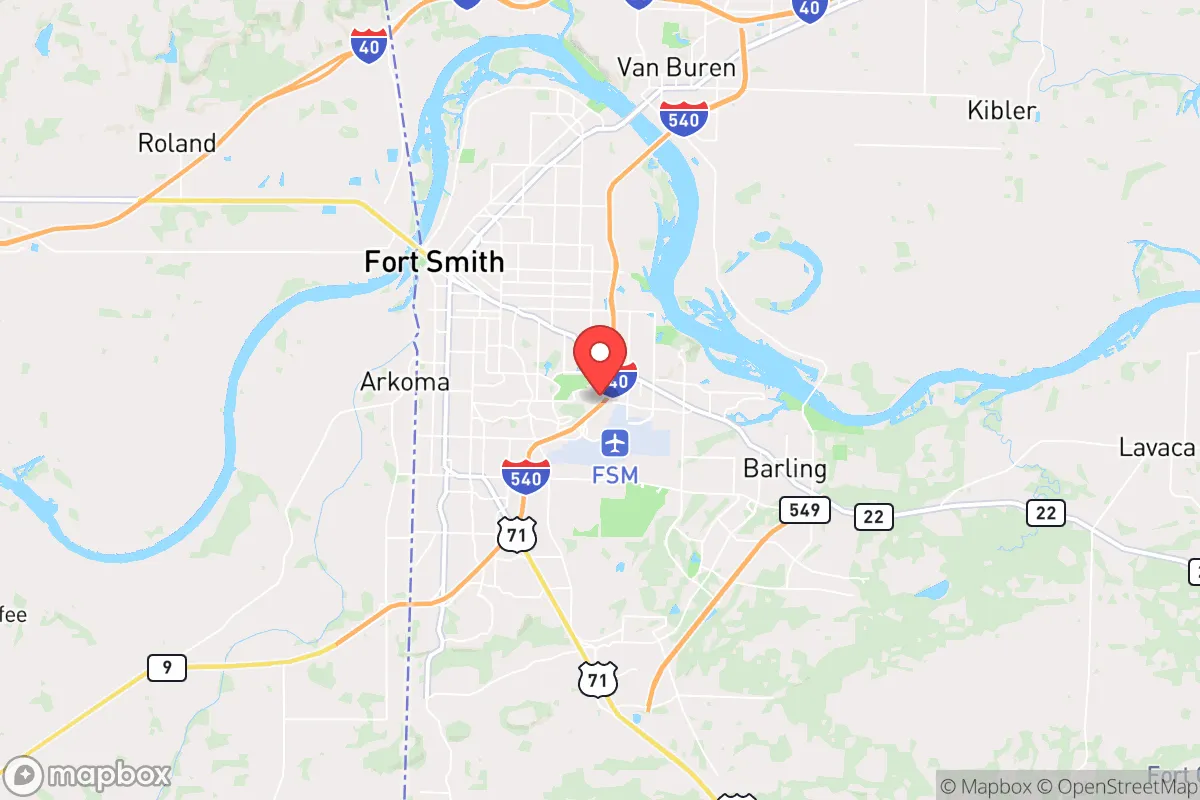
Key Distances
Regional Safe Places
Below is our recommended "safe zones" in Arkansas and the surrounding area based on our strategic heuristics. For most people, it's unrealistic to live in a “safe zone” full-time due to work, family or other personal reasons. They tend to be more rural. However, many of these areas are perfect for second homes and retreat properties that double as a vacation home or even a short-term rental.
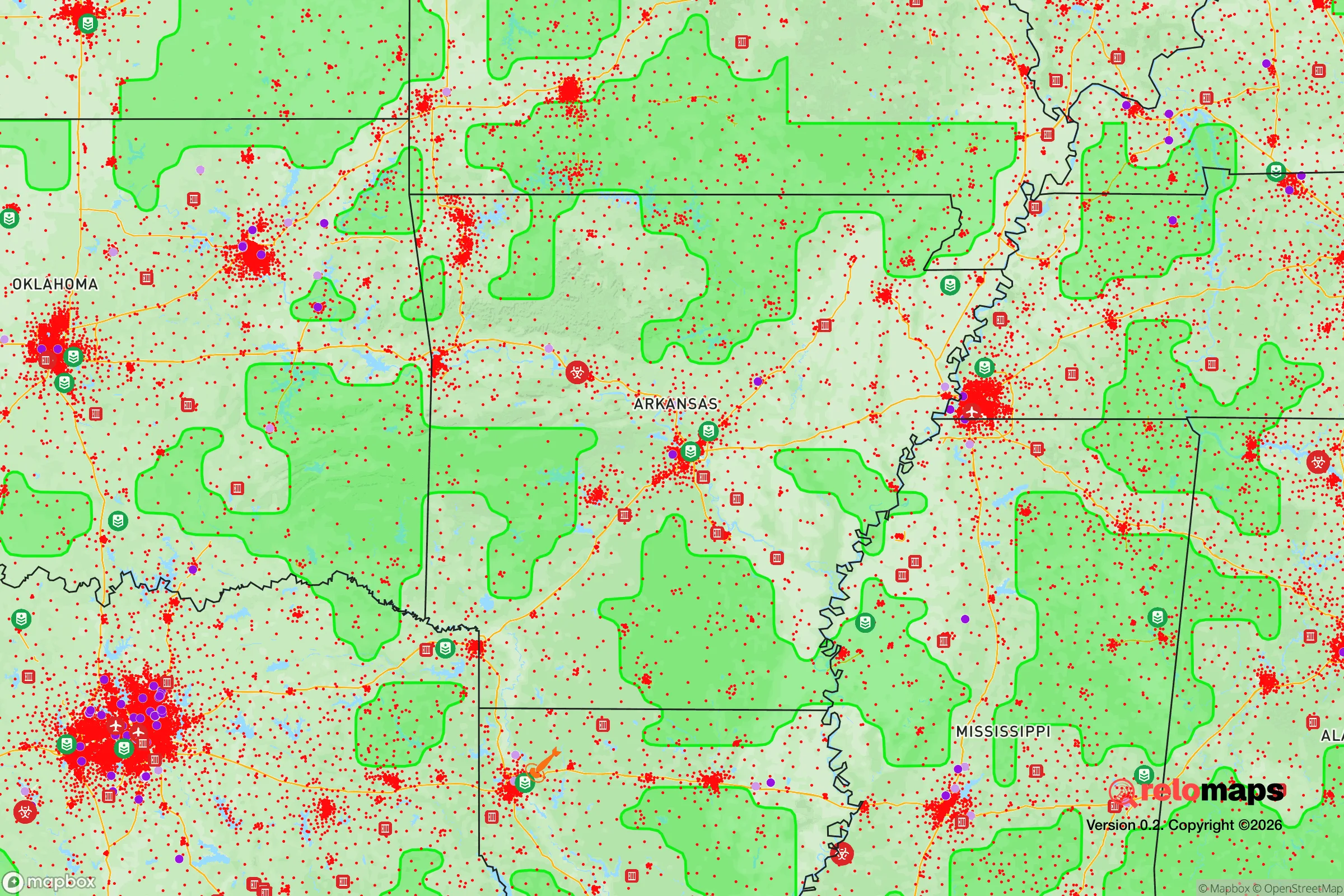
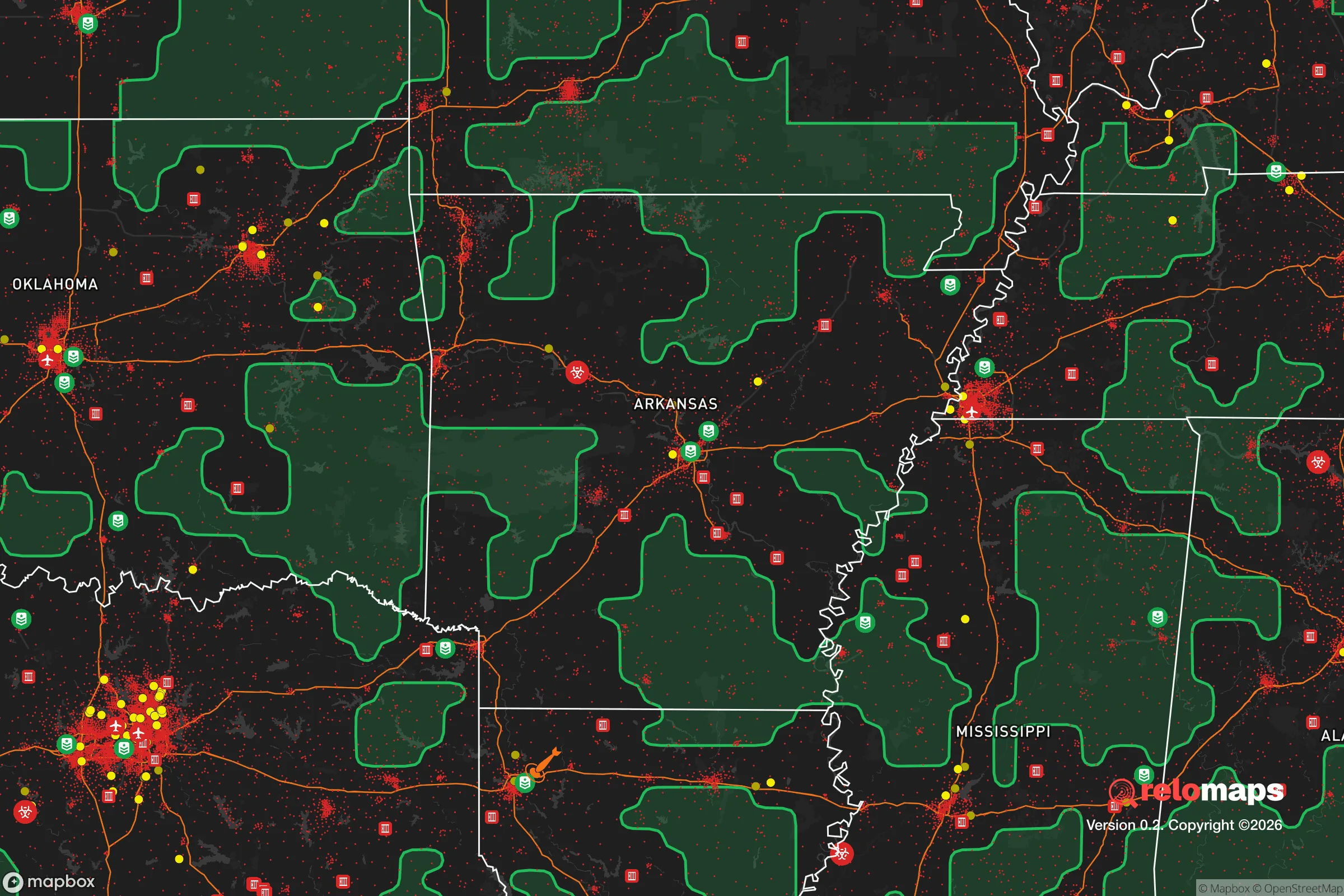


Important Note: For informational purposes only. This does not mean nothing bad ever happens in the green zones. Please use common sense. This is based on public data and modeled with AI. We tried to take a conservative approach but mistakes happen. We update this regularly as new information becomes available.
Solar Generator Recommendations
Backup power matters more here than in safer locations. We've picked three solar generators across budgets and capacity tiers — start with the budget unit if you only need a few essentials, or step up if you want to run a fridge and HVAC for days at a time.

Jackery Portable Power Station Explorer 300
Budget OptionPower on the Go: Weighing only 11 lbs, it's convenient to set up and store with book-sized foldable solar panels

BLUETTI Portable Power Station AC180
Designed for both indoor and outdoor scenarios, AC180 is highly capable as it has a robost capacity and continuous output power.

EF ECOFLOW DELTA Pro Ultra Power Station
Upgraded PickEcoFlow DELTA Pro Ultra is a whole-home energy system designed to grow with your family. Integrated with the Smart Home Panel 2, it scales to meet your evolving energy needs — keeping your home powered, intelligent, and secure through every stage of life.
We earn a commission, at no additional cost to you.
Strategic Assessment Analysis
Fort Smith, Arkansas, offers a compelling strategic position for those prioritizing resilience and long-term stability, balancing industrial infrastructure with a location that sits just outside the most volatile zones of national unrest. The city’s history as a frontier fort is not just a footnote; it’s a blueprint for its current advantages—situated at the crossroads of the Arkansas River valley and the Boston Mountains, it provides a natural buffer against the chaos that tends to ripple outward from major coastal and metropolitan hubs. For a relocator thinking in terms of decades, not just the next election cycle, Fort Smith represents a place where the grid is robust enough for modern life but the geography offers a genuine fallback position when things go sideways.
Geographic position and natural advantages for long-term stability
Fort Smith’s location is its primary strategic asset. It sits in the Arkansas River Valley, a corridor that has historically been a transportation and trade route, but one that is flanked by the Ozark and Ouachita Mountains to the north and south. This means the area is not a flat, exposed plain vulnerable to every weather system or population surge. The surrounding terrain provides natural chokepoints and defensible high ground within a 30- to 60-minute drive, particularly north toward the Ozark National Forest. The Arkansas River itself is a reliable water source, and the region’s annual rainfall—averaging around 45 inches—ensures that surface water and groundwater are generally plentiful, unlike the arid West. For a prepper, this is a critical detail: you are not dependent on a single reservoir or a fragile aqueduct system. The city’s position roughly 150 miles from both Tulsa and Little Rock means it is close enough to access major medical and supply chains in a stable period, but far enough that a cascading failure in either city would not immediately overwhelm Fort Smith. The lack of any major military nuclear or strategic target within a 50-mile radius—no major ICBM fields, no major naval bases, no high-value command centers—further reduces the risk of being a primary or secondary fallout target in a conflict scenario.
Risks, exposures, and proximity to fallout-relevant landmarks
No location is without exposure, and Fort Smith has a few that demand honest assessment. The most significant is the Arkansas Nuclear One power plant, located roughly 75 miles southeast near Russellville. While that distance provides a substantial safety buffer—well beyond the typical 10-mile emergency planning zone—a catastrophic failure or a targeted strike on that facility could still produce fallout patterns that affect the Fort Smith area depending on wind direction. The prevailing winds in this region are from the south and southwest, meaning a release from that plant would more likely drift toward the Ozarks than directly over Fort Smith, but it is not a zero-risk scenario. Additionally, the city itself has industrial infrastructure—including a major steel mill and a large poultry processing plant—that could become secondary targets in a broader conflict or attract civil unrest due to supply chain disruptions. The proximity to the Oklahoma border also means that any unrest or resource competition in the Sooner State could spill over, particularly along the I-40 corridor. However, compared to living within 20 miles of a major port, a nuclear submarine base, or a federal government hub like Washington D.C., these risks are manageable and can be mitigated with a solid plan and a rural property within 30 minutes of the city center.
Practical resilience for a relocator: food, water, energy, and defensibility
For the individual or family looking to build a resilient life, Fort Smith offers a practical mix of resources and space. The region is part of the Arkansas River Valley, which has fertile soil and a long growing season—typically from April to October. This makes small-scale agriculture and gardening viable for supplementing food supplies. The local food system is also strong: the area is a hub for poultry and cattle production, and there are multiple farmers' markets and local processors that reduce dependence on national grocery chains. Water is not a concern here; the Arkansas River provides a massive surface water source, and the Ozark aquifer system beneath the region is one of the most productive in the country. For off-grid energy, the area has decent solar potential—not as strong as the Southwest, but more than enough for a well-designed system—and the forested hills provide ample biomass for heating. Defensibility is where Fort Smith truly shines for the strategic relocator. The city itself is a mix of older neighborhoods with brick homes and newer subdivisions, but the real value is in the surrounding rural areas. Within a 20-minute drive, you can find properties with good road access but limited visibility, set against hills or creek bottoms that provide natural cover. The local culture is still heavily oriented toward self-reliance, hunting, and firearms ownership, which means you are not an outlier for being prepared. The county sheriff's office and local law enforcement are generally responsive, but in a prolonged crisis, the expectation is that communities handle their own security—a reality that aligns well with a prepper mindset.
The overall strategic picture for Fort Smith is that of a solid, unglamorous anchor point for a long-term resilience plan. It is not a bug-out location in the sense of a remote mountain cabin; it is a functioning city with a hospital, an airport, and a Walmart, but one that sits in a region where you can realistically own land, grow food, and keep a low profile. The risks from nuclear power, industrial targets, and regional spillover are real but manageable, especially when compared to the existential vulnerabilities of coastal cities or political capitals. For a conservative-leaning individual or family who sees the writing on the wall regarding national instability, Fort Smith offers a place where you can live a normal life while quietly building the capacity to weather whatever comes next. The key is to treat it as a base of operations—secure a rural property within 30 minutes, establish a water and food storage plan, and get to know your neighbors before the crisis hits. In a world where the grid is fragile and the social contract is fraying, that is about as good as it gets without going completely off-grid in the Alaskan bush.

* Values derived from national, state, county, city and local statistics and may differ in a specific area. Last updated: 2026-04-23T02:18:26.000Z
Narrative content on this page is AI-generated and may contain mistakes. Verify any details that matter before acting on them.
ReloMaps may earn a commission from affiliate links at no extra cost to you.

