 Popular
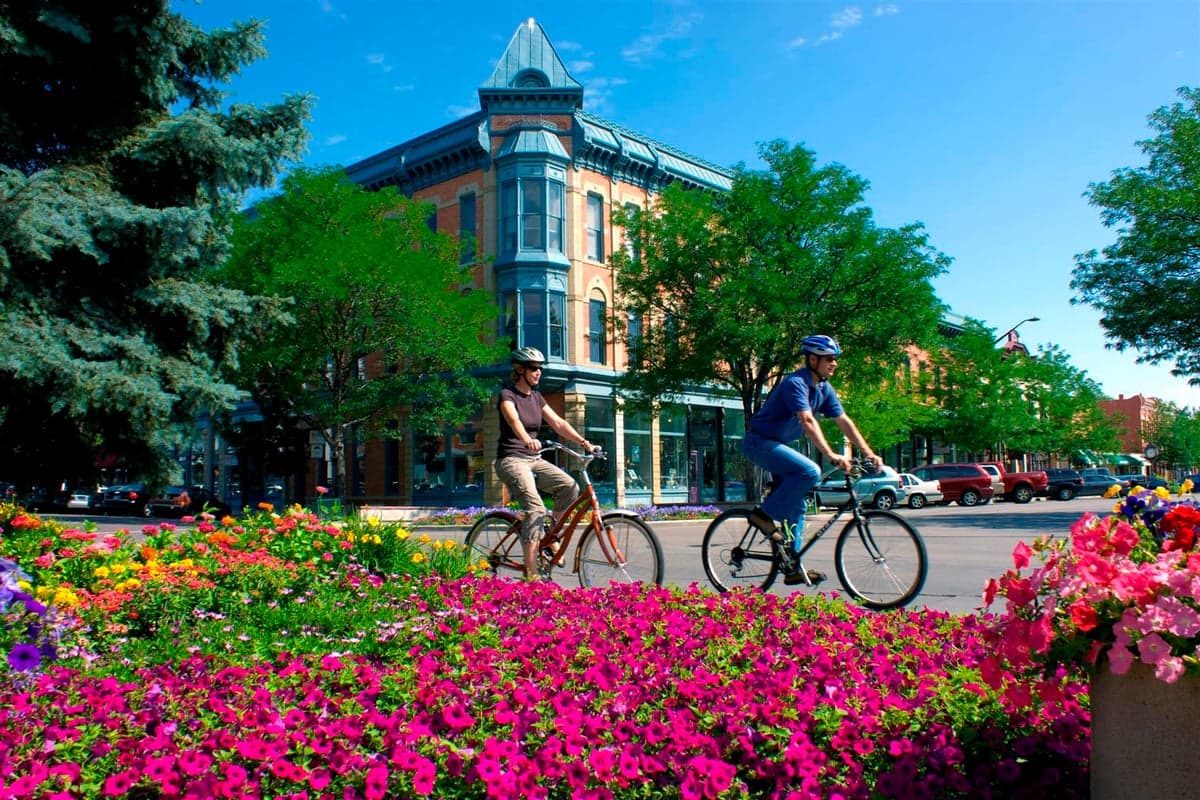
Photo: Wikipedia
Demographics of Fort Collins, CO
Affluence Level in Fort Collins, CO
A middle-class area roughly in line with national averages across income, home values, education, and employment.
People of Fort Collins, CO
Fort Collins today is a city of 169,705 residents defined by its high educational attainment — 59.9% hold a bachelor’s degree or higher — and its predominantly white, native-born character. The foreign-born share sits at just 3.4%, well below the national average, and the city’s racial makeup is 77.8% white, 12.3% Hispanic, 2.3% East/Southeast Asian, 1.2% Black, and 1.0% Indian (subcontinent). This is a college town and tech hub that has grown steadily through domestic in-migration, attracting professionals and families who value outdoor recreation, conservative-leaning local governance, and a relatively homogeneous social fabric.
How the city was settled and grew
Fort Collins was founded in 1864 as a military outpost on the Cache la Poudre River, but its permanent population arrived with the railroad and the agricultural boom of the 1870s. The original settlers were predominantly Anglo-American homesteaders drawn by the promise of irrigated farmland and the establishment of Colorado Agricultural College (now Colorado State University) in 1870. The Old Town neighborhood, centered on Linden Street and Mountain Avenue, was the original commercial and residential core, built by these early farmers and merchants. A second wave arrived in the early 1900s with the sugar beet industry, which brought a small number of German-Russian and Mexican laborers who settled in the Buckingham and Andersonville neighborhoods east of the railroad tracks. These enclaves remained modest in size; Fort Collins never experienced the large-scale immigrant settlement seen in Denver or Pueblo. By 1950, the city’s population was roughly 15,000 and overwhelmingly white, with a tiny Hispanic minority concentrated in the North College Avenue corridor.
Modern era (post-1965)
The post-1965 period transformed Fort Collins through two forces: the expansion of Colorado State University and the rise of high-tech manufacturing. The 1965 Hart-Cellar Act had minimal direct impact here — the foreign-born share remained below 5% through the 1990s — but domestic in-migration surged. The University Park neighborhood, surrounding the CSU campus, absorbed a steady flow of students and faculty from across the Midwest and West Coast. Meanwhile, the arrival of Hewlett-Packard in 1976 and later Agilent Technologies and Broadcom drew engineers and managers to new subdivisions in South Fort Collins, particularly the Ridgewood Hills and Horsetooth Mountain areas. Hispanic growth accelerated modestly after 1990, with families moving into East Fort Collins near Lemay Avenue and the Willow Springs area, drawn by construction and service jobs. The East/Southeast Asian population — primarily Chinese, Korean, and Vietnamese — grew from near-zero to 2.3% by 2020, clustering near the university in University Park and in newer apartments along Harmony Road. The Indian subcontinent population (1.0%) is smaller and more dispersed, with many working in tech or at CSU. Black residents remain at 1.2%, with no single neighborhood concentration.
The future
Fort Collins is likely to remain a predominantly white, highly educated city over the next 10–20 years, but with gradual diversification driven by university recruitment and tech hiring. The Hispanic share is projected to rise slowly, possibly reaching 15–16% by 2040, as families in East Fort Collins and the Timberwood area grow through natural increase. East/Southeast Asian and Indian populations will likely increase as CSU and local tech firms recruit internationally, but the city’s high housing costs — median home prices above $550,000 — will limit large-scale immigration. The foreign-born share may climb to 5–6% but will remain far below the national average. The city is not tribalizing into distinct ethnic enclaves; instead, new arrivals are dispersing into existing neighborhoods, especially University Park and South Fort Collins. The most significant demographic trend is the aging of the white population, with the 65+ cohort growing faster than the under-18 cohort, a pattern that will shape housing demand and school enrollment.
For someone moving to Fort Collins now, the city offers a stable, low-diversity environment with strong schools and a conservative-leaning local government. The population is becoming slightly more diverse but remains overwhelmingly native-born and white. New residents should expect a community where the dominant culture is shaped by CSU, outdoor recreation, and a tech-driven economy, with limited ethnic or linguistic diversity outside of the university sphere.

* Values derived from national, state, county, city and local statistics and may differ in a specific area. Last updated: 2026-04-25T04:19:49.000Z
Narrative content on this page is AI-generated and may contain mistakes. Verify any details that matter before acting on them.
ReloMaps may earn a commission from affiliate links at no extra cost to you.

