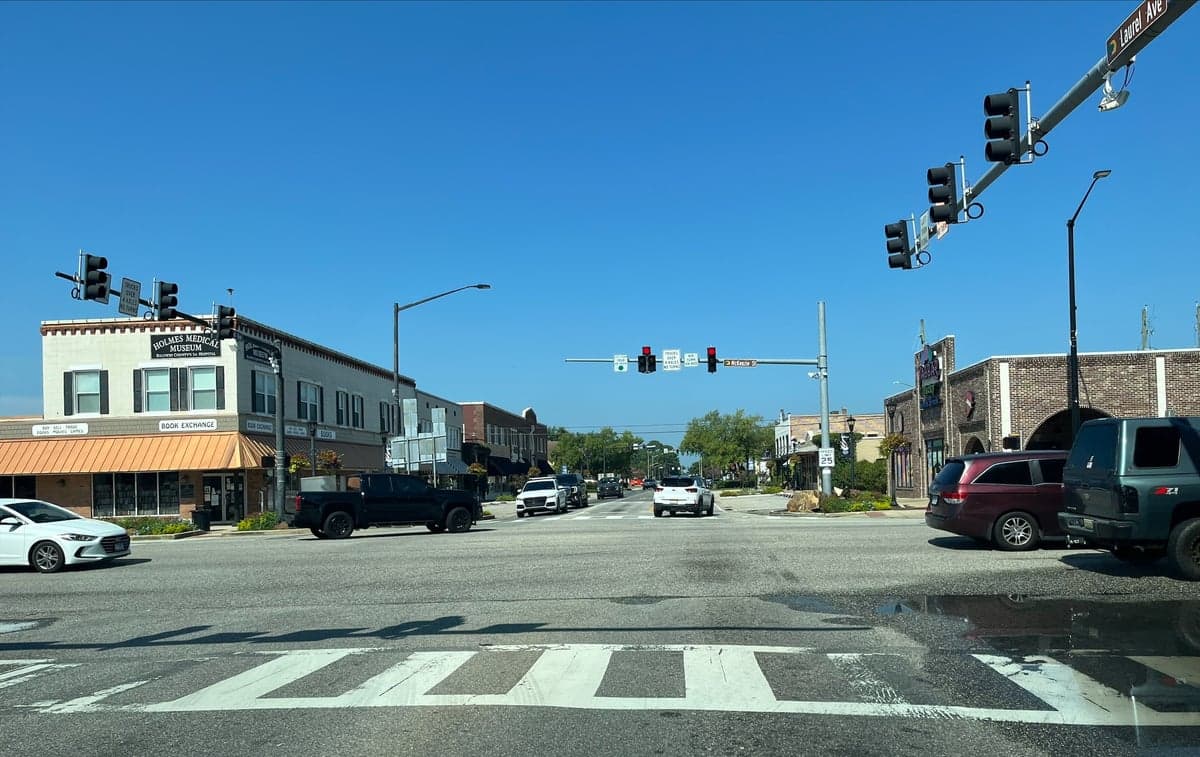
Photo: Wikipedia
Personal Sovereignty in Foley, AL
Viable for self-reliance. Generally workable, though some barriers may limit total independence.
What does Personal Sovereignty tell us?
Personal Sovereignty measures your capacity for self-reliance and independence with minimal government friction. Higher scores mean fewer barriers between you and the way you want to live... but it assumes you have the space you need and good neighbors.
What does this tell us?
Personal Sovereignty measures your capacity for self-reliance and independence with minimal government friction. Higher scores mean fewer barriers between you and the way you want to live... but it assumes you have the space you need and good neighbors.
State Policy
Energy independence: Importer (45% of energy produced in-state)
Personal Liberty
Homesteading

Personal Liberty Analysis
Foley, Alabama, offers a notably high degree of personal sovereignty compared to many other parts of the country, particularly for those who prioritize minimal government interference in daily life. The city sits within a state that has deliberately constructed a legal and regulatory environment favoring individual autonomy, from low taxation to strong property rights and expansive gun laws. For a single individual or parent operating from a survivalist or prepper mindset, Foley represents a strategic location where the state’s posture is one of deference to the citizen, not the other way around. The key question is not whether you can live freely here, but how far you can push that freedom before bumping into the limits of local zoning or municipal ordinances.
Tax burden and regulatory posture: How much the state takes and how much it stays out of your way
Alabama’s tax structure is one of the most favorable in the nation for those seeking to keep more of what they earn. There is no state-level tax on groceries or prescription drugs, and the state income tax is a flat 5% on taxable income over $3,000, with a standard deduction of $4,000 for single filers and $7,500 for married couples. Property taxes are among the lowest in the country—the effective rate in Baldwin County, where Foley sits, is roughly 0.4% of assessed value. For a $300,000 home, that’s about $1,200 annually. The state’s regulatory posture is equally light: there is no state-level occupational licensing board that creates unnecessary hurdles for trades like welding, electrical work, or plumbing, and the state has a right-to-work law that prevents forced union membership. For a prepper or survivalist, this means less of your income is siphoned off for government programs you may not support, and fewer bureaucratic barriers exist to starting a side business or working independently. The city of Foley itself has a relatively business-friendly zoning code, though it does enforce standard municipal regulations on building permits and setbacks. The overall message from the state is clear: they want you to keep your money and make your own decisions, as long as you’re not causing harm.
Self-defense and gun law specifics: What you can carry, where, and how to store it
Alabama is a constitutional carry state, meaning no permit is required to carry a concealed handgun for anyone 19 or older who is legally allowed to possess a firearm. This applies to Foley and all of Baldwin County. There is no state-level waiting period for firearm purchases, no universal background check requirement beyond the federal NICS check, and no ban on standard-capacity magazines or so-called "assault weapons." The state also has a strong "Stand Your Ground" law, codified in Alabama Code § 13A-3-23, which removes any duty to retreat before using deadly force in self-defense if you are in a place you have a legal right to be. For parents, this extends to protecting your home and family: the "Castle Doctrine" applies to your dwelling, vehicle, and occupied workplace. Storage laws are minimal—there is no state requirement for gun safes or trigger locks, though federal law prohibits transferring a handgun to a minor. For a prepper, this means you can maintain a fully stocked armory without worrying about state-level registration or confiscation schemes. The only notable restriction is that carrying a firearm into a posted "no guns" sign is a misdemeanor trespassing violation, not a felony, and there is no state preemption that overrides local ordinances—though Foley itself has not enacted any restrictive gun laws. The legal environment here is designed to maximize your ability to defend yourself and your family without asking permission first.
Self-reliance and homesteading viability: Lot sizes, zoning, and off-grid feasibility
Foley’s zoning code is a mixed bag for serious homesteading. Within the city limits, residential lots are typically small—standard subdivisions offer quarter-acre to half-acre plots—and the city enforces rules against keeping livestock like chickens, goats, or pigs in most residential zones. However, the city does allow for "urban agriculture" on lots of one acre or more with a special permit, and beekeeping is permitted with registration. The real opportunity lies just outside the city limits in unincorporated Baldwin County, where zoning is far more relaxed. There, you can find parcels ranging from 1 to 20 acres, often with no HOA restrictions, where you can keep livestock, build a workshop, and even install a septic system for off-grid living. Off-grid feasibility is high: Alabama has no state-level ban on rainwater collection, and solar panel installation is straightforward with no net metering restrictions that penalize self-generation. The county does require a permit for any structure over 200 square feet, but there is no prohibition on tiny homes or shipping container dwellings as long as they meet basic building codes. For a prepper, the strategic play is to buy land in the county, not the city. Foley’s municipal water and sewer are reliable, but if you want true independence—well water, solar power, and a root cellar—you’ll need to look at the rural parcels along County Road 12 or near the Bon Secour River. The soil is sandy loam, good for gardening with amendment, and the growing season runs from March to November. The biggest hurdle is the cost: land in Baldwin County has appreciated significantly, with raw acreage now running $15,000–$30,000 per acre depending on proximity to the coast.
Personal liberties: Parental rights, medical autonomy, speech, and property
Alabama is one of the strongest states in the nation for parental rights. The state has a Parents’ Bill of Rights (Alabama Code § 16-40-1) that explicitly affirms a parent’s right to direct the upbringing, education, and healthcare of their child. This means no school district can hide curriculum or medical decisions from parents, and there is no state-level mandate for comprehensive sex education that overrides parental opt-out. Medical autonomy is also robust: there is no state vaccine mandate for adults, and while schools require standard childhood immunizations for enrollment, religious and medical exemptions are available and relatively easy to obtain. The state has also passed a law (SB 184) prohibiting the enforcement of federal gun laws that conflict with state law, signaling a willingness to push back against federal overreach. Free speech is protected under the Alabama Constitution, which has its own free speech clause that has been interpreted broadly by state courts. Property rights are strong: Alabama is a "lien theory" state, meaning you hold the title to your property even with a mortgage, and there is no state-level rent control or forced inclusionary zoning. For a prepper, this means you can put up a "No Trespassing" sign and enforce it with deadly force if necessary, you can homeschool without excessive state oversight, and you can refuse medical treatments or vaccines without losing your job or custody of your children. The only notable limitation is that Baldwin County does have a noise ordinance that could theoretically be used against generators or shooting ranges in residential areas, but enforcement is complaint-driven and rare.
Overall, Foley’s personal sovereignty profile is strong but not absolute. The city itself is a comfortable, low-tax, low-regulation environment that respects gun rights, parental authority, and property ownership. The trade-off is that true off-grid self-reliance requires moving outside the city limits, where you can control your land and resources without municipal interference. Compared to states like California, New York, or Illinois, where taxes are high, gun laws are restrictive, and parental rights are under constant legal attack, Foley offers a sanctuary for those who want to live by their own rules. The biggest risk is not government overreach at the state level—that’s minimal—but the creeping influence of coastal development and tourism, which drives up land prices and could eventually bring more restrictive zoning. For now, Foley remains a solid choice for the strategic relocator who values freedom over convenience, and who is willing to trade a bit of urban amenity for a lot of personal autonomy.

* Values derived from national, state, county, city and local statistics and may differ in a specific area. Last updated: 2026-04-19T18:51:31.000Z
Narrative content on this page is AI-generated and may contain mistakes. Verify any details that matter before acting on them.
ReloMaps may earn a commission from affiliate links at no extra cost to you.

