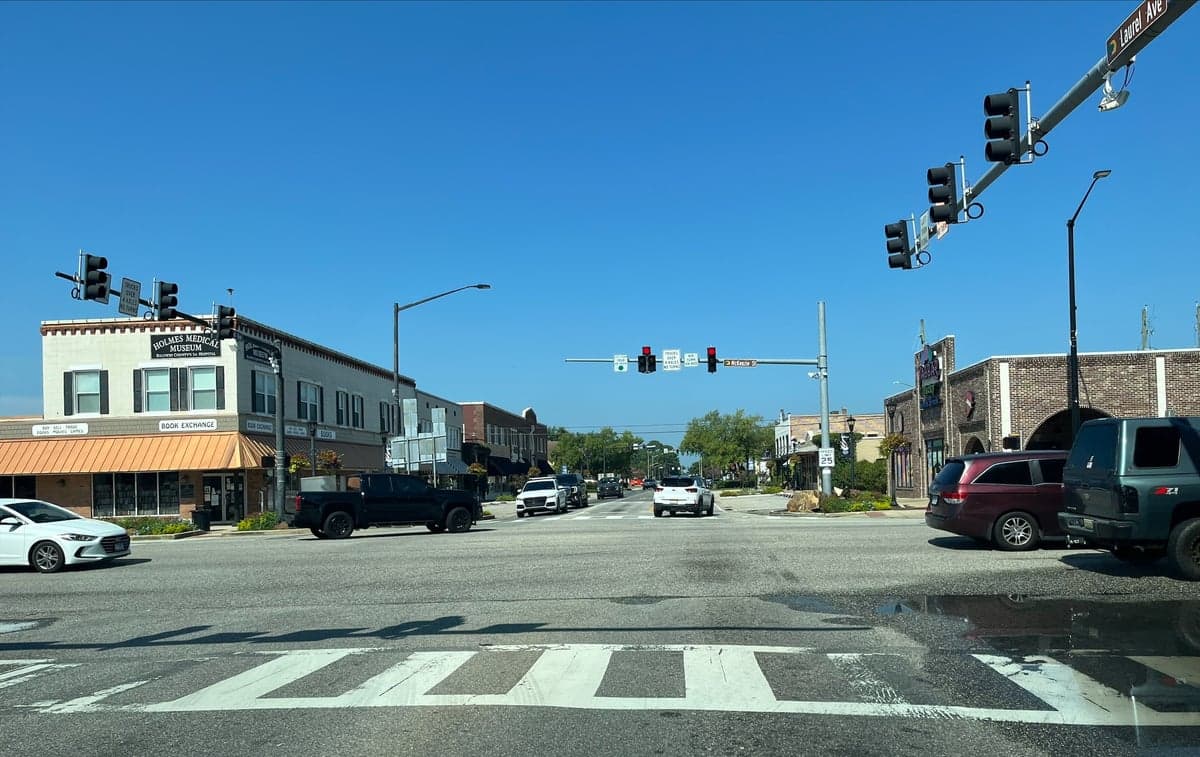
Photo: Wikipedia
Demographics of Foley, AL
Affluence Level in Foley, AL
A middle-class area roughly in line with national averages across income, home values, education, and employment.
People of Foley, AL
The people of Foley, Alabama, today form a predominantly white (77.0%) and increasingly Hispanic (10.6%) community of 22,330 residents, shaped by decades of tourism-driven growth and domestic in-migration from the Midwest and Southeast. The city’s identity is rooted in its role as a retail and service hub for the Gulf Shores beach economy, with a lower college attainment rate (26.3%) than the national average and a very small foreign-born population (3.1%). Foley is a family-oriented, conservative-leaning town where newcomers are drawn by affordable housing, low property taxes, and proximity to the coast, creating a population that is both transient and steadily expanding.
How the city was settled and grew
Foley was founded in 1905 by John B. Foley, a Chicago railroad executive who saw opportunity in the pine forests and farmland of Baldwin County. The original settlers were mostly white farmers and timber workers from the Deep South, drawn by the promise of cheap land along the newly built Gulf, Mobile & Ohio Railroad. The city’s first residential core developed around the original downtown grid, now known as Historic Downtown Foley, where early merchants and railroad employees built modest homes and storefronts. A second wave arrived during the 1920s and 1930s, when the Foley State Bank and the Foley Lumber Company attracted more white laborers and small business owners, who settled in the North Foley area along what is now Highway 59. By 1950, the population had reached just 1,500, and the city remained a quiet agricultural and lumber town with a nearly all-white population. No significant immigrant or minority communities formed during this period, as the local economy offered little beyond seasonal farm work and timber.
Modern era (post-1965)
The post-1965 era transformed Foley from a rural crossroads into a bedroom suburb of the Gulf Shores tourism economy. The opening of the Foley Beach Express toll bridge in 2000 and the expansion of the Tanger Outlets mall in the 1990s triggered a construction and retail boom that drew domestic migrants from the Midwest—particularly Ohio, Indiana, and Michigan—seeking warmer winters and lower living costs. These new residents, overwhelmingly white and often retired or semi-retired, concentrated in master-planned subdivisions such as Heron Lakes and Oyster Bay, both built in the 2000s along the Foley Beach Express corridor. A smaller but notable influx of Hispanic workers began in the 1990s, drawn by construction and hospitality jobs; they settled primarily in the East Foley area near the Foley Sports Complex, where rental duplexes and mobile home parks provided affordable entry points. The Black population, historically minimal in Foley (4.6% today), remains concentrated in the West Foley neighborhood near the old railroad tracks, a legacy of pre-1965 segregation patterns that have not significantly shifted. East/Southeast Asian communities (1.5%) and Indian-subcontinent residents (0.8%) are very small and scattered, with no distinct ethnic enclave; most are professionals employed in healthcare or retail management, living in newer subdivisions like Magnolia Springs on the city’s southern edge.
The future
Foley’s population is projected to continue growing at roughly 2–3% annually, driven by ongoing residential development and the expansion of the South Baldwin Regional Medical Center. The Hispanic share is likely to rise modestly, from 10.6% toward 15–18% over the next decade, as service-sector jobs multiply and family reunification continues; however, the foreign-born share (3.1%) suggests this growth will come primarily from U.S.-born Hispanic families rather than new immigration. The white population will remain dominant but slowly decline in percentage as the city diversifies. The Black and Asian shares are expected to remain stable or grow only slightly, as Foley lacks the industrial or professional job base that attracts larger minority populations. The city is not tribalizing into distinct enclaves—most neighborhoods are already majority-white, and the Hispanic population is geographically dispersed across East Foley and the newer subdivisions. For a conservative-leaning mover, Foley offers a culturally homogeneous, family-oriented environment with a growing tax base and improving schools, but little racial or ethnic diversity beyond the Hispanic community.
Foley is becoming a more populous, slightly more diverse version of its 1990s self—a white-majority, conservative, service-oriented suburb where the main demographic story is domestic in-migration, not international immigration. For someone moving in now, the city offers stability, affordability, and a predictable social landscape, but those seeking significant ethnic or cultural variety will find it limited.

* Values derived from national, state, county, city and local statistics and may differ in a specific area. Last updated: 2026-04-19T18:51:31.000Z
Narrative content on this page is AI-generated and may contain mistakes. Verify any details that matter before acting on them.
ReloMaps may earn a commission from affiliate links at no extra cost to you.

