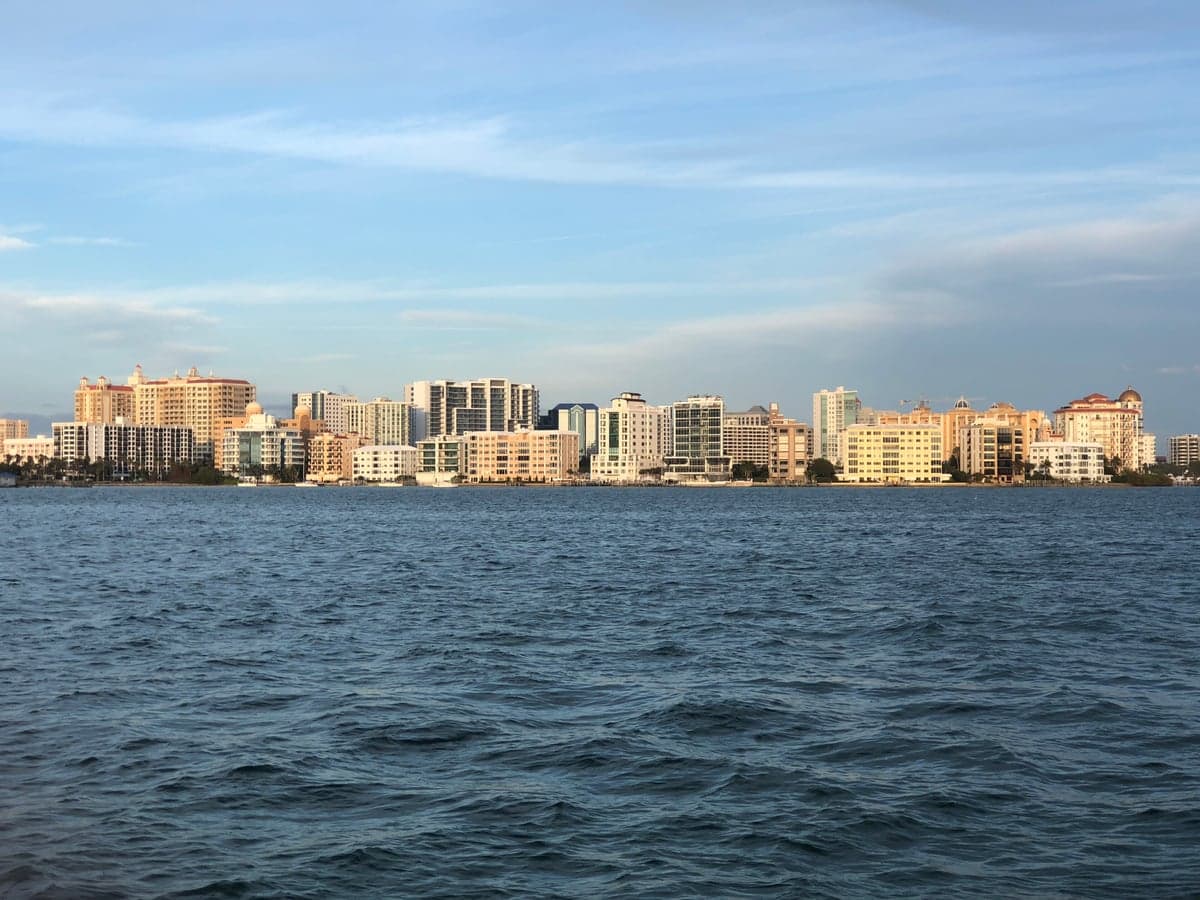
Photo: Wikipedia
Demographics of Sarasota County
Affluence Level in Sarasota County
An upper-middle-class area. Household wealth, education levels, and homeownership run ahead of national benchmarks.
People of Sarasota County
Sarasota County's population of 449,011 is predominantly White (80.6%) and older, with a median age well above the national average, reflecting its long-standing identity as a retirement destination for Midwestern and Northeastern families. The county's foreign-born share is just 4.5%, one of the lowest in Florida, and its Hispanic population (10.2%) and Black population (4.0%) are smaller than state averages. The cultural character is distinctly traditional and conservative, shaped by generations of domestic migrants seeking a coastal, low-tax lifestyle in communities like Sarasota, Venice, and North Port.
Settlement & growth (pre-1960)
Before American settlement, the area now known as Sarasota County was inhabited by the Calusa people, who controlled much of southwest Florida's coast for centuries. Spanish explorers made contact in the 1500s, but no permanent European colony took root here. By the 1800s, the Seminole had moved into the region, and the U.S. government forcibly removed most of them during the Seminole Wars, opening the land to Anglo-American settlers.
The first significant wave of American settlers arrived in the 1840s and 1850s, primarily cattle ranchers from Georgia and the Carolinas. These "cracker" families established homesteads along the Myakka River and near what is now the city of Sarasota, raising cattle on open range. The community remained small and isolated until the arrival of the railroad in the early 1900s, when developer Bertha Palmer and others began promoting the area as a winter retreat for wealthy Northerners. The 1920s land boom brought a flood of speculators and retirees, particularly from the Midwest, who built homes in Sarasota and on Siesta Key and Longboat Key.
After World War II, the county experienced its most dramatic growth wave. Veterans and their families, many from the Rust Belt states of Ohio, Michigan, and Pennsylvania, moved south for the warm climate and affordable land. The city of Venice, originally founded as a planned retirement community by the Brotherhood of Locomotive Engineers in the 1920s, expanded rapidly as a destination for railroad retirees. North Port, platted in the 1950s as a massive subdivision called "North Port Charlotte," began attracting working-class families from the Northeast. By 1960, the county's population had grown to roughly 76,000, and the foundation of a retiree-dominated, conservative-leaning culture was firmly in place.
Modern era (post-1965)
The 1965 Hart-Cellar Act had a muted effect on Sarasota County compared to other parts of Florida. The foreign-born population remains low at 4.5%, and the county never developed large immigrant enclaves. Instead, domestic migration

* Values derived from national, state, county, city and local statistics and may differ in a specific area. Last updated: 2026-05-14T20:38:04.000Z
Narrative content on this page is AI-generated and may contain mistakes. Verify any details that matter before acting on them.
ReloMaps may earn a commission from affiliate links at no extra cost to you.

