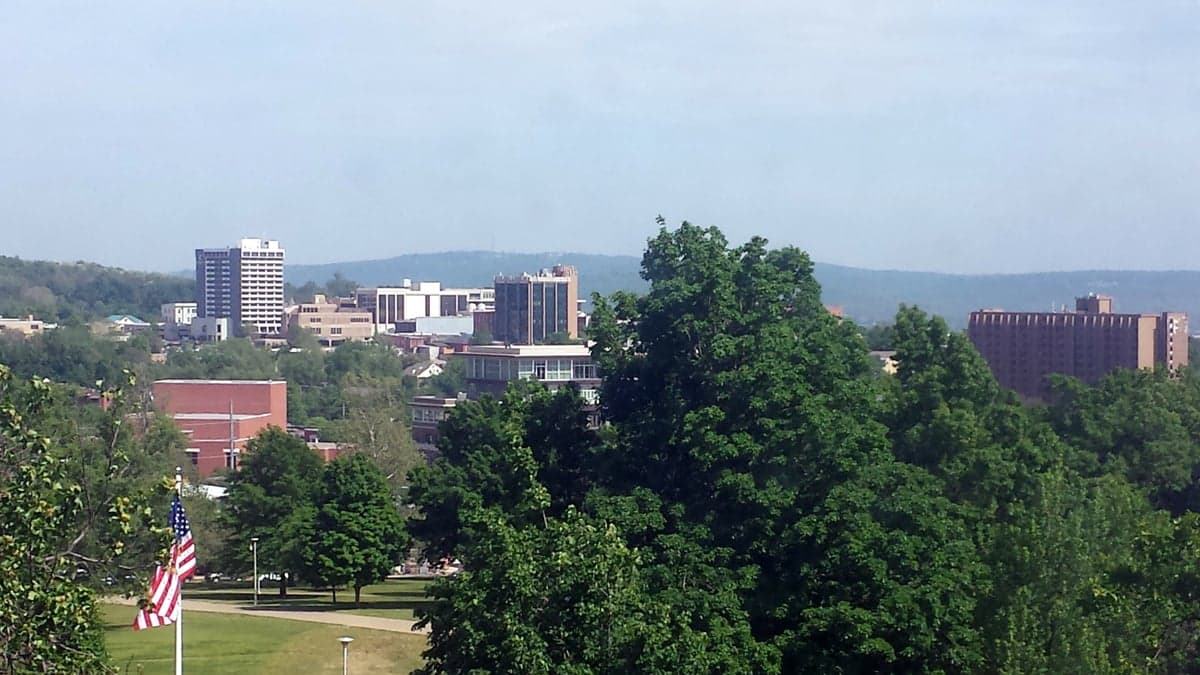
Photo: Wikipedia
Political ClimatePolitical Climate in Fayetteville, AR
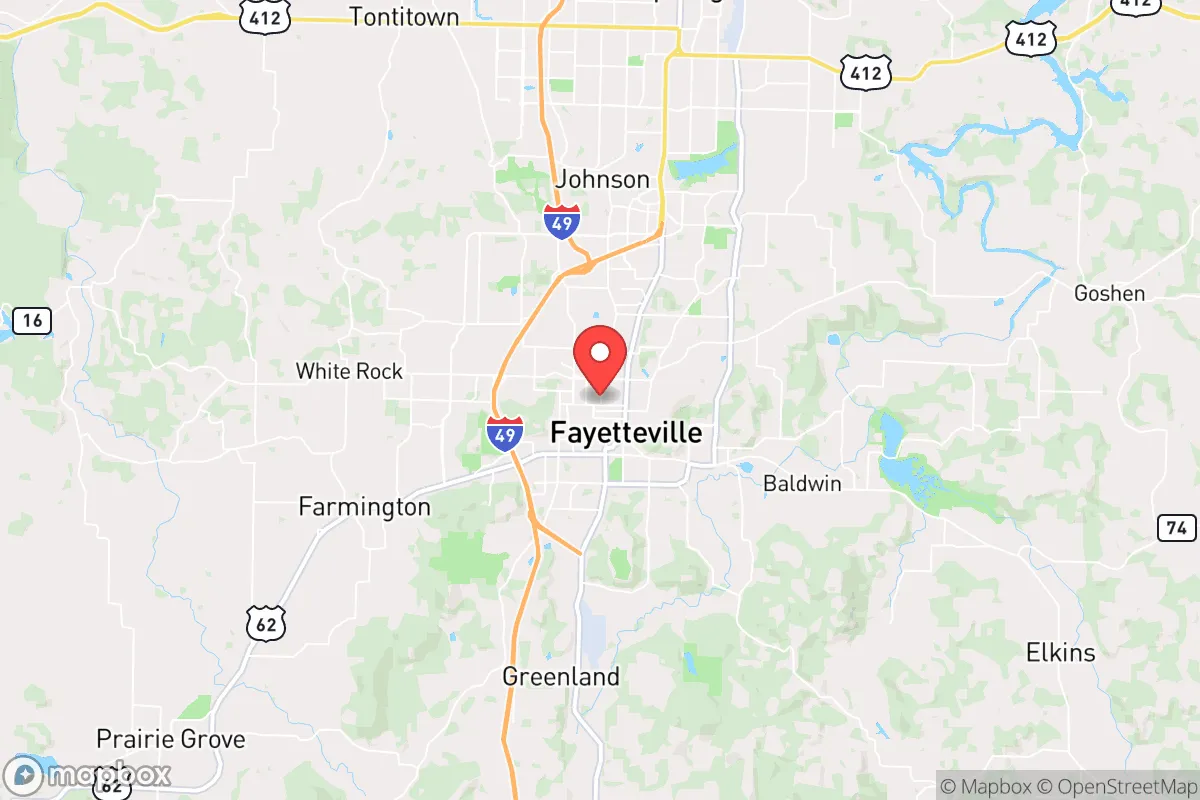
District shown is the primary district for this city’s centroid. Cities may span multiple districts.
Local Political AnalysisPolitical Analysis of Fayetteville, AR
Fayetteville, Arkansas, sits in a bit of a political bubble compared to the rest of the state. While the city itself has shifted noticeably leftward in recent years, the surrounding region—and the state as a whole—remains deeply conservative. The Cook PVI for Arkansas’s 3rd Congressional District, which includes Fayetteville, is R+13, meaning the area is still reliably Republican at the federal level, but that number masks a growing urban-rural divide that’s become impossible to ignore. If you’ve lived here as long as I have, you’ve watched the old guard slowly get pushed aside by a wave of newcomers who see things very differently.
How it compares
Drive just 20 minutes south to Springdale or 30 minutes east to Huntsville, and you’ll feel the political temperature drop. Those towns vote solidly red, with little of the progressive energy you find in Fayetteville’s core. Even Rogers and Bentonville, though growing fast, still lean more conservative than Fayetteville. The contrast is stark: Fayetteville’s city council has pushed policies like a non-discrimination ordinance and a plastic bag ban, while neighboring towns have largely resisted such measures. At the county level, Washington County still votes Republican, but Fayetteville’s precincts often break for Democrats. It’s a classic story of a college town—home to the University of Arkansas—becoming a liberal island in a red sea.
What this means for residents
For those of us who value limited government and personal freedoms, the trend here is concerning. The city’s recent moves—like expanding the police oversight board and pushing for more affordable housing mandates—feel like creeping government overreach into decisions that used to be left to individuals and neighborhoods. Property taxes have crept up to fund new public projects, and some residents worry that the next step will be zoning restrictions that tell you what you can do with your own land. The local school board has also seen heated debates over curriculum and library books, with progressive members pushing for changes that many parents see as unnecessary interference. If you’re a conservative who values keeping government out of your life, you’ll find Fayetteville’s direction unsettling, even if the county as a whole still offers a buffer.
Culturally, Fayetteville still holds onto some of its old charm—the farmers’ market, the outdoor concerts, the neighborly feel—but the political undercurrent has shifted. You’ll see more yard signs for progressive candidates than you did a decade ago, and conversations at the coffee shop can get tense if you bring up taxes or school policies. Longtime residents like me remember when the biggest local debates were about road improvements and park maintenance, not social issues. Looking ahead, I expect the divide to widen as more out-of-state transplants arrive, drawn by jobs at Walmart, Tyson, and JB Hunt. If you’re considering a move here, just know that Fayetteville’s politics are no longer the quiet, live-and-let-live kind they used to be. The city is changing, and not everyone is happy about it.

State Political ClimatePolitical Climate in Arkansas
State Political AnalysisPolitical Environment in the State
Arkansas has long been a reliably red state, but its conservatism is of a distinct, populist strain—less about libertarian small-government purity and more about cultural traditionalism and a deep skepticism of federal overreach. The state hasn’t voted for a Democratic presidential candidate since Bill Clinton’s 1996 re-election, and the GOP now holds every statewide office and supermajorities in both legislative chambers. Over the past 20 years, the shift has been dramatic: as recently as 2008, Democrats still controlled the legislature and held the governorship. The realignment accelerated after 2010, driven by the nationalization of politics and the exodus of culturally conservative rural voters from the Democratic Party. Today, Arkansas is one of the most solidly Republican states in the country, but the flavor of that conservatism is distinct—more “don’t tread on me” than “country club,” with a strong streak of evangelical social conservatism and a growing libertarian undercurrent.
Urban vs. rural divide
The political map of Arkansas is a textbook case of the urban-rural chasm. The state’s two major metros—Little Rock (Pulaski County) and Fayetteville (Washington County)—are the only real blue dots on an otherwise crimson landscape. Pulaski County has voted Democratic in every presidential election since 2004, driven by the city’s more diverse and college-educated population. Washington County, home to the University of Arkansas, flipped blue in 2020 and 2024, reflecting the national trend of college towns moving left. But outside these two islands, the state is deeply red. Benton County (Bentonville, Rogers) is a fascinating exception: it’s the headquarters of Walmart and a magnet for corporate transplants, yet it votes reliably Republican—though with a more moderate, business-friendly flavor than the rural counties. The real engine of the state’s GOP dominance is the Arkansas Delta and the Ozarks. Counties like Mississippi County (Blytheville) and Stone County (Mountain View) routinely deliver 70-80% Republican margins. The shift in the Delta is especially stark: these were once solidly Democratic, New Deal-aligned areas that have become some of the most Republican in the state as cultural issues overtook economic ones.
Policy environment
Arkansas’s policy environment is aggressively conservative, with a strong emphasis on tax cuts, deregulation, and cultural conservatism. The state has a flat income tax that was cut from 4.9% to 4.4% in 2023, with a goal of reaching 3.9% by 2027. The sales tax is 6.5% at the state level, but local add-ons can push it over 10% in some cities. Property taxes are relatively low, with no state-level property tax. On education, Arkansas passed a major school choice expansion in 2023—the LEARNS Act—which created universal Education Freedom Accounts (vouchers) for private school tuition, expanded charter schools, and banned “critical race theory” and “indoctrination” in classrooms. The state also enacted a near-total abortion ban in 2022 (trigger law) with no exceptions for rape or incest, and has some of the strictest voter ID laws in the country. Healthcare is a mixed bag: Arkansas expanded Medicaid under the “private option” model (using federal funds to buy private insurance), but the state has also imposed work requirements for able-bodied adults. The regulatory climate is business-friendly, with a right-to-work law and no state-level minimum wage above the federal $7.25 (though a 2024 ballot measure raised it to $11.00, passing with 58% support despite GOP opposition).
Trajectory & freedom
On the freedom front, Arkansas has been moving decisively in the direction of expanded personal liberty on most fronts—but with notable exceptions. The Arkansas Freedom of Information Act is one of the strongest in the country, though there have been recent attempts to weaken it. Gun rights are robust: Arkansas is a constitutional carry state (permitless carry for adults 18+ since 2021), and the legislature passed a “Second Amendment Sanctuary” law in 2021 prohibiting state enforcement of federal gun laws. Parental rights were strengthened with the 2023 LEARNS Act, which includes a “Parents’ Bill of Rights” guaranteeing access to curriculum and the right to opt children out of objectionable materials. Medical freedom is a mixed bag: the state banned COVID-19 vaccine mandates for state employees and contractors, but it also has one of the highest COVID vaccination rates in the South. The biggest red flag for liberty-minded newcomers is the state’s medical marijuana program, which is heavily restricted—only 33 qualifying conditions, no smokable flower initially (that was later allowed via lawsuit), and a limited number of dispensaries. There’s also a growing concern about eminent domain abuse for economic development projects, particularly in northwest Arkansas. On the whole, Arkansas is trending more free on most metrics, but the state’s paternalistic streak—especially on drug policy and alcohol sales (still dry in many counties)—remains a frustration for libertarians.
Civil unrest & political movements
Arkansas has seen relatively little civil unrest compared to other states, but there have been notable flashpoints. The 2020 Black Lives Matter protests in Little Rock were largely peaceful, though there were some instances of property damage and a controversial police response that led to lawsuits. The state’s political movements are dominated by the Arkansas Citizens for Liberty (a Tea Party-aligned group) and the Family Council (a socially conservative lobbying organization). On the left, the Arkansas Public Policy Panel and Indivisible Arkansas are active but have limited influence. Immigration politics are relatively quiet—Arkansas has a small foreign-born population (about 5%), and the state passed a law in 2023 requiring local law enforcement to cooperate with federal immigration authorities. There’s been no serious secession or nullification rhetoric, though the state did join the Texas-led lawsuit challenging the 2020 election results in four swing states. The most visible political flashpoint in recent years has been the library wars: in 2023, the legislature passed Act 372, which allows local governments to restrict “obscene” materials in public libraries and creates a process for citizens to challenge books. This has led to heated school board and library board meetings across the state, particularly in Bentonville and Fayetteville, where progressive and conservative parents clash over LGBTQ-themed books.
Projection
Over the next 5-10 years, Arkansas is likely to become more Republican and more culturally conservative, but with a growing libertarian wing that could create internal tensions. The biggest demographic shift is the explosive growth of northwest Arkansas—Benton and Washington counties are among the fastest-growing in the country, driven by the Walmart supply chain and the broader corporate migration from high-tax states. This influx is bringing in a mix of moderate Republicans and libertarian-leaning tech workers who are culturally conservative but economically skeptical of corporate welfare. The Delta, meanwhile, continues to lose population, which will further entrench GOP dominance. The biggest wild card is the Hispanic population, which grew 40% between 2010 and 2020, concentrated in northwest Arkansas. This community is culturally conservative on many issues (religion, family, abortion) but could shift the state’s politics if Democrats ever figure out how to turn out this vote. Expect continued tax cuts, further school choice expansion, and a push to legalize recreational marijuana (which failed in 2022 but will likely pass in the next few years). The biggest threat to freedom in the near term is the state’s growing reliance on sales taxes, which are regressive and could become a burden on lower-income residents as the state cuts income taxes.
Bottom line for a new resident: If you’re moving to Arkansas, you’re coming to a state that is deeply conservative but with a populist, anti-establishment edge. You’ll find low taxes, strong gun rights, and a government that mostly stays out of your business—except when it comes to social issues like abortion, marijuana, and library books. The culture is friendly and informal, but you’ll need to get used to the fact that your local school board meeting might be the most contentious political event in town. The state is trending more free on economic and gun issues, but less free on cultural and medical ones. If that trade-off works for you, Arkansas is a solid bet for the next decade.
* Values derived from national, state, county, city and local statistics and may differ in a specific area. Last updated: 2026-04-29T02:32:23.000Z
Narrative content on this page is AI-generated and may contain mistakes. Verify any details that matter before acting on them.
ReloMaps may earn a commission from affiliate links at no extra cost to you.

