Photo: Wikipedia
Demographics of Fayetteville, AR
Affluence Level in Fayetteville, AR
A middle-class area roughly in line with national averages across income, home values, education, and employment.
People of Fayetteville, AR
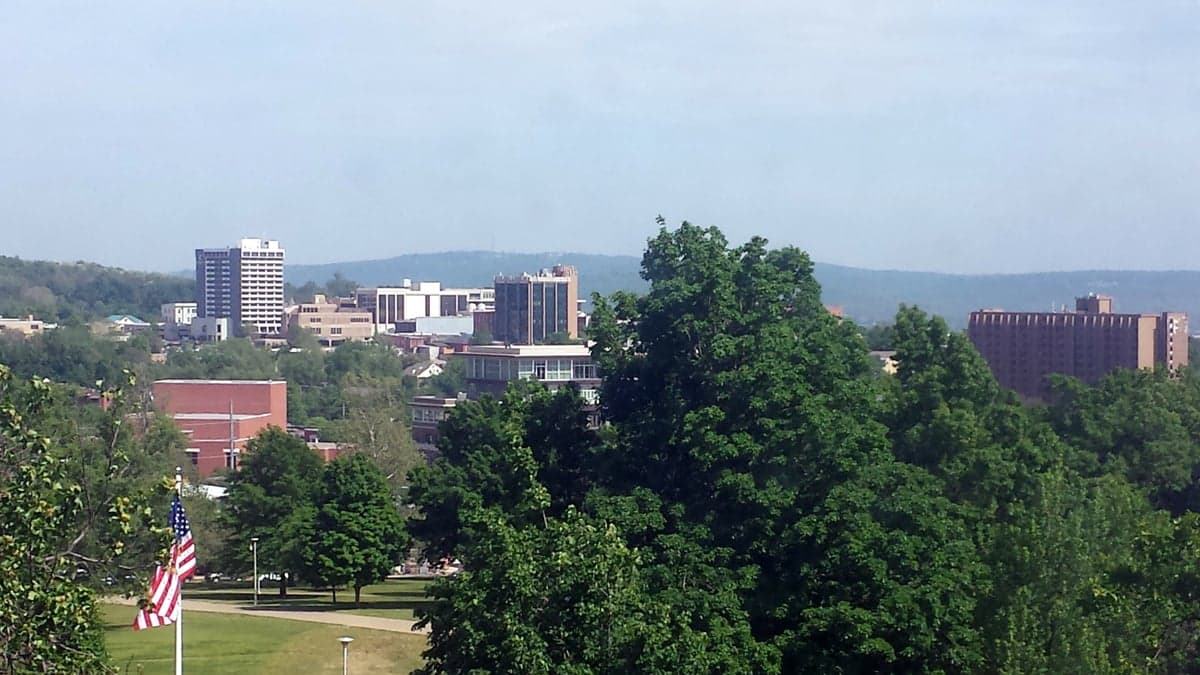
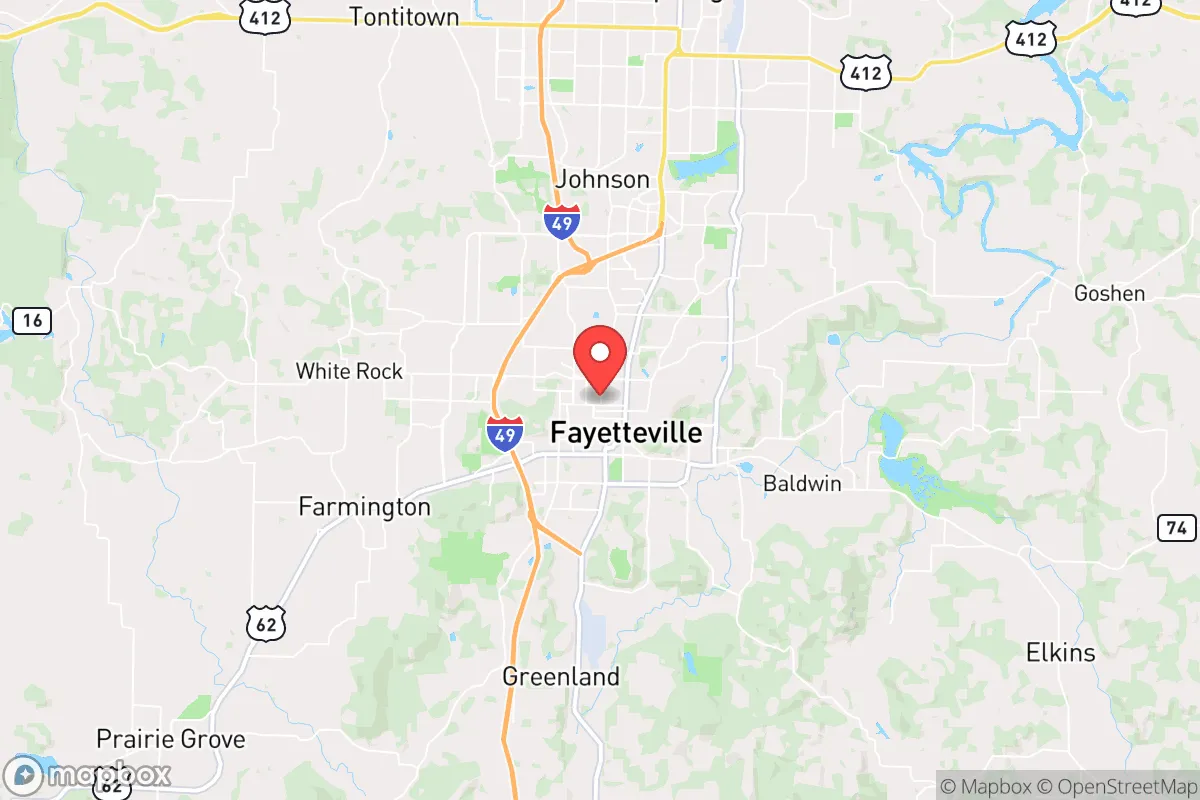
Fayetteville, Arkansas is a rapidly growing university city of 97,227 residents, defined by its youthful, highly educated population and a distinctive blend of Ozark roots and newcomer dynamism. With nearly half of adults holding a college degree (49.8%) and a foreign-born population of just 3.8%, the city is predominantly white (73.3%) but has seen modest diversification through its university and regional economic growth. The city’s identity is shaped by the tension between its historic Southern small-town character and the progressive, transient influence of the University of Arkansas, creating a politically moderate-to-liberal enclave within a conservative state.
How the city was settled and grew
Fayetteville was founded in 1828 as the seat of Washington County, drawing its earliest settlers from Tennessee, Kentucky, and the Upper South who were attracted by the fertile Ozark valleys and the promise of land under the 1820s federal land grants. These original families—many of Scots-Irish and English descent—established farms and small businesses, building the city’s first neighborhoods around the courthouse square in what is now the Downtown Historic District. The arrival of the St. Louis–San Francisco Railway in the 1880s triggered the first major growth wave, bringing merchants, railroad workers, and a small number of German and Irish immigrants who settled in the Washington-Willow Historic District, a late-19th-century streetcar suburb of Victorian homes. The founding of the University of Arkansas in 1871 as a land-grant institution created a second, enduring population stream: faculty, administrators, and students from across the South and Midwest, who concentrated in the University Heights and Mount Sequoyah neighborhoods near campus. By 1950, Fayetteville’s population had reached roughly 17,000, remaining overwhelmingly white and native-born, with a small African American community centered around the South Fayetteville area near the historic Booker T. Washington School.
Modern era (post-1965)
The 1965 Hart-Cellar Act had a limited direct effect on Fayetteville, as the city’s foreign-born population remains low at 3.8%. Instead, the post-1965 era was defined by domestic in-migration driven by the expansion of the University of Arkansas and the rise of Walmart’s headquarters in neighboring Bentonville (30 miles north) in the 1970s and 1980s. This created a new wave of white-collar professionals, many from the Midwest and Northeast, who settled in planned subdivisions like Rupple Woods and Lake Fayetteville areas in the city’s western and northern corridors. The Hispanic population grew from near zero in 1970 to 7.7% today, driven by construction, poultry processing, and service jobs; these families concentrated in South Fayetteville and the Weddington Road corridor, where Spanish-language churches and tiendas emerged. The East/Southeast Asian community (2.2%) arrived primarily as university faculty, graduate students, and medical professionals, settling near campus in Wilson Park and Maple Hill neighborhoods. The Indian-subcontinent population (0.8%) followed a similar pattern, clustering in the College Avenue corridor near the university. The Black population (5.2%) has grown modestly since 2000, with new arrivals drawn to professional and service jobs, dispersing across the city rather than concentrating in a single historic district.
The future
Fayetteville’s population is projected to reach 110,000–120,000 by 2040, driven by continued university enrollment growth and the spillover of the Northwest Arkansas metro’s economic boom. The city is not homogenizing but rather tribalizing into distinct enclaves: the historic core and near-campus neighborhoods are becoming denser, younger, and more liberal, while the outer subdivisions (Rupple Woods, Lake Fayetteville) remain family-oriented, whiter, and more politically moderate. The Hispanic and Asian populations are growing slowly but steadily, likely reaching 10–12% and 4–5% respectively by 2040, though they remain small compared to peer Sun Belt cities. The foreign-born share is expected to rise only to 5–6%, as Fayetteville lacks the manufacturing or agricultural base that drives large-scale immigration in other Arkansas towns. The city is becoming more politically polarized between the progressive university core and the conservative suburban periphery, but overall remains a relatively homogeneous, highly educated, and economically secure community.
For a conservative-leaning individual or family considering relocation, Fayetteville offers a stable, safe, and growing environment with strong schools and a low crime rate, but it is not a culturally or politically conservative city—the university and newcomer influence tilt it left of the surrounding region. The population is becoming more educated, more affluent, and slightly more diverse, but the pace of change is gradual, and the city’s character remains firmly rooted in its white, native-born, college-town identity. New arrivals will find a community that values education, outdoor recreation, and civic engagement, but one where political and cultural differences are increasingly visible between neighborhoods.

* Values derived from national, state, county, city and local statistics and may differ in a specific area. Last updated: 2026-04-29T02:32:23.000Z
Narrative content on this page is AI-generated and may contain mistakes. Verify any details that matter before acting on them.
ReloMaps may earn a commission from affiliate links at no extra cost to you.

