Photo: Wikipedia
Demographics of Eunice, LA
Affluence Level in Eunice, LA
A low-income area with significant economic hardship. Household wealth and educational attainment are well below national averages.
People of Eunice, LA
The people of Eunice, Louisiana, today number 9,261, forming a community defined by its deep Cajun and Creole roots and a stark demographic split between a white majority (53.8%) and a substantial Black minority (37.2%). The city is notably homogeneous, with a foreign-born population of just 0.4% and negligible Hispanic (2.0%) and Asian (0.0%) communities. This is a place where family lineage and local Catholic parish identity matter more than newcomer influx, and where the population is slowly declining, reflecting broader rural Louisiana trends of out-migration among younger residents.
How the city was settled and grew
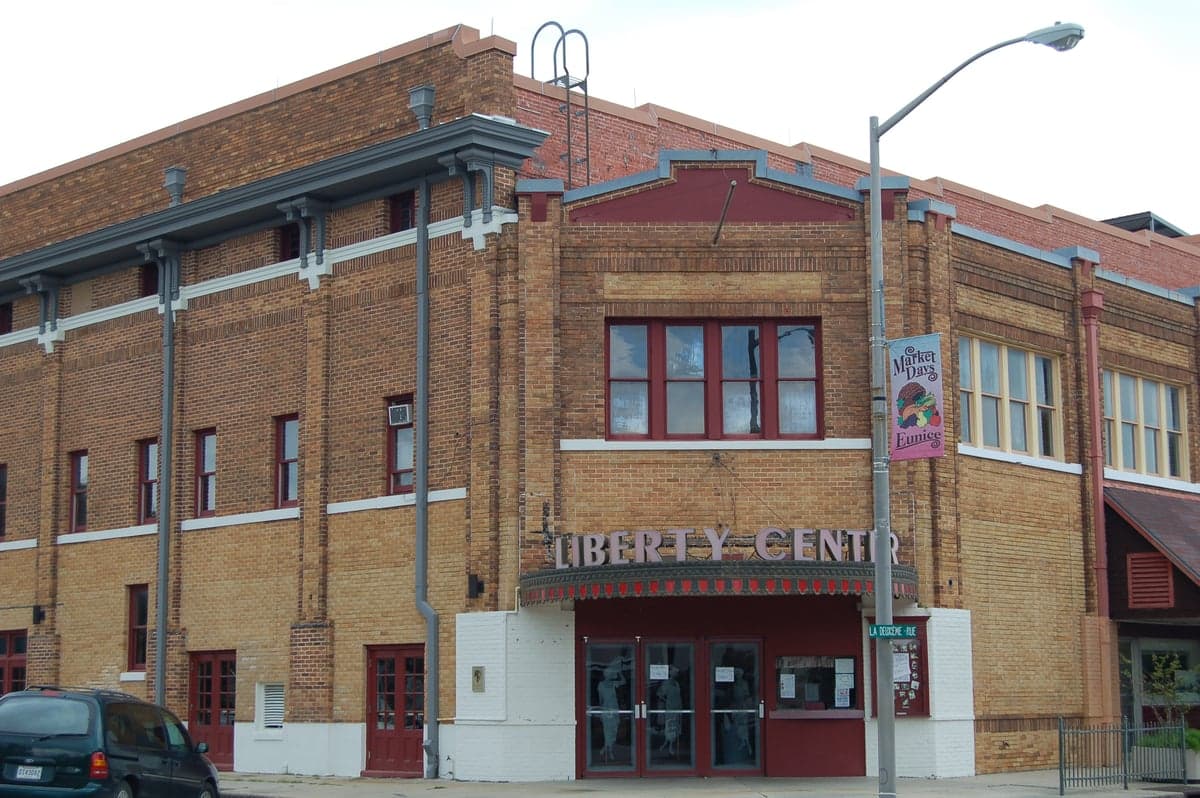
Eunice was founded in 1894 as a railroad town, carved out of prairie and piney woods in St. Landry Parish. The initial wave of settlers were French-speaking Acadians (Cajuns) who had been pushed westward from Nova Scotia in the 18th century and later migrated from other parts of south Louisiana. They were drawn by the promise of fertile land for cotton and rice farming, and by the new rail line that connected the area to markets in New Orleans and Houston. The original Cajun families built their homes in what is now Old Town Eunice, the historic core centered around Second Street and Park Avenue, where the iconic Liberty Theatre and Cajun music venues still anchor the cultural district. A second, smaller wave of Anglo-American farmers arrived in the early 1900s, settling along the northern edges of town near what became North Eunice, an area that remains predominantly white and rural in character. By the 1920s, the discovery of oil and gas in the surrounding Evangeline Parish fields brought a brief boom, but Eunice never industrialized heavily; its economy remained tied to agriculture, small-scale oil services, and the nearby Louisiana State University Eunice campus, founded in 1964.
Modern era (post-1965)
After the 1965 Hart-Cellar Act, Eunice saw virtually no new international immigration. The foreign-born share has remained below 1% for decades, and the city’s Asian and Indian populations are effectively zero. Instead, the major demographic shift since the 1970s has been internal: the gradual out-migration of young white and Black residents seeking jobs in Lafayette, Baton Rouge, or Houston. The Black population, which has held steady at roughly 37%, is concentrated in the Southside neighborhood, historically the area east of Martin Luther King Drive and south of Maple Street, where many families trace their roots to the sharecropping era. The white population, now a slim majority, is spread across West Eunice (west of the railroad tracks, near the high school) and the newer subdivisions like Acadian Village, a late-1990s development of ranch-style homes that attracted middle-class families. The city’s college-educated share is just 15.8%, well below the national average, reflecting the limited white-collar job base and the pull of larger metros for degree holders. The Catholic Church remains a central institution, with St. Anthony and St. Lawrence parishes serving as de facto community centers for white and Black congregants respectively, though worship is largely segregated.
The future
Eunice’s population is heading toward slow, steady decline, with projections suggesting a drop below 9,000 by 2035. The city is not homogenizing into a single identity; rather, it is tribalizing into distinct, stable enclaves. The white and Black neighborhoods remain geographically separate, with little residential mixing, and the near-zero immigration means no new ethnic groups are emerging to bridge the divide. The Hispanic share (2.0%) is growing slightly, driven by a handful of migrant farmworker families, but this group is too small to reshape the city’s character. The biggest demographic wildcard is the aging of the Cajun population: the median age is rising as young adults leave, and the city’s cultural institutions—like the Prairie Acadian Cultural Center and the annual Cajun Music Festival—may struggle to retain relevance with a shrinking tax base. For a newcomer, Eunice offers a deeply rooted, slow-paced community where family history and church affiliation determine social circles, but where economic opportunity is limited and the population is unlikely to grow.
For someone moving in now, Eunice is a place where you will be an outsider for years, not months. The city’s future is one of preservation rather than growth—a tight-knit, culturally rich Cajun and Creole community that is slowly aging in place. If you value deep local traditions, low crime, and a quiet life, it can be a rewarding home. If you seek diversity, career growth, or a dynamic social scene, you will likely find it stifling.

* Values derived from national, state, county, city and local statistics and may differ in a specific area. Last updated: 2026-05-01T08:40:52.000Z
Narrative content on this page is AI-generated and may contain mistakes. Verify any details that matter before acting on them.
ReloMaps may earn a commission from affiliate links at no extra cost to you.

