Photo: Wikipedia
Demographics of Ellensburg, WA
Affluence Level in Ellensburg, WA
A below-average socioeconomic profile. Incomes, home values, and educational attainment trail the U.S., with higher poverty and unemployment.
People of Ellensburg, WA
The people of Ellensburg, Washington, today number 18,913, forming a community that is predominantly white (75.1%) with a significant Hispanic minority (13.1%) and small but growing East/Southeast Asian (2.4%) and Indian (0.7%) populations. The city is notably well-educated, with 41.3% of adults holding a college degree, a figure that reflects the influence of Central Washington University (CWU) on the local character. Ellensburg retains a distinctively Western, agricultural-rooted identity, balanced by a steady influx of students, faculty, and remote workers drawn to its historic downtown and access to outdoor recreation.
How the city was settled and grew
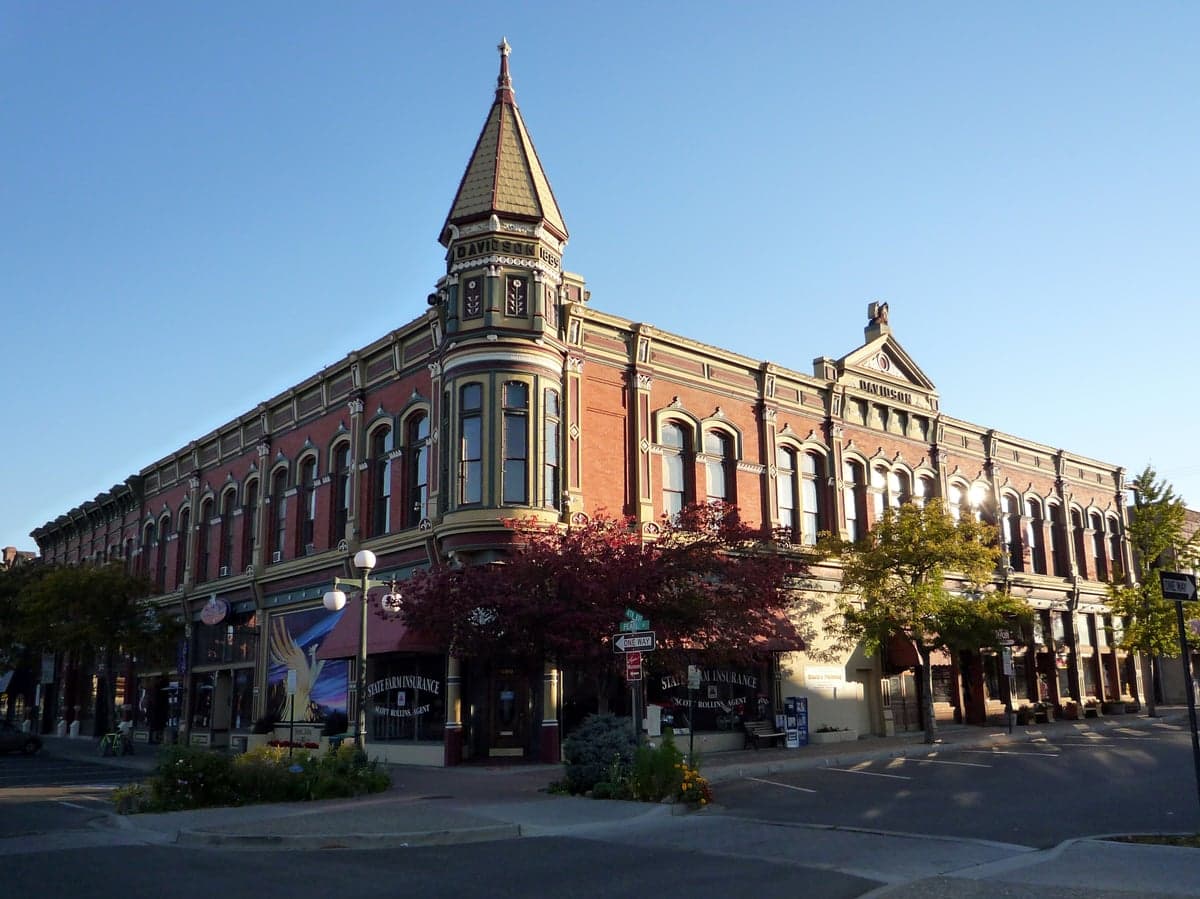
Ellensburg's original population was drawn by the promise of fertile land and the Northern Pacific Railroad, which arrived in 1886. The city was officially incorporated in 1883, but its growth exploded after the railroad established a depot, transforming a small trading post into a regional agricultural hub. The first major wave of settlers were white homesteaders of Northern European descent—primarily German, Irish, and Scandinavian—who established wheat and cattle ranches. These families built the core of what is now the Historic Downtown District, constructing brick commercial blocks and Victorian homes along Fourth and Fifth Avenues. A second wave arrived in the early 1900s, when the Washington State Normal School (now CWU) opened in 1891, drawing educators and their families to the University District, the area immediately surrounding campus. By the mid-20th century, Ellensburg remained overwhelmingly white and rural, with a small Japanese American community that was largely displaced by wartime internment. The city's population hovered around 8,000 through the 1950s, anchored by agriculture and the college.
Modern era (post-1965)
After the 1965 Hart-Cellar Act, Ellensburg saw modest diversification. The most notable shift has been the growth of the Hispanic population, which rose from under 5% in 1990 to 13.1% today. This wave was driven by agricultural labor—primarily in the region's hay, cattle, and dairy operations—and by service-sector jobs tied to CWU. Hispanic families have concentrated in the South Ellensburg area, particularly around the neighborhoods near Ahtanum Road and the Kittitas Valley Event Center, where more affordable housing and proximity to farm work exist. The East/Southeast Asian population (2.4%) is largely tied to CWU, with many faculty and graduate students settling in the University District and the newer Mountain View subdivision east of campus. The Indian subcontinent population (0.7%) is also university-linked, with families renting or buying in the same areas. The Black population remains small at 1.8%, concentrated in the West Ellensburg neighborhoods near the hospital and industrial zones. Domestic in-migration since 2000 has been steady, with retirees and remote workers from the Seattle area buying homes in the Historic Downtown District and the North Ellensburg area, drawn by lower housing costs and a slower pace of life.
The future
Ellensburg's population is projected to grow modestly, likely reaching 22,000–24,000 by 2040, driven by CWU enrollment stability and continued domestic migration from the Puget Sound region. The Hispanic share is expected to rise gradually, possibly to 18–20%, as younger families settle in South Ellensburg and the Kittitas Valley outskirts. The East/Southeast Asian and Indian populations will likely grow slowly, remaining tied to the university. The white share will decline proportionally but remain the large majority. The city's cultural identity is evolving from a purely agricultural and college town into a more diverse, amenity-oriented community, though it remains politically moderate to conservative compared to western Washington. For a newcomer, Ellensburg offers a stable, safe environment with a strong sense of place, but the social fabric is still shaped by its rural roots and the university's influence—meaning it is welcoming but not rapidly transforming.
Bottom-line: Ellensburg is becoming a slightly more diverse, college-anchored town where agricultural heritage and new arrivals coexist. For someone moving in now, the city offers a tight-knit, educated community with a conservative-leaning character, affordable housing relative to the coast, and a population that is slowly broadening without losing its core identity. The key neighborhoods to watch are South Ellensburg for Hispanic growth, the University District for Asian and Indian families, and the Historic Downtown for incoming remote workers and retirees.

* Values derived from national, state, county, city and local statistics and may differ in a specific area. Last updated: 2026-08-15T00:45:23.000Z
Narrative content on this page is AI-generated and may contain mistakes. Verify any details that matter before acting on them.
ReloMaps may earn a commission from affiliate links at no extra cost to you.

