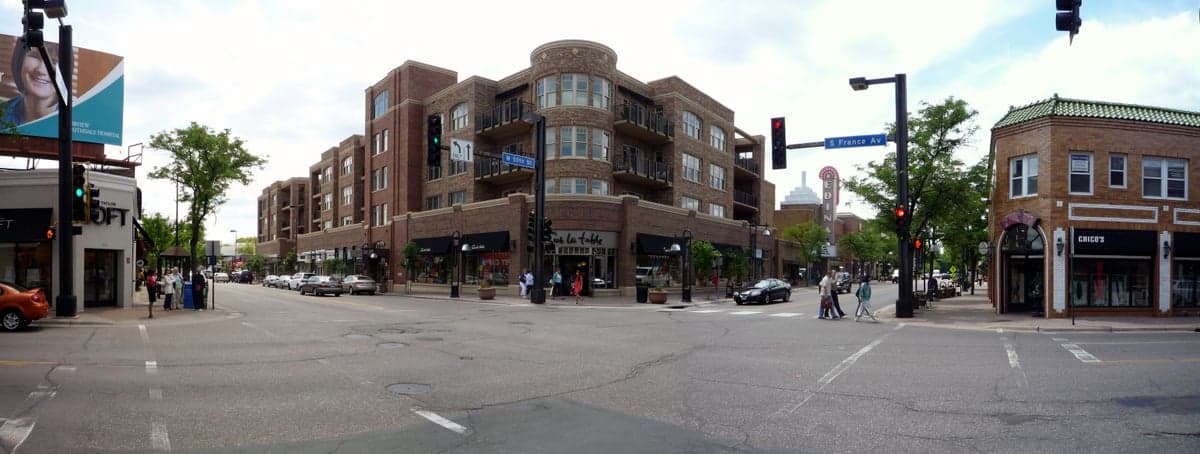
Photo: Wikipedia
Demographics of Edina, MN
Affluence Level in Edina, MN
An upper-middle-class area. Household wealth, education levels, and homeownership run ahead of national benchmarks.
People of Edina, MN
The people of Edina, Minnesota, today number roughly 53,125, forming a highly educated, predominantly white suburb with a distinctive blend of old-money tradition and modern professional ambition. With 72.2% of adults holding a college degree and a foreign-born population of just 4.2%, Edina is among the most homogeneous and credential-heavy communities in the Twin Cities metro. Its residents are known for a quiet, civic-minded affluence, a strong local school system, and a reputation as a place where established families and upwardly mobile professionals coexist in carefully maintained neighborhoods.
How the city was settled and grew
Edina’s human history begins not with colonial settlement but with the 1850s arrival of Yankee farmers and European immigrants drawn by the fertile soil of the Minnesota River valley. The area was originally part of Richfield Township, but in 1888, residents voted to incorporate as the Village of Edina, named after a Scottish estate. The first major population wave came from Swedish and Norwegian immigrants who worked the land and later found jobs in the city’s early milling and railroad industries. These families settled primarily in the Morningside and Countryside neighborhoods, where modest frame houses and small farms dotted the landscape. A second wave arrived in the 1920s and 1930s, driven by the development of the Edina Country Club and the construction of the Southdale Center area, which attracted wealthier Protestant families from Minneapolis seeking larger lots and suburban tranquility. By 1950, Edina’s population had swelled to over 15,000, and the city’s identity as an affluent, white-collar enclave was firmly established.
Modern era (post-1965)
The post-1965 era brought modest demographic shifts, though Edina remained overwhelmingly white. The 1970s and 1980s saw an influx of Jewish families from Minneapolis, who settled in the Indian Hills and Yorkshire neighborhoods, contributing to the city’s reputation for religious diversity within a largely Christian context. The 1990s and 2000s introduced a small but growing East/Southeast Asian community, primarily of Chinese and Korean heritage, drawn by the Edina Public Schools reputation and professional opportunities in the Twin Cities. These families concentrated in the Southdale and Normandale areas, near the city’s commercial corridors. The Indian subcontinent community (2.4% of the population) arrived later, in the 2000s and 2010s, largely as tech and medical professionals, and settled in the Braemar and Highlands neighborhoods. The Hispanic (3.9%) and Black (2.6%) populations remain small, with no single neighborhood emerging as a concentrated enclave; instead, these groups are dispersed across the city, often in rental units near the Southdale area. The foreign-born share, at 4.2%, is notably low for a major metro suburb, reflecting Edina’s continued appeal to native-born professionals and its relatively high housing costs.
The future
Edina’s population is heading toward slow, incremental diversification rather than rapid change. The white share, currently 81.3%, is projected to decline gradually as the East/Southeast Asian and Indian communities grow through professional migration and family formation. The Hispanic and Black populations are expected to remain small, plateauing at current levels due to housing affordability constraints and the city’s limited rental stock. The city is not tribalizing into distinct ethnic enclaves; instead, the trend is toward assimilation, with second-generation Asian and Indian children attending Edina schools and integrating into the city’s civic life. The biggest demographic shift may be generational: as older, long-time residents age in place, younger families—often dual-income professionals—are buying homes in neighborhoods like Morningside and Countryside, gradually lowering the median age. The next 10-20 years will likely see Edina remain a predominantly white, highly educated suburb, but with a more visible Asian and Indian professional class, and a slightly more diverse school-age population.
For someone moving in now, Edina is becoming a place where tradition and professional ambition coexist, but where demographic change is measured and incremental. It is not a melting pot in the classic sense, but a stable, affluent community where new arrivals—particularly from East/Southeast Asia and India—are quietly integrating into an established, predominantly white social fabric. The city’s future is one of slow diversification within a framework of enduring homogeneity, making it a predictable, low-risk choice for families and professionals seeking a high-quality suburban life.

* Values derived from national, state, county, city and local statistics and may differ in a specific area. Last updated: 2026-04-24T06:44:24.000Z
Narrative content on this page is AI-generated and may contain mistakes. Verify any details that matter before acting on them.
ReloMaps may earn a commission from affiliate links at no extra cost to you.

