
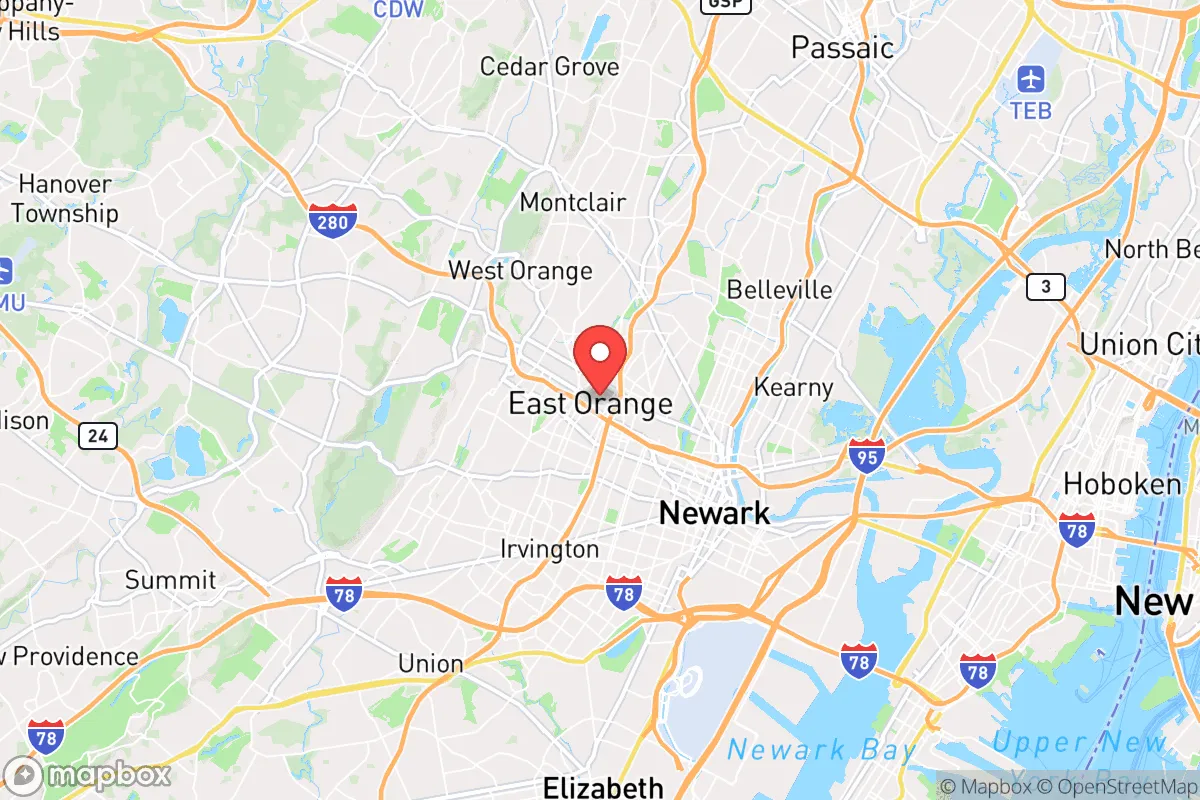
Photo: Wikipedia
Personal Sovereignty in East Orange, NJ
Viable for self-reliance. Generally workable, though some barriers may limit total independence.
What does Personal Sovereignty tell us?
Personal Sovereignty measures your capacity for self-reliance and independence with minimal government friction. Higher scores mean fewer barriers between you and the way you want to live... but it assumes you have the space you need and good neighbors.
What does this tell us?
Personal Sovereignty measures your capacity for self-reliance and independence with minimal government friction. Higher scores mean fewer barriers between you and the way you want to live... but it assumes you have the space you need and good neighbors.
State Policy
Energy independence: Importer (8% of energy produced in-state)
Personal Liberty
Homesteading

Personal Liberty Analysis
East Orange, New Jersey, presents a challenging environment for personal sovereignty, particularly for those with a survivalist or prepper mindset who prioritize autonomy from government overreach. As a densely urbanized city of roughly 70,000 residents within Essex County, it operates under some of the most restrictive state-level laws in the nation regarding self-defense, taxation, and personal liberties. For a conservative-leaning individual or family evaluating relocation, East Orange offers limited room for self-reliance, with high taxes, stringent gun control, and zoning that effectively prohibits homesteading or off-grid living. The city’s proximity to New York City (just 15 miles away) means it is deeply integrated into a regional political and regulatory apparatus that consistently prioritizes collective mandates over individual rights, making it a low-sovereignty option compared to rural or red-state alternatives.
Tax burden and regulatory posture: what it costs to live under state control
New Jersey’s tax burden is the highest in the nation, and East Orange residents feel this acutely. The state’s income tax rates range from 1.4% to 10.75%, with the top bracket hitting earners above $1 million—a threshold that affects few here but signals the state’s aggressive revenue collection. Property taxes in East Orange average around 2.3% of assessed home value, one of the highest effective rates in the country, meaning a $300,000 home carries roughly $6,900 in annual property taxes. For a prepper focused on financial independence, this is a permanent drain on resources that could otherwise fund supplies, land, or equipment. The regulatory environment is equally dense: New Jersey imposes strict environmental codes, building permits, and business licensing that make even minor home improvements or side hustles a bureaucratic ordeal. The state’s Corporate Business Tax rate of 9% (plus a 2.5% surtax on income over $1 million) discourages entrepreneurship, and local zoning in East Orange is heavily restrictive—no backyard chicken coops, no sheds over a certain size without permits, and no unlicensed home-based businesses. For anyone seeking to minimize government entanglement, this is a high-friction environment where every aspect of daily life is subject to oversight and fees.
Self-defense and gun law specifics: navigating the strictest regime in the region
New Jersey’s gun laws are among the most restrictive in the United States, and East Orange offers no local relief. The state requires a Firearms Purchaser Identification Card (FPID) for long guns and a separate permit for each handgun purchase, with a 30-day waiting period between handgun purchases. Concealed carry is effectively impossible for most residents: after the Supreme Court’s Bruen decision (2022), New Jersey shifted to a “shall-issue” system but still requires a “justifiable need” demonstration, extensive background checks, and a $200 application fee. In practice, approval rates remain low, and the state’s “sensitive places” law bans carry in parks, public transit, restaurants serving alcohol, and private property without explicit owner permission—covering virtually all of East Orange’s urban landscape. Magazine capacity is capped at 10 rounds, and “assault weapons” (defined broadly to include many common semi-automatic rifles) are banned outright. For a survivalist, this means self-defense options are severely limited: a home-defense shotgun or bolt-action rifle is feasible, but the legal hurdles for handguns and AR-platform rifles are prohibitive. The state also maintains a red flag law allowing temporary seizure of firearms without a criminal conviction, a tool that critics argue can be abused in domestic disputes or neighbor complaints. In East Orange, police response times in high-density areas can exceed 10 minutes, making personal defense a critical concern—yet the law actively restricts the tools to address it.
Self-reliance and homesteading viability: lot sizes, zoning, and off-grid feasibility
East Orange is a classic urban grid with average lot sizes under 5,000 square feet, mostly attached row houses or small single-family homes on narrow plots. Zoning is strictly residential-commercial, with no agricultural allowances. Raising livestock—even chickens—is prohibited within city limits, and community gardens require city permits and are limited to ornamental or vegetable plants. Off-grid living is a non-starter: the city mandates connection to municipal water, sewer, and electric grids, and solar panel installation requires permits and utility approval. Rainwater collection is technically allowed but limited to 50 gallons per property under state water rights laws, and composting is restricted to enclosed bins to avoid odor complaints. For a prepper seeking food security, the only realistic option is a small vegetable garden in a backyard or container gardening on a balcony, but even that is vulnerable to theft or vandalism in a dense urban environment. The lack of vacant land within a 30-minute drive means any serious homesteading requires a second property in rural New Jersey or Pennsylvania, defeating the purpose of living in East Orange. The city’s population density of over 11,000 people per square mile also means noise, light, and air pollution are constant, making any attempt at self-reliance feel like a battle against the environment itself.
Personal liberties: parental rights, medical autonomy, speech, and property
New Jersey is a blue state that has consistently expanded government authority over personal decisions, and East Orange reflects this. Parental rights are limited: the state mandates comprehensive sex education in public schools (including LGBTQ+ content) with no opt-out for parents, and vaccine requirements for school attendance are strict, with no philosophical exemptions. Medical autonomy is similarly constrained—New Jersey has a mandatory COVID-19 vaccination policy for healthcare workers (still in effect as of 2026) and broad public health powers that allow the governor to declare emergencies and impose mandates without legislative approval. Medical marijuana is legal but heavily taxed and regulated, and home cultivation is limited to patients with a prescription (and only 6 plants). Free speech is protected under the First Amendment, but local ordinances in East Orange restrict “disorderly conduct” broadly, and the state’s hate crime laws can be applied to speech deemed threatening or harassing, creating a chilling effect for controversial political expression. Property rights are weak: the city has used eminent domain for redevelopment projects, and zoning laws give the planning board broad discretion to deny permits for fences, sheds, or modifications that don’t fit the “character” of the neighborhood. For a conservative concerned about government overreach, East Orange offers little buffer against state-level mandates on health, education, and property use.
Overall, East Orange ranks very low on the personal sovereignty scale compared to other areas in the region or nation. For a survivalist or prepper, the combination of high taxes, restrictive gun laws, zero homesteading potential, and limited parental or medical autonomy makes it a location to avoid unless specific job or family ties force the move. Even within New Jersey, rural counties like Sussex or Warren offer more land, lower taxes, and slightly less restrictive gun laws (though still state-level constraints). For those prioritizing self-reliance, East Orange is a strategic dead end—a place where the state’s reach is long, the individual’s options are narrow, and the cost of living under that control is both financial and personal.

* Values derived from national, state, county, city and local statistics and may differ in a specific area. Last updated: 2026-10-10T16:27:20.000Z
Narrative content on this page is AI-generated and may contain mistakes. Verify any details that matter before acting on them.
ReloMaps may earn a commission from affiliate links at no extra cost to you.

