Demographics of DeSoto, TX
Affluence Level in DeSoto, TX
A middle-class area roughly in line with national averages across income, home values, education, and employment.
People of DeSoto, TX
DeSoto, Texas, is a majority-Black, middle-class suburb of Dallas with a population of 55,896, known for its strong sense of community, well-kept neighborhoods, and a notably high homeownership rate. The city is characterized by a distinctive blend of established Black professional families, a growing Hispanic population now at 19.2%, and a small White population of 8.1%. Its identity is rooted in a history of intentional community-building by African American families seeking quality suburban life, a legacy that continues to shape its civic culture and residential patterns today.
How the city was settled and grew
DeSoto was not a plantation-era settlement or a railroad town. It was incorporated in 1949 as a small, predominantly White farming community, but its modern character was forged in the 1960s and 1970s. The original population was drawn by inexpensive land and the post-World War II suburban boom radiating from Dallas. The first significant wave of African American residents arrived in the 1960s and 1970s, fleeing redlined neighborhoods in southern Dallas and seeking newer, larger homes with better schools. These early Black homebuyers concentrated in the North Hampton and Glenn Oaks neighborhoods, which became the foundation of DeSoto’s Black middle-class identity. The city’s population grew from roughly 2,000 in 1960 to over 15,000 by 1980, driven almost entirely by this domestic migration.
Modern era (post-1965)
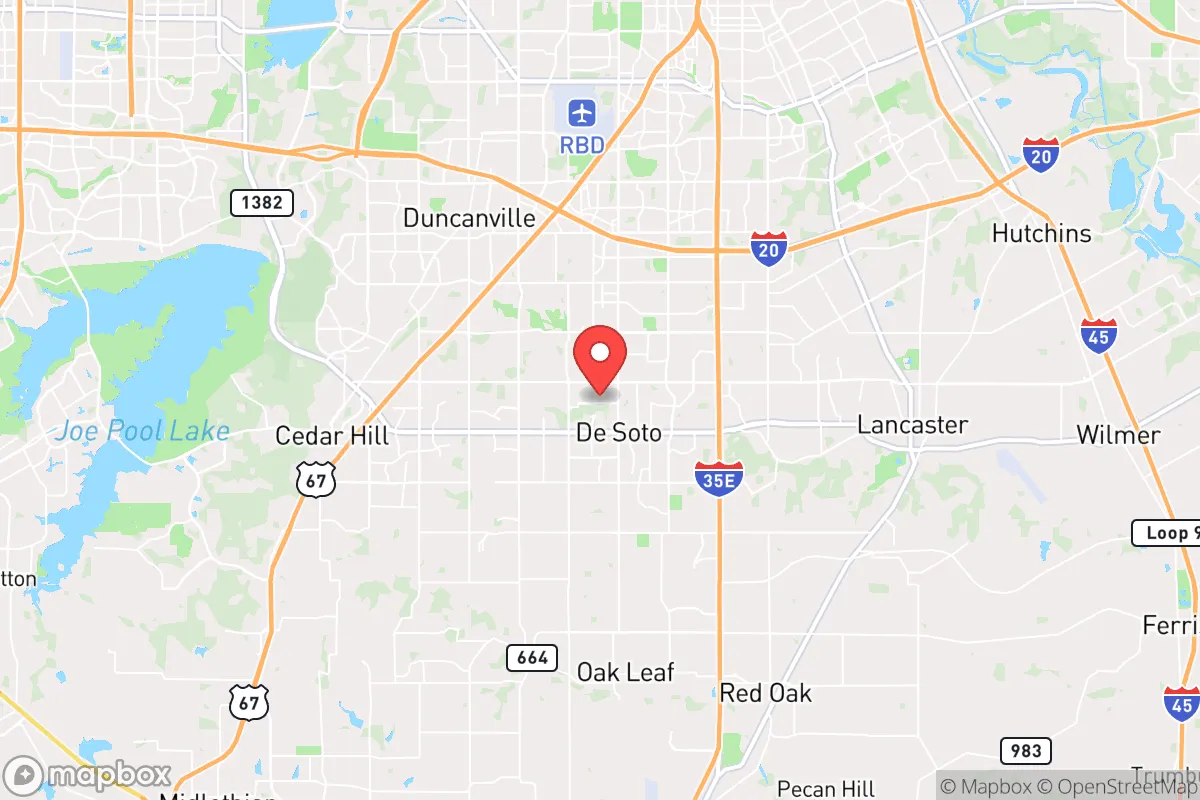
The post-1965 Immigration and Nationality Act had a minimal direct effect on DeSoto; the city’s foreign-born population remains low at just 4.6%. Instead, the major demographic shift was internal: sustained Black in-migration from Dallas and other parts of North Texas throughout the 1980s and 1990s. By 2000, DeSoto had become one of the most affluent majority-Black suburbs in the United States. Newer subdivisions like Eagle Ford Estates and Hampton Estates attracted Black professionals, including doctors, lawyers, and corporate managers. The Hispanic population began a steady increase after 2000, drawn by affordable housing and construction jobs in the broader Dallas-Fort Worth metroplex. These families have concentrated in the Westmoreland Heights area and along the eastern edge of the city near Interstate 35E. The White population, which was nearly 90% in 1970, has declined to 8.1% as older residents moved out and were not replaced by new White in-movers. East/Southeast Asian residents (0.4%) and Indian-subcontinent residents (0.2%) remain very small communities, with no single neighborhood concentration.
The future
DeSoto’s population is projected to become more diverse, but the direction of change is nuanced. The Black majority is slowly shrinking as a share of the total, while the Hispanic share is growing steadily, likely reaching 25-30% within a decade. This Hispanic growth is dispersing across the city rather than clustering in a single barrio, with new arrivals buying homes in established subdivisions like Briarwood and Park Trail. The White population is expected to remain stable or decline slightly, as DeSoto does not attract significant White in-migration from outside the region. The city’s cultural identity is evolving from a historically Black suburb into a Black-majority, multiethnic community. Younger Black families are still moving in, but they are increasingly competing with Hispanic buyers for the same affordable housing stock. The college-educated share (29.9%) is below the national average for suburbs, suggesting that DeSoto may be losing some of its most educated residents to higher-cost suburbs or to Dallas itself. The next 10-20 years will likely see a continuation of these trends: a slowly diversifying population, a stable but aging housing stock, and a civic identity that must balance its proud Black heritage with a growing Hispanic presence.
For someone moving in now, DeSoto offers a stable, family-oriented suburb with a strong Black institutional presence, affordable home prices relative to northern Dallas suburbs, and a population that is becoming more Hispanic and more economically diverse. It is not a gentrifying boomtown or a declining inner-ring suburb; it is a mature community navigating a gradual demographic transition while retaining its core identity as a place where Black homeownership and community life remain central.

* Values derived from national, state, county, city and local statistics and may differ in a specific area. Last updated: 2026-07-20T01:36:54.000Z
Narrative content on this page is AI-generated and may contain mistakes. Verify any details that matter before acting on them.
ReloMaps may earn a commission from affiliate links at no extra cost to you.

