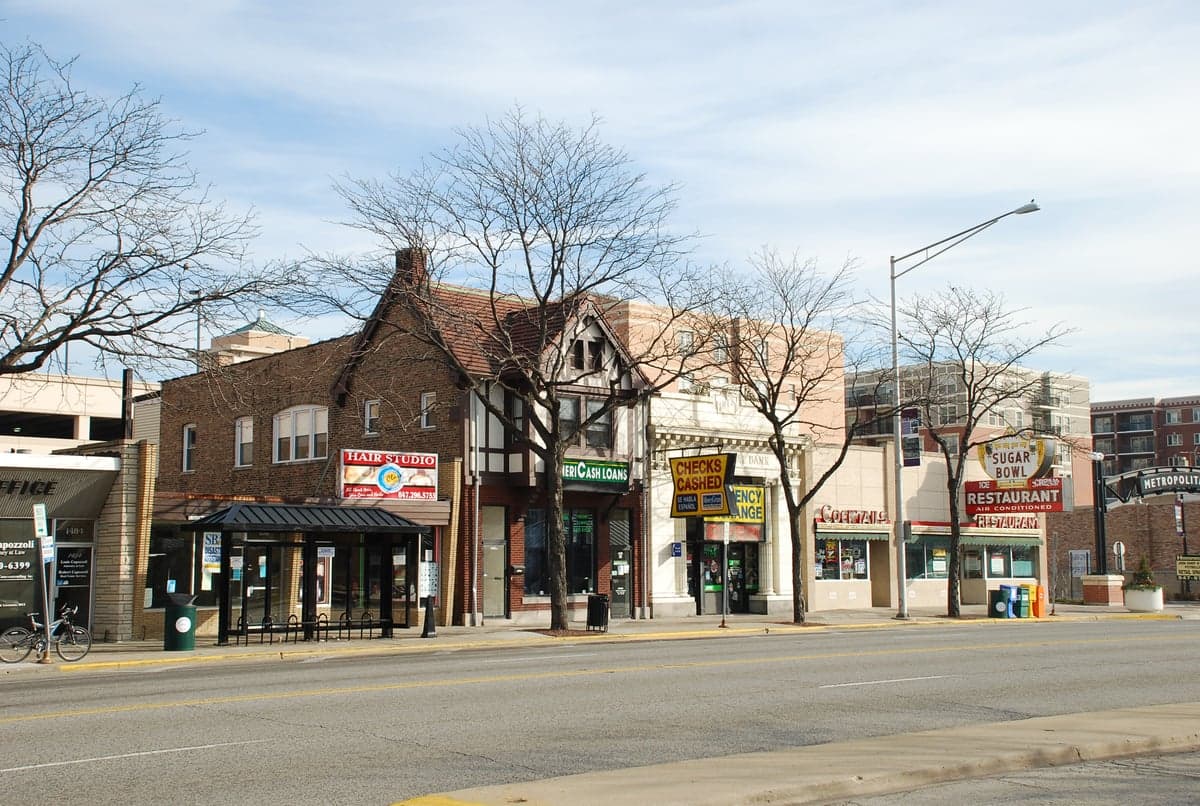
Photo: Wikipedia
Personal Sovereignty in Des Plaines, IL
Viable for self-reliance. Generally workable, though some barriers may limit total independence.
What does Personal Sovereignty tell us?
Personal Sovereignty measures your capacity for self-reliance and independence with minimal government friction. Higher scores mean fewer barriers between you and the way you want to live... but it assumes you have the space you need and good neighbors.
What does this tell us?
Personal Sovereignty measures your capacity for self-reliance and independence with minimal government friction. Higher scores mean fewer barriers between you and the way you want to live... but it assumes you have the space you need and good neighbors.
State Policy
Energy independence: Importer (45% of energy produced in-state)
Personal Liberty
Homesteading

Personal Liberty Analysis
Des Plaines, Illinois, presents a mixed picture for those prioritizing personal sovereignty. While the city offers a stable suburban environment with access to Chicago’s resources, its location in Cook County and the state of Illinois imposes significant constraints on individual autonomy, particularly in areas of taxation, self-defense, and medical freedom. For a survivalist or prepper mindset, the trade-offs between community stability and government overreach are sharp and require careful consideration before relocation.
Tax burden and regulatory climate in Cook County
Illinois ranks among the highest in the nation for combined state and local tax burden, and Des Plaines sits squarely in Cook County, which amplifies that pressure. The state’s flat income tax rate of 4.95% is compounded by Cook County’s sales tax of 10.25%—one of the highest in the country. Property taxes are the most punishing: the average effective property tax rate in Des Plaines hovers around 2.1% of assessed value, meaning a $300,000 home carries roughly $6,300 in annual property taxes. This is a direct drain on self-reliance capital. Regulatory posture is similarly heavy. Illinois mandates strict building codes, environmental regulations, and business licensing that can stifle small-scale entrepreneurial efforts—like running a home-based repair shop or selling preserved food. The state’s progressive income tax structure, though currently flat, remains a political vulnerability; voters rejected a graduated tax in 2020, but the issue resurfaces regularly. For anyone seeking to minimize government extraction, Des Plaines is a high-cost environment.
Self-defense rights and Illinois gun law specifics
Illinois is one of the most restrictive states for gun owners, and Des Plaines residents must navigate a dense web of regulations. The state requires a Firearm Owner’s Identification (FOID) card for possession of any firearm or ammunition—a process that involves background checks, fingerprinting, and a wait that can stretch months. Concealed carry requires a separate license, with a 16-hour training course and a $150 fee. Cook County adds its own layer: a county-wide ban on assault weapons and large-capacity magazines, though this is currently under legal challenge. Home defense is legally complicated; Illinois has no “castle doctrine” but does have a “stand your ground” provision, though it is weaker than in states like Texas or Florida. Magazine capacity is capped at 10 rounds for long guns and 15 for handguns under state law. For a prepper, building a robust home arsenal requires significant paperwork, cost, and patience. The political climate in Cook County is hostile to gun rights, and local law enforcement may not be sympathetic to defensive firearm ownership. If self-defense is a priority, Des Plaines is a challenging jurisdiction.
Self-reliance and homesteading viability in a suburban grid
Des Plaines is a dense suburb with typical lot sizes ranging from 5,000 to 10,000 square feet—enough for a garden but not for meaningful homesteading. Zoning codes are strict: keeping chickens is allowed with a permit and limits on numbers, but goats, pigs, or larger livestock are prohibited. Rainwater collection is legal but must comply with state plumbing codes, and any structure over 120 square feet requires a building permit. Off-grid living is effectively impossible; the city requires connection to municipal water and sewer, and solar panel installation must meet utility interconnection standards. The Cook County Department of Environment and Sustainability enforces composting and waste disposal rules that limit independent waste management. For a prepper seeking land for food production, water independence, or energy autonomy, Des Plaines is a poor fit. The best option is to look at exurban areas like McHenry or DeKalb counties, where lot sizes are larger and zoning is looser. Within Des Plaines, the focus should be on maximizing a small urban garden, building a deep pantry, and establishing community networks rather than land-based self-sufficiency.
Personal liberties: parental rights, medical autonomy, and property
Illinois has moved aggressively in recent years to centralize authority over personal decisions. Parental rights are under pressure: the state mandates comprehensive sex education in public schools, and parents cannot opt their children out of LGBTQ-inclusive curriculum. Medical autonomy is similarly constrained. Illinois has some of the most permissive vaccine mandates in the country, and during the COVID-19 pandemic, the state imposed broad mask and vaccine requirements that were enforced by local health departments. Des Plaines public schools followed state guidance, limiting parental choice. On medical freedom, Illinois is a “physician-assisted suicide” state, but it also has strict prescription drug monitoring and mandatory reporting laws that limit alternative treatments. Property rights are relatively strong for existing homeowners, but new construction faces extensive permitting and environmental review. The state’s “just compensation” standard for eminent domain is standard, but Cook County has used eminent domain for economic development projects in the past. Speech is protected under the First Amendment, but Illinois has a broad “hate speech” statute that can be used to prosecute online comments, and local ordinances in Des Plaines restrict noise and signage in ways that can limit political expression. For a conservative individual, the trend is toward reduced personal sovereignty in family and medical decisions.
Overall, Des Plaines offers a stable suburban base with good infrastructure and proximity to Chicago, but it comes with a heavy tax burden, restrictive gun laws, limited homesteading potential, and eroding personal liberties. Compared to areas in Indiana, Wisconsin, or downstate Illinois, Des Plaines ranks low on the sovereignty scale. For a survivalist or prepper, the city is best viewed as a temporary staging ground or a location for building financial resources before moving to a more freedom-friendly jurisdiction. If you must live here, focus on legal compliance, build deep community ties, and keep your options open for relocation when conditions change.

* Values derived from national, state, county, city and local statistics and may differ in a specific area. Last updated: 2026-04-23T09:59:48.000Z
Narrative content on this page is AI-generated and may contain mistakes. Verify any details that matter before acting on them.
ReloMaps may earn a commission from affiliate links at no extra cost to you.

