
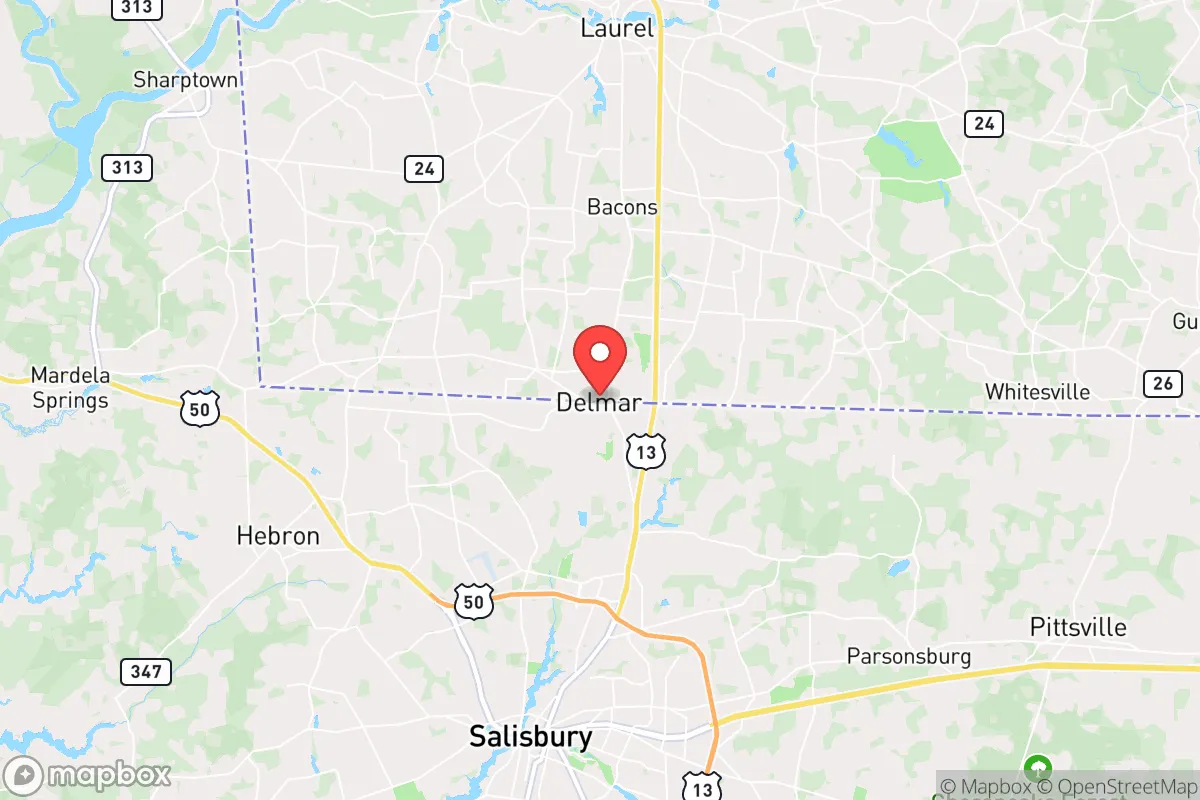
Photo: Wikipedia
Personal Sovereignty in Delmar, DE
Viable for self-reliance. Generally workable, though some barriers may limit total independence.
What does Personal Sovereignty tell us?
Personal Sovereignty measures your capacity for self-reliance and independence with minimal government friction. Higher scores mean fewer barriers between you and the way you want to live... but it assumes you have the space you need and good neighbors.
What does this tell us?
Personal Sovereignty measures your capacity for self-reliance and independence with minimal government friction. Higher scores mean fewer barriers between you and the way you want to live... but it assumes you have the space you need and good neighbors.
State Policy
Energy independence: Importer (2% of energy produced in-state)
Personal Liberty
Homesteading

Personal Liberty Analysis
Delmar, Delaware, offers a notably higher degree of personal sovereignty than many comparably sized towns in the Mid-Atlantic, largely because it sits at the intersection of a low-tax state and a community culture that still values self-reliance. While no location is immune from the creeping expansion of federal and state authority, Delmar’s position in Sussex County places it within a jurisdiction that has historically resisted heavy-handed mandates, from pandemic-era restrictions to zoning overreach. For the individual or family prioritizing autonomy—whether that means keeping more of what you earn, defending your home without bureaucratic hurdles, or living with minimal interference from code enforcement—Delmar represents a pragmatic choice in a region where such freedoms are increasingly constrained.
Tax burden and regulatory posture: how Delaware’s structure protects your wallet and choices
Delaware’s tax structure is a significant draw for those who view high taxation as a form of government overreach. The state has no sales tax, which means every dollar you earn stays in your pocket at the point of purchase—a direct benefit for preppers stockpiling supplies, tools, or bulk goods. Property taxes in Sussex County are among the lowest in the nation, with effective rates often below 0.5% of assessed value, and Delmar itself benefits from this county-level restraint. The state’s corporate-friendly laws, while primarily aimed at businesses, also create a regulatory environment that is less inclined to micromanage individual economic activity. However, be aware that Delaware does impose a progressive income tax with rates up to 6.6%, so high earners will see some leakage. On the regulatory front, Sussex County has historically maintained a light touch on land use compared to northern Delaware or neighboring Maryland. Building permits are required, but the process is generally straightforward, and there is no county-wide ban on accessory structures like sheds, greenhouses, or workshops—critical for anyone wanting to establish a self-sufficient homestead. The key regulatory risk to monitor is potential future expansion of state-level environmental mandates, but as of 2026, Delmar remains a low-friction zone for those who want to be left alone to manage their own property.
Self-defense and gun law specifics: what the Second Amendment looks like in Delmar
For the survivalist-minded, Delaware’s gun laws are a mixed bag, but Delmar’s location offers practical advantages. The state itself is a shall-issue jurisdiction for concealed carry, meaning that if you meet the basic requirements—background check, fingerprinting, and a training course—the state must issue your permit. There is no discretionary “may-issue” system that gives officials veto power over your right to carry. However, Delaware does have a state-level assault weapons ban (passed in 2022) and a magazine capacity limit of 17 rounds for long guns and 15 for handguns, which is a genuine restriction for those who view standard-capacity magazines as a basic tool of self-defense. The practical workaround for Delmar residents is proximity: the town sits less than a mile from the Maryland line, and a short drive into that state avoids the magazine ban entirely for storage or training purposes. Additionally, Delaware law explicitly allows the use of deadly force in defense of your home, vehicle, or workplace without a duty to retreat—a critical protection for anyone serious about home defense. Castle doctrine is codified in state statute, and there is no “red flag” law currently on the books in Delaware, though such legislation has been proposed. For the prepper, the bottom line is that while Delaware is not a constitutional carry state (permit required), and the magazine limit is an annoyance, the legal framework for self-defense in the home is solid, and the shall-issue system means you can carry without political interference.
Self-reliance and homesteading viability: lot sizes, zoning, and off-grid feasibility
Delmar’s zoning and land-use patterns are a strong match for the self-reliant lifestyle. The town itself is a mix of older residential lots (typically 0.25 to 0.5 acres) and newer subdivisions, but the real opportunity lies in the unincorporated areas of Sussex County just outside town limits. Here, zoning allows for residential lots as small as one acre with no HOA restrictions, and larger parcels of 5 to 20 acres are still affordable relative to the Northeast corridor. Raising chickens, keeping bees, and maintaining a substantial vegetable garden are all permitted without special permits in most agricultural-residential zones. The county does not prohibit rainwater collection, and well water is common in rural areas, meaning you can reduce dependency on municipal systems. Off-grid solar is legally feasible, though you will need to coordinate with the local electric cooperative (Delmarva Power) if you want to net-meter; going fully off-grid with battery storage is allowed but requires an electrical permit. The biggest regulatory hurdle for serious homesteaders is the county’s stance on livestock: pigs and cattle require a minimum of 5 acres, and slaughtering animals for personal consumption is allowed but must comply with state health guidelines. For the prepper focused on long-term sustainability, the key takeaway is that Delmar’s rural fringe offers the space and permissive zoning to build a resilient homestead without constant government oversight, something increasingly rare in the Mid-Atlantic.
Personal liberties: parental rights, medical autonomy, speech, and property
On the broader spectrum of personal liberties, Delmar benefits from Delaware’s relatively neutral stance on parental rights and medical autonomy, though the state is not a libertarian paradise. Delaware has no statewide vaccine mandate for children attending public school (religious and philosophical exemptions are allowed), which is a significant point for parents who want to retain medical decision-making authority. The state also does not have a “medical freedom” law that explicitly protects the right to refuse treatment, but in practice, adults can decline medical procedures without legal penalty. On the speech front, Delaware is a typical First Amendment jurisdiction—no notable prior restraint laws, and public protests are generally allowed with standard permitting. Property rights are where Delmar shines: the town and county have no rent control, no short-term rental bans (though Sussex County has some restrictions near the beach), and no forced inclusionary zoning that would compel property owners to accept government-mandated housing types. The biggest threat to property sovereignty in Delaware is the potential for future “climate action” plans that could impose energy-efficiency mandates on existing homes, but as of 2026, no such measures are in effect in Sussex County. For the conservative individual, the combination of parental opt-out rights in education, no forced medical mandates, and strong property protections makes Delmar a defensible outpost for personal autonomy.
In the broader context of the Mid-Atlantic, Delmar stands out as a pocket of relative sovereignty in a region trending toward centralization. Compared to neighboring Maryland, where gun laws are more restrictive, taxes are higher, and county-level zoning is more intrusive, Delmar offers a tangible buffer against government overreach. It is not a free state in the Western sense—you still pay income tax, need a permit to carry, and must navigate some building codes—but for the survivalist or prepper who needs to remain within commuting distance of employment or family on the East Coast, Delmar provides a realistic balance of affordability, legal self-defense, and the space to build a self-reliant life without constant interference. The key is to act before the regulatory creep that has already consumed northern Delaware reaches Sussex County; for now, the town remains a stronghold for those who value personal sovereignty above convenience.

* Values derived from national, state, county, city and local statistics and may differ in a specific area. Last updated: 2026-10-10T16:27:15.000Z
Narrative content on this page is AI-generated and may contain mistakes. Verify any details that matter before acting on them.
ReloMaps may earn a commission from affiliate links at no extra cost to you.

