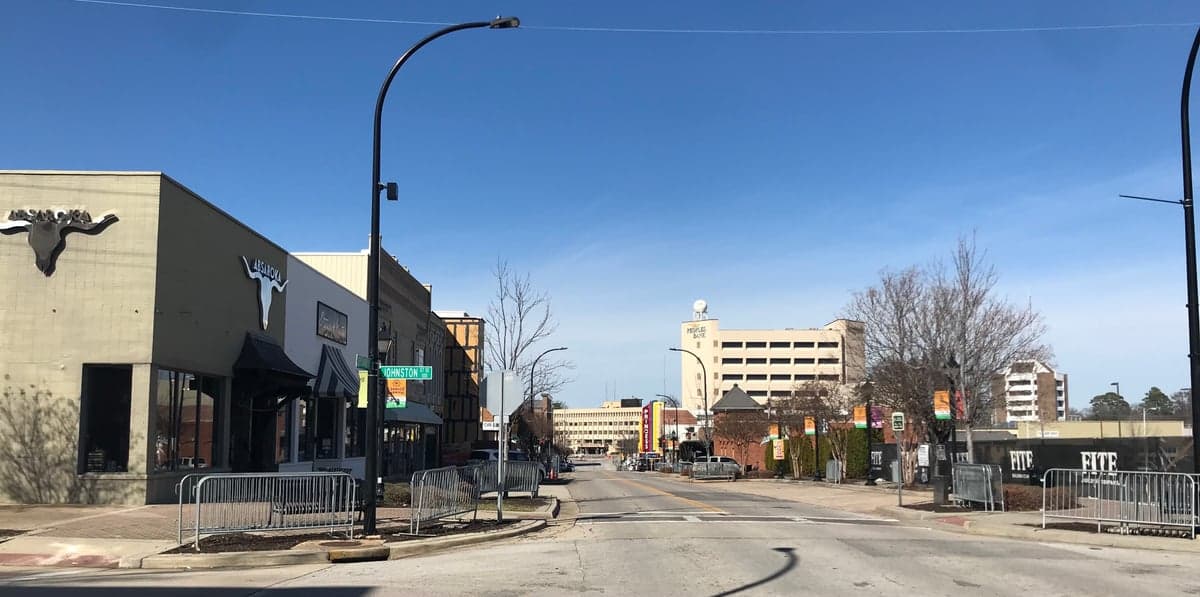
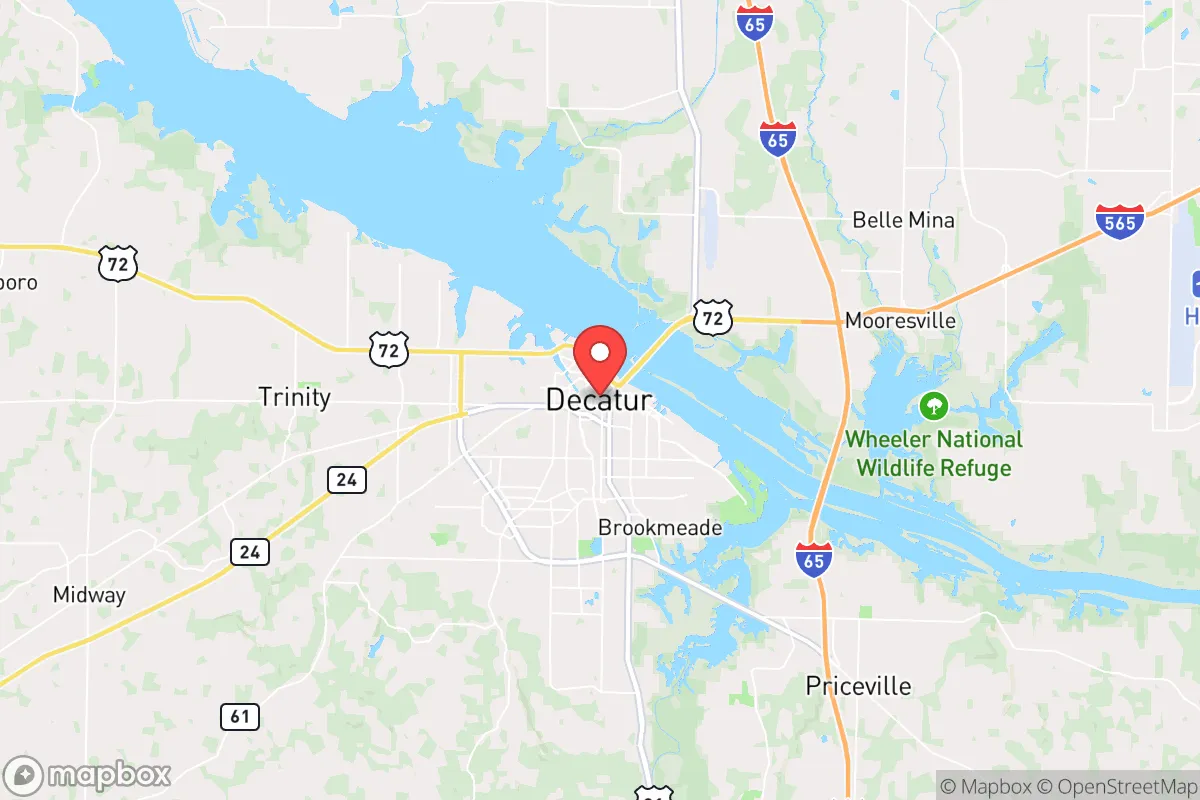
Photo: Wikipedia
Strategic Assessment of Decatur, AL
Workable tactical position. Some exposure to population density or targets, but generally defensible in a crisis.
What does the Strategic Assessment tell us?
Our Strategic Assessment grades tactical survivability of an area. Major population centers, military targets, fallout zones, natural disasters, and border exposure all drive risk — lower exposure means a more defensible position in a crisis.
This is heavily inspired by Joel Skousen's Strategic Relocation book. Highly recommended you checkout the book ($)What does this tell us?
Our Strategic Assessment grades tactical survivability of an area. Major population centers, military targets, fallout zones, natural disasters, and border exposure all drive risk — lower exposure means a more defensible position in a crisis.
This is heavily inspired by Joel Skousen's Strategic Relocation book. Highly recommended you checkout the book ($)Strategic Pillars

Key Distances
Regional Safe Places
Below is our recommended "safe zones" in Alabama and the surrounding area based on our strategic heuristics. For most people, it's unrealistic to live in a “safe zone” full-time due to work, family or other personal reasons. They tend to be more rural. However, many of these areas are perfect for second homes and retreat properties that double as a vacation home or even a short-term rental.
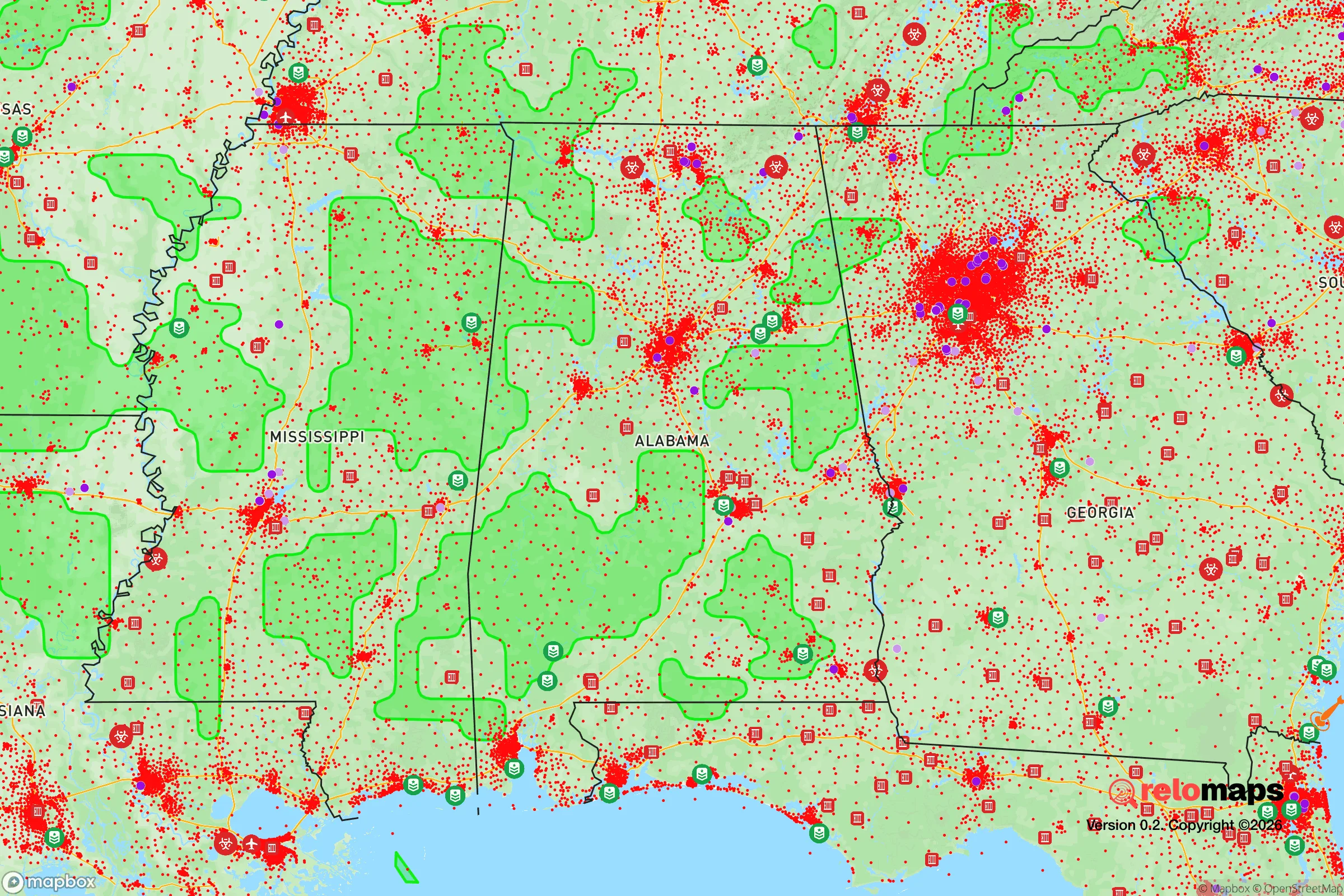
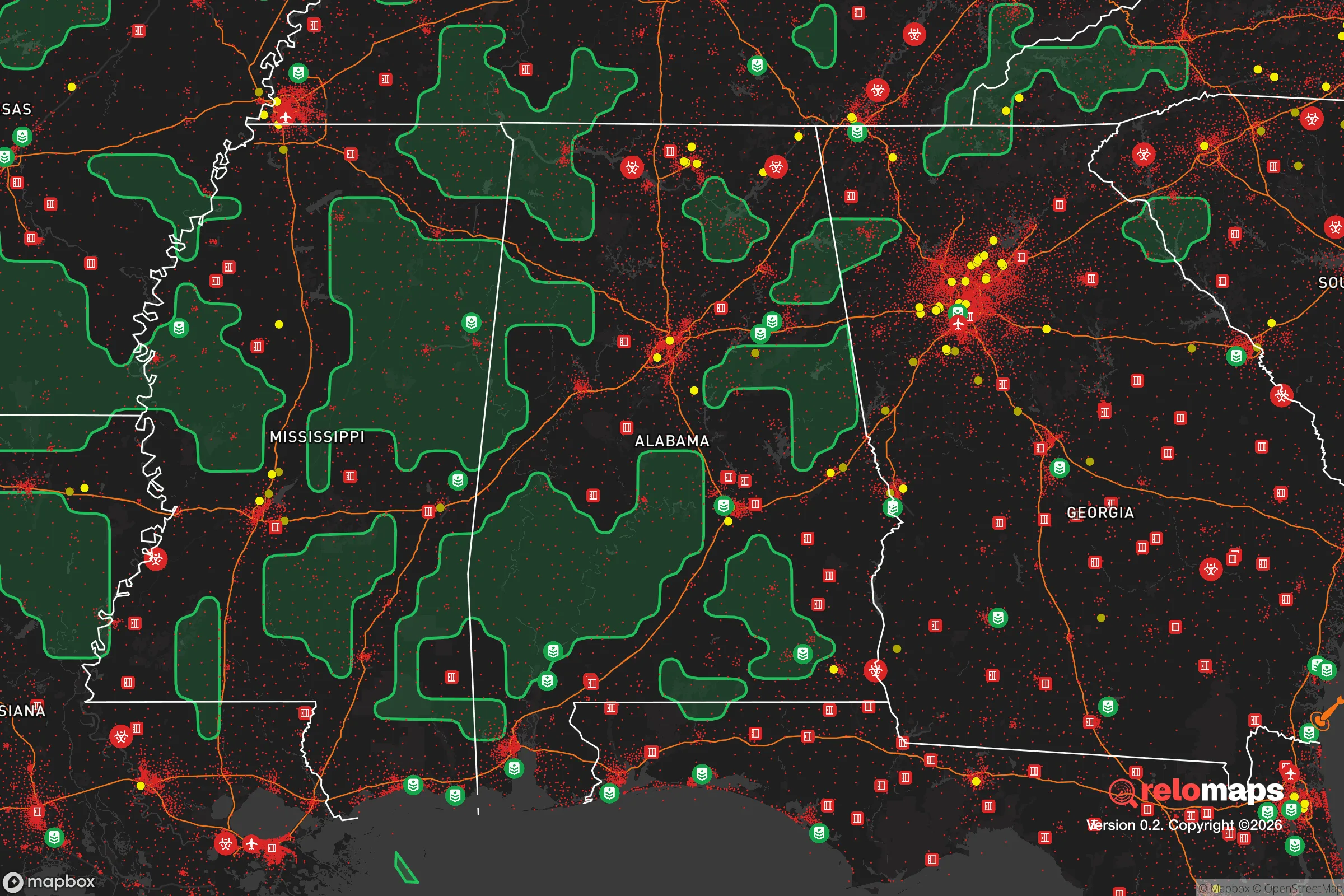


Important Note: For informational purposes only. This does not mean nothing bad ever happens in the green zones. Please use common sense. This is based on public data and modeled with AI. We tried to take a conservative approach but mistakes happen. We update this regularly as new information becomes available.
Solar Generator Recommendations
Backup power matters more here than in safer locations. We've picked three solar generators across budgets and capacity tiers — start with the budget unit if you only need a few essentials, or step up if you want to run a fridge and HVAC for days at a time.

Jackery Portable Power Station Explorer 300
Budget OptionPower on the Go: Weighing only 11 lbs, it's convenient to set up and store with book-sized foldable solar panels

BLUETTI Portable Power Station AC180
Designed for both indoor and outdoor scenarios, AC180 is highly capable as it has a robost capacity and continuous output power.

EF ECOFLOW DELTA Pro Ultra Power Station
Upgraded PickEcoFlow DELTA Pro Ultra is a whole-home energy system designed to grow with your family. Integrated with the Smart Home Panel 2, it scales to meet your evolving energy needs — keeping your home powered, intelligent, and secure through every stage of life.
We earn a commission, at no additional cost to you.
Strategic Assessment Analysis
Decatur, Alabama, sits in a position that demands serious consideration for anyone thinking about long-term strategic relocation in an increasingly unstable world. Its location along the Tennessee River, combined with a manufacturing-heavy economy and a population that leans conservative, offers a blend of industrial resilience and cultural stability that is hard to find in the Southeast. However, the same factors that make it economically viable also introduce specific vulnerabilities that a prepper or survivalist must weigh carefully before making a move.
Geographic position and natural advantages for long-term stability
Decatur’s geography is its strongest card. The city is anchored by the Tennessee River, a major navigable waterway that provides a reliable source of fresh water and a potential transportation corridor if roads become impassable. The surrounding terrain is a mix of rolling hills, farmland, and hardwood forests, offering decent cover and agricultural potential. The area sits in the Tennessee Valley, which has a moderate climate with four distinct seasons, reducing the risk of extreme weather events compared to the Gulf Coast or the Plains. Winters are mild enough to avoid prolonged deep freezes, and summers are hot but not unbearable, making year-round gardening and outdoor work feasible. The soil in the surrounding Morgan County and Limestone County areas is generally fertile, particularly along the river bottoms, which is a significant advantage for anyone planning to grow food. The region also has abundant groundwater, with many rural properties relying on wells, and the Tennessee River itself is a massive, reliable surface water source. For a relocator, this means you are not dependent on a single municipal supply that could be compromised by a cyberattack or a contamination event.
Risks, exposures, and proximity to fallout-relevant landmarks
No strategic assessment is honest without confronting the downsides, and Decatur has several that a prepper cannot ignore. The most glaring is its proximity to Huntsville, just 20 miles to the east. Huntsville is home to Redstone Arsenal, a major U.S. Army base and the hub of the nation’s missile defense and space operations. In a major conflict or a terrorist event targeting military infrastructure, Huntsville is a high-value target. A conventional strike or a dirty bomb detonated at Redstone could send fallout or a shockwave that reaches Decatur, depending on wind patterns and yield. Additionally, the Tennessee River is lined with industrial facilities, including a major TVA coal-fired power plant and several chemical plants. A catastrophic failure at one of these, whether from sabotage, accident, or natural disaster, could contaminate the river and force a large-scale evacuation. The city itself is not a major population center—around 57,000 people—but it is part of the Huntsville-Decatur combined statistical area, which pushes past 500,000. That density creates a target profile for civil unrest: if supply chains break down, Decatur could see an influx of people fleeing Huntsville, straining local resources. The city also sits along Interstate 65, a major north-south corridor that would be a choke point for refugees or military movements during a crisis. For a survivalist, being near a major highway is a double-edged sword—it offers escape routes but also invites unwanted traffic.
Practical resilience for a relocator: food, water, energy, and defensibility
On the practical side, Decatur offers a mixed bag. Food security is achievable if you are willing to put in the work. The surrounding farmland is productive, and there are several local farmers' markets and a strong network of independent growers. The area is also home to a large poultry processing industry, which means a steady supply of protein even if national distribution falters. However, the local grocery infrastructure is dominated by big-box chains like Walmart and Kroger, which are vulnerable to supply chain disruptions. A prepper should plan to establish a home garden, raise chickens or rabbits, and build relationships with local farmers before a crisis hits. Water is less of a concern. The Tennessee River is a massive resource, but it is also a public water source that could be contaminated. A well on your property is the gold standard here, and many rural properties in Morgan County have them. If you are buying land, prioritize a site with a tested well and a backup hand pump. Energy is a bright spot. The Tennessee Valley Authority (TVA) provides reliable electricity, and the region has a growing solar presence. Decatur also has a municipal electric utility, which tends to be more responsive than private companies during outages. For off-grid capability, the area has good sun exposure for solar panels, and wood is plentiful for heating. Defensibility is where Decatur gets tricky. The city itself is flat and open, with few natural chokepoints. A rural property on the outskirts, particularly one with a long driveway, tree cover, and a creek or pond, offers much better security. The local law enforcement presence is adequate but not heavy, and the sheriff's office in Morgan County is generally conservative and pro-Second Amendment, which aligns with a prepper’s mindset. The downside is that the area has a moderate property crime rate, so you need to harden your home against theft, especially if you are stockpiling supplies.
The overall strategic picture for Decatur is one of calculated risk. It is not a bug-out paradise in the mountains, nor is it a fortified compound in the desert. It is a working-class Southern city with real industrial assets, a reliable water source, and a population that is largely self-reliant and conservative. The proximity to Huntsville and the industrial river corridor are genuine liabilities that require a plan—either a rural buffer zone or a well-prepared urban retreat with multiple escape routes. For a single individual or a family who wants to be part of a community that will pull together rather than tear apart during a crisis, Decatur has a lot to offer. But you cannot move here and assume the river and the farmland will save you. You need to buy the right property, dig the well, plant the garden, and get to know your neighbors before the lights go out. If you do that, Decatur can be a solid anchor in a storm. If you don’t, it is just another town on the interstate waiting for the next disaster to roll through.

* Values derived from national, state, county, city and local statistics and may differ in a specific area. Last updated: 2026-04-19T18:47:38.000Z
Narrative content on this page is AI-generated and may contain mistakes. Verify any details that matter before acting on them.
ReloMaps may earn a commission from affiliate links at no extra cost to you.

