Photo: Wikipedia
Demographics of Decatur, AL
Affluence Level in Decatur, AL
A middle-class area roughly in line with national averages across income, home values, education, and employment.
People of Decatur, AL
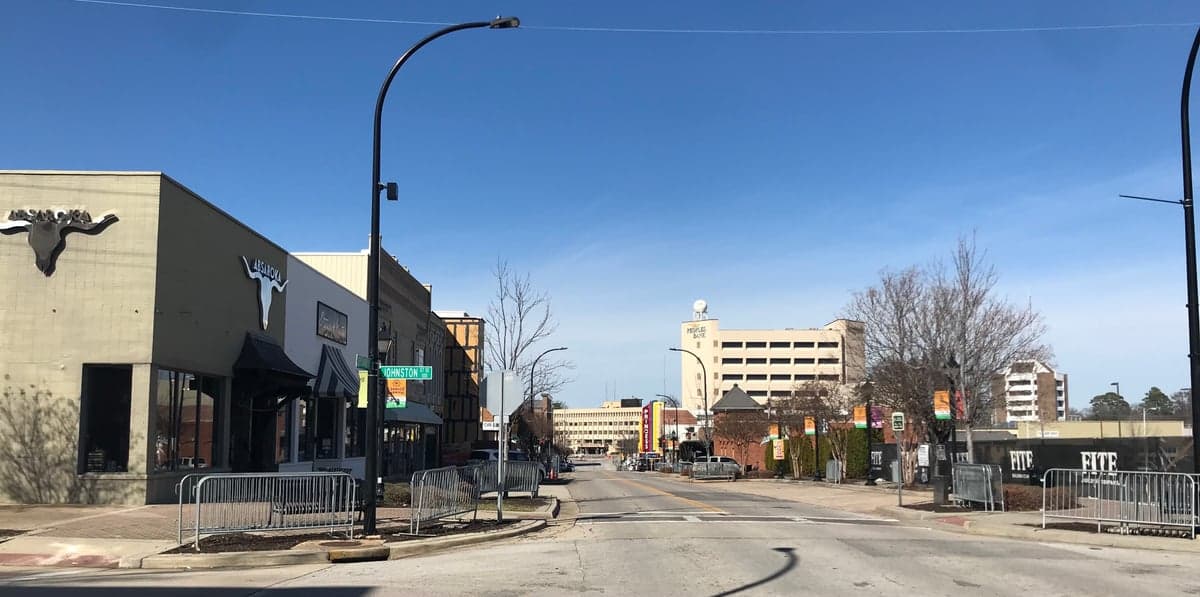
The people of Decatur, Alabama, today number roughly 57,760, forming a city with a distinctly Southern, working-class character shaped by its industrial roots and a growing Hispanic population. The city is denser than much of rural North Alabama, with a population identity marked by a white majority (56.7%), a significant Black community (22.1%), and a rapidly expanding Hispanic segment (16.4%). This is not a transient or college-town population—only 22.8% of adults hold a bachelor's degree—but a place where family, manufacturing, and faith-based community ties run deep.
How the city was settled and grew
Decatur's human history begins with its strategic location on the Tennessee River, which drew early settlers as a river crossing and trading post. The city was formally incorporated in 1826, and its first major population wave came with the arrival of the railroad in the 1830s, making it a key stop on the Memphis & Charleston line. The original white settlers, largely of Scots-Irish and English descent, built the Old Decatur historic district along the river, where many of the city's earliest homes and churches still stand. The post-Civil War era brought a second wave: freed Black families who moved to Decatur for work on the river and railroads, forming the West Decatur neighborhood, which became the historic heart of the city's African American community. A third wave arrived with the 20th-century industrial boom—the Tennessee Valley Authority's Wilson Dam (completed 1925) and the establishment of chemical plants and manufacturing drew white workers from rural Appalachia and Black workers from the Deep South. These groups settled in distinct areas: white workers filled the Burningtree and Point Mallard subdivisions, while Black families concentrated in Flint and Cherry Street corridors. By 1960, Decatur was a solidly biracial, blue-collar city of about 30,000.
Modern era (post-1965)
The post-1965 period reshaped Decatur's population in two major ways. First, domestic in-migration continued as the city's industrial base expanded—especially with the arrival of major employers like 3M, Nucor Steel, and United Launch Alliance—drawing white and Black workers from across the South. Suburbanization pushed middle-class families, both white and Black, into newer subdivisions like Burningtree Mountain and Indian Hills, while older neighborhoods like West Decatur and Flint saw population decline and aging housing stock. Second, the city experienced its most dramatic demographic shift: the growth of the Hispanic population. Beginning in the 1990s, immigrants from Mexico and Central America arrived for jobs in poultry processing, construction, and agriculture. By 2020, the Hispanic share had risen to over 16%, with families concentrating in the Southwest Decatur area near the industrial plants and along the Highway 31 corridor. This wave has been largely family-based, with high birth rates and chain migration creating a visible, growing community. The East/Southeast Asian population remains tiny at 0.5%, and the Indian subcontinent population is effectively zero—Decatur has not attracted the tech or medical professional immigration seen in Huntsville or Birmingham.
The future
Decatur's population is heading toward greater diversity, but not toward homogenization. The white share is slowly declining (from roughly 65% in 2000 to 56.7% today), while the Hispanic share is projected to continue rising, potentially reaching 20-25% by 2040. The Black population has remained stable at around 22%, suggesting a plateau rather than growth. The city is not tribalizing into hostile enclaves, but distinct residential patterns persist: West Decatur and Flint remain predominantly Black, Southwest Decatur is heavily Hispanic, and the newer subdivisions on the city's east side (Burningtree, Point Mallard) are overwhelmingly white. The foreign-born share (5.6%) is modest compared to national averages, and immigration from outside the Americas is negligible. The next decade will likely see continued Hispanic growth through natural increase and family reunification, while the white population ages and the Black population holds steady. Decatur is becoming a tri-ethnic Southern city, but one where the boundaries between groups remain visible in housing and schools.
For someone moving in now, Decatur offers a stable, family-oriented community with a strong manufacturing base and a clear sense of place. The city is not a melting pot in the classic sense—it is a place where distinct ethnic and racial neighborhoods persist, but where daily life is generally cooperative and neighborly. The population is becoming more Hispanic, more working-class, and less white, but the core identity of Decatur as a river-and-railroad industrial town remains intact. New residents should expect a community where church, family, and job define social life, and where the demographic changes are gradual enough to feel organic rather than disruptive.

* Values derived from national, state, county, city and local statistics and may differ in a specific area. Last updated: 2026-04-19T18:47:38.000Z
Narrative content on this page is AI-generated and may contain mistakes. Verify any details that matter before acting on them.
ReloMaps may earn a commission from affiliate links at no extra cost to you.

