Photo: Wikipedia
Demographics of Dayton, OH
Affluence Level in Dayton, OH
A below-average socioeconomic profile. Incomes, home values, and educational attainment trail the U.S., with higher poverty and unemployment.
People of Dayton, OH
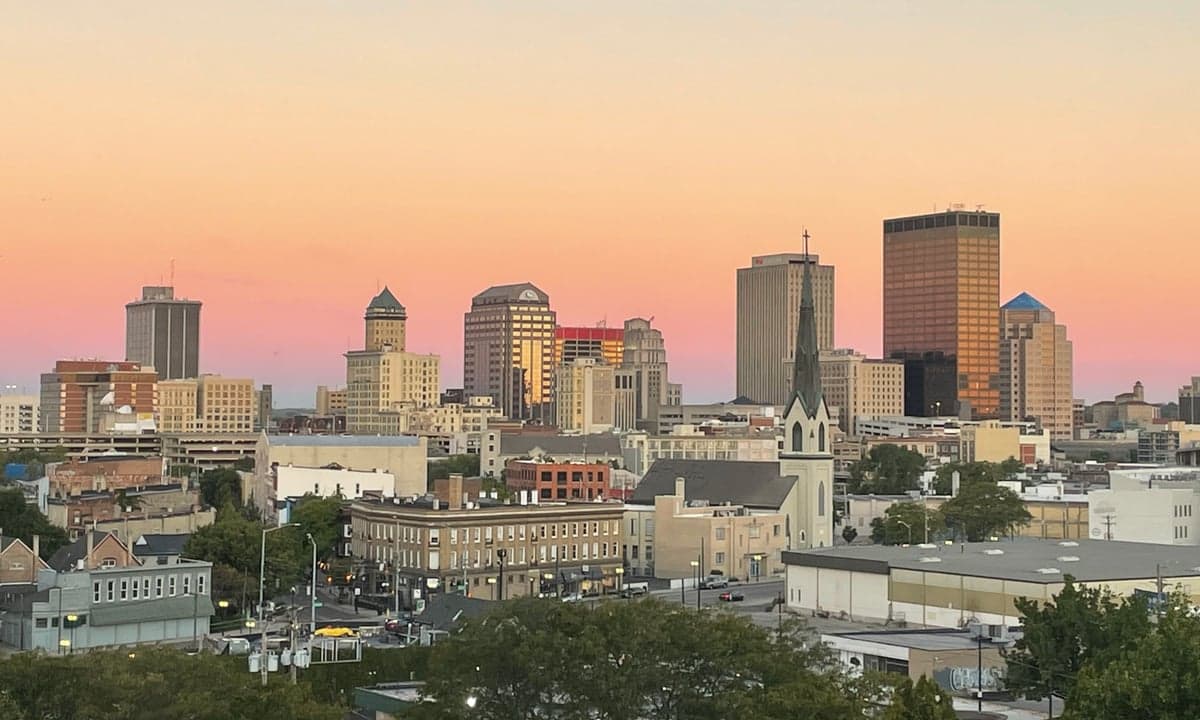
The people of Dayton, Ohio today number 136,741, making it a mid-sized Midwestern city with a distinctly biracial character: 50.0% White and 37.8% Black, with a small but growing Hispanic population at 5.6%. The city is notably less diverse in foreign-born residents than the national average, with only 3.1% born abroad, and its college-educated share sits at 20.7%, below the national median. Dayton’s identity is shaped by a legacy of industrial boom and subsequent decline, producing a population that is resilient, rooted, and increasingly aging, as younger residents often leave for job markets elsewhere.
How the city was settled and grew
Dayton was founded in 1796 by a group of surveyors and land speculators, including Israel Ludlow, who purchased the land at the confluence of the Great Miami and Mad Rivers. The original settlers were primarily of English, German, and Scots-Irish stock, drawn by fertile river valleys and the promise of agricultural prosperity. By the mid-19th century, the Miami and Erie Canal turned Dayton into a manufacturing and transportation hub, attracting a wave of German and Irish immigrants who settled in neighborhoods like Oregon District and St. Anne’s Hill, building the brick row houses and churches that still define those areas. The late 1800s brought a second wave of European immigrants, including Italians, Greeks, and Eastern European Jews, who clustered in the Dayton View and McPherson Town neighborhoods, working in the city’s burgeoning machine tool, cash register, and automotive parts factories. The Great Migration of African Americans from the South began in earnest during World War I and accelerated through the 1940s and 1950s, as defense plants like Wright-Patterson Air Force Base and National Cash Register (NCR) offered steady industrial jobs. Black families primarily settled in the West Dayton corridor, including neighborhoods like Wright-Dunbar and Five Oaks, creating a vibrant but segregated community that became the cultural heart of the city’s Black population.
Modern era (post-1965)
The post-1965 era brought profound demographic change. The Immigration and Nationality Act of 1965 had a muted effect on Dayton compared to coastal cities; the foreign-born share remains low at 3.1%. However, domestic migration reshaped the city dramatically. White flight to suburbs like Centerville, Beavercreek, and Kettering accelerated after the 1970s, driven by deindustrialization, school desegregation busing orders, and rising crime. This left Dayton’s core increasingly Black and poor. The Hispanic population, now 5.6%, began growing in the 1990s, with Mexican and Puerto Rican families settling in the Old North Dayton neighborhood, historically a Polish and Lithuanian enclave, and in parts of East Dayton. East/Southeast Asian communities (0.8%) and Indian-subcontinent residents (0.4%) remain very small, concentrated near the university and medical districts around Miami Valley Hospital and the University of Dayton. The city’s population peaked at 262,332 in 1960 and has since fallen by nearly half, a decline that hollowed out many neighborhoods and left large tracts of vacant land, particularly in West Dayton.
The future
Dayton’s population trajectory points toward continued slow decline or stabilization, rather than a rebound. The city is not homogenizing into a single identity; rather, it is tribalizing into distinct enclaves. West Dayton remains overwhelmingly Black and economically distressed, while East Dayton is becoming more Hispanic and working-class white. The Oregon District and downtown areas are seeing a modest influx of younger, college-educated professionals, but this gentrification is limited in scale and has not reversed the overall loss. Immigrant communities are growing slowly — the Hispanic share rose from 3.0% in 2010 to 5.6% today — but remain too small to drive a demographic turnaround. The Indian and East/Southeast Asian populations are plateauing, with most growth occurring in the suburbs rather than the city proper. Over the next 10-20 years, Dayton will likely become older, poorer, and more racially polarized between a shrinking white population and a stable Black population, with Hispanics gradually increasing their share. The city’s future depends on whether it can retain young families and attract new immigrants, both of which face headwinds from weak job growth and a struggling public school system.
For someone moving in now, Dayton is a city of stark contrasts: affordable housing and a strong sense of community in established neighborhoods, but limited economic opportunity and a population that is aging and shrinking. The city is not becoming a diverse melting pot; it is a place where racial and ethnic lines remain clearly drawn, and where the best prospects for newcomers lie in the revitalizing downtown core or in the stable, middle-class suburbs that surround it.

* Values derived from national, state, county, city and local statistics and may differ in a specific area. Last updated: 2026-04-21T18:42:13.000Z
Narrative content on this page is AI-generated and may contain mistakes. Verify any details that matter before acting on them.
ReloMaps may earn a commission from affiliate links at no extra cost to you.

