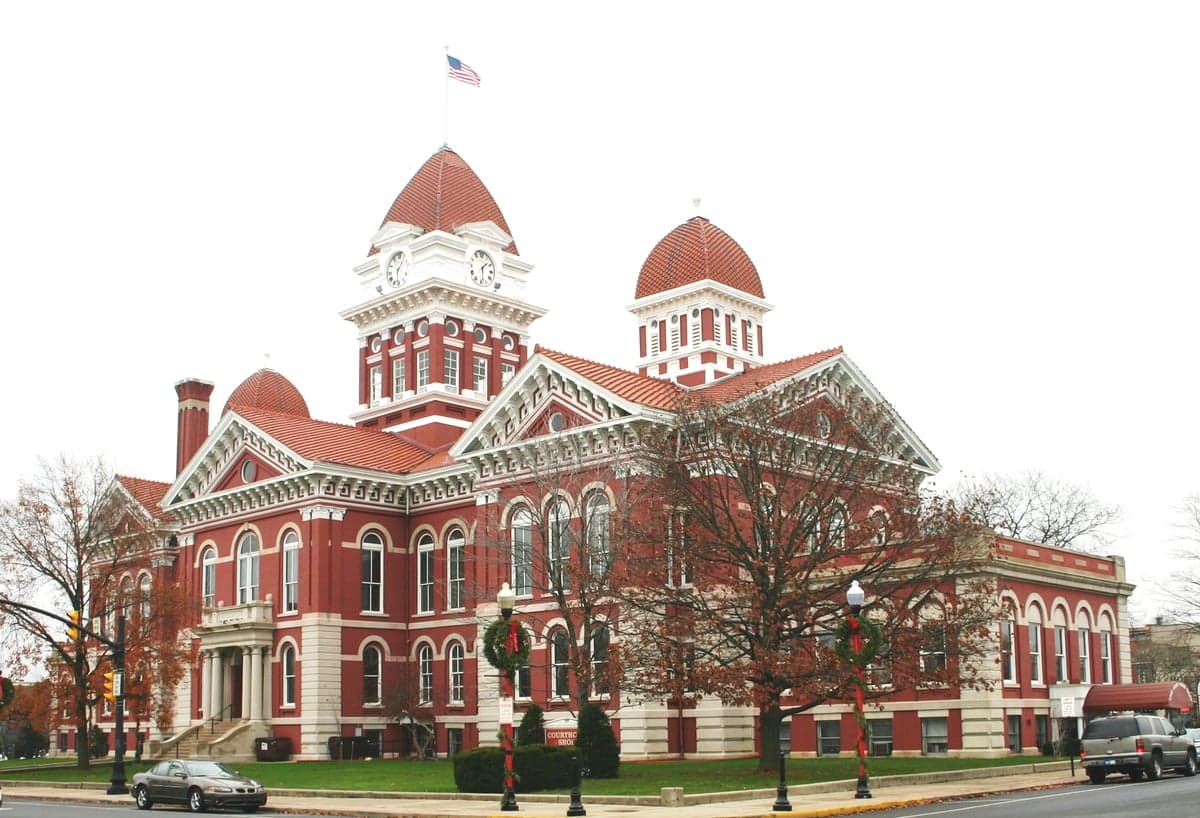
Photo: Wikipedia
Political ClimatePolitical Climate in Crown Point, IN
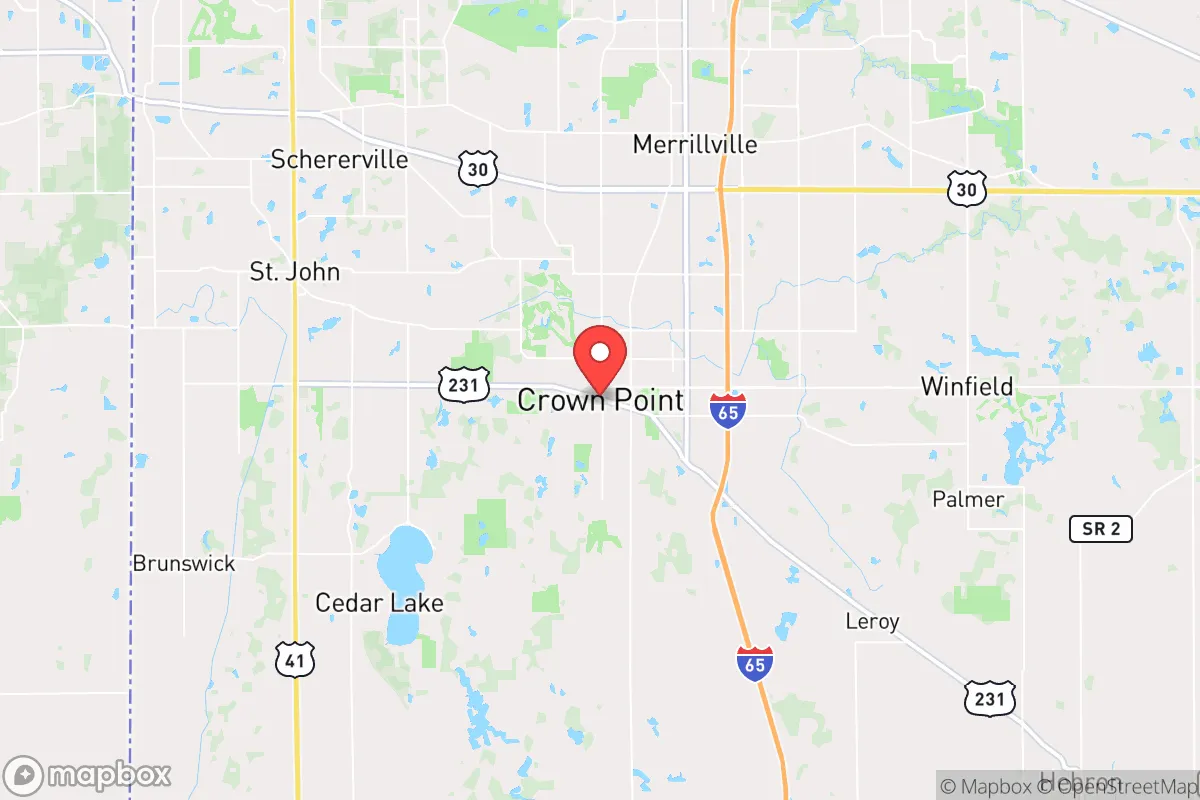
District shown is the primary district for this city’s centroid. Cities may span multiple districts.
Local Political AnalysisPolitical Analysis of Crown Point, IN
Crown Point, Indiana, sits in a political tug-of-war that’s gotten a lot more interesting over the last decade. The Cook PVI clocks it at D+1, meaning the area leans just barely Democratic on paper, but anyone who’s lived here a while will tell you that number doesn’t tell the whole story. Lake County as a whole has been a Democratic stronghold for generations, but Crown Point itself has always had a strong conservative undercurrent—folks who value local control, low taxes, and the freedom to live without a bunch of government telling you how to run your life. In recent years, that undercurrent has been rising, especially as neighboring towns like St. John and Schererville have shifted noticeably redder, and as more families move out of Chicago and Cook County looking for a place where the government stays out of their business.
How it compares
Crown Point is a bit of an island in Lake County. Drive ten minutes north to Gary or east to Hammond, and you’re in deep blue territory—places where union politics and big-city machine-style governance still hold sway. Head south or west to St. John or Cedar Lake, and you’ll find communities that vote reliably Republican, with a focus on property rights and school choice. Crown Point sits right in the middle, politically and geographically. The D+1 rating reflects that split: the city itself has a sizable base of moderate Democrats, many of them older or tied to county government, but the newer arrivals—especially young families and remote workers—tend to lean conservative. The result is a place where local elections are often decided by a few hundred votes, and where the school board and city council races can get surprisingly heated over issues like mask mandates, curriculum transparency, and zoning restrictions.
What this means for residents
For the average person living here, the political climate means you get a mix of both worlds, but with a growing sense that the old guard is losing its grip. On one hand, property taxes are still reasonable compared to Cook County, and the city hasn’t gone overboard with new regulations on small businesses or homeowners. On the other hand, there’s a creeping concern about government overreach—especially when you see the county health department or school administration trying to push mandates or policies that feel like they came straight out of Indianapolis or Washington. The shift toward progressive ideology in some corners of Lake County government is a real red flag for a lot of us. You see it in things like zoning changes that favor developers over neighborhoods, or in school policies that prioritize equity agendas over academic standards. The good news is that Crown Point’s conservative base is organized and vocal. The bad news is that the D+1 rating means it only takes a small shift in turnout to tip the balance the other way.
Culturally, Crown Point still feels like a place where people wave to each other at the square and the Fourth of July parade is a big deal. But there’s a quiet tension underneath—a sense that the old Lake County machine politics are being replaced by a newer, more progressive brand of top-down control. The long-term trajectory depends on who shows up to vote. If the trend of conservative-leaning newcomers continues, Crown Point could easily flip to R+ territory within a decade. If not, you might see more policies that feel like they were written for a big city, not a close-knit town where people just want to be left alone to raise their kids and run their businesses. For now, it’s a place to keep an eye on—and a place where your vote really does count.

State Political ClimatePolitical Climate in Indiana
State Political AnalysisPolitical Environment in the State
Indiana has been a reliably Republican state for decades, but the nature of that conservatism is shifting. The state hasn't voted for a Democratic presidential candidate since 2008, when Barack Obama narrowly won it, and since then the GOP margin has widened to around 11-16 points. However, the coalition is changing: the old-school, union-friendly, socially moderate Democrats who once held sway in industrial towns like Gary, Hammond, and South Bend are fading, replaced by a more populist, culturally conservative Republican base that dominates the rural and suburban landscape. The 10-20 year arc shows a state that is becoming more uniformly red at the state level, even as its largest county, Marion (Indianapolis), has trended blue and now votes Democratic by double digits.
Urban vs. rural divide
The political map of Indiana is a textbook case of the urban-rural split. Indianapolis (Marion County) is the Democratic stronghold, delivering about 60% of its vote to Joe Biden in 2020. The other urban centers—Fort Wayne (Allen County), Evansville (Vanderburgh County), and South Bend (St. Joseph County)—are more competitive but still lean Republican at the county level, though their core cities are bluer. The real engine of GOP dominance is the vast rural and exurban expanse. Hamilton County, just north of Indianapolis, is the wealthiest and most reliably Republican county in the state, often giving GOP candidates 65-70% of the vote. Counties like Elkhart, Kosciusko, and Dubois are deep red, driven by manufacturing, agriculture, and strong church attendance. The divide is stark: drive 20 minutes north of the Indianapolis loop into Carmel or Fishers, and you’re in a world of low taxes, school choice, and Trump flags. Drive 20 minutes south of downtown into Johnson County, and you’re in similar territory. The only real blue pockets outside Marion County are Lake County (Gary and Hammond) and Monroe County (Bloomington, home to Indiana University).
Policy environment
Indiana’s policy environment is broadly conservative, but with some notable wrinkles. The state has a flat income tax rate of 3.05%, which is scheduled to drop to 2.9% by 2027 under legislation passed in 2022. Property taxes are relatively low, with an average effective rate around 0.85%, though they vary by county. The state is a right-to-work state (passed in 2012), and it has a Republican supermajority in both chambers of the legislature. On education, Indiana was an early leader in school choice, with the nation’s largest private school voucher program (the Choice Scholarship Program) and robust charter school laws. Parents have significant freedom to choose schools, and the state’s education savings account program was expanded in 2023 to cover nearly all students. Healthcare policy is mixed: Indiana expanded Medicaid under the Affordable Care Act via the HIP 2.0 waiver, which was a conservative compromise, but the state has not expanded abortion access post-Dobbs—a near-total ban was enacted in 2023, with narrow exceptions. Election laws are moderately restrictive: voter ID is required, early voting is available but not as expansive as in some states, and the legislature passed a law in 2021 limiting drop boxes and requiring stricter absentee ballot verification. There is no state-level income tax on Social Security benefits, which is a draw for retirees.
Trajectory & freedom
On balance, Indiana has been moving toward more personal freedom in several key areas, but with some concerning backsliding. The most significant expansion of liberty came in 2022 with the passage of constitutional carry (permitless carry of handguns), making Indiana the 23rd state to do so. This was a major win for Second Amendment advocates. Parental rights were strengthened in 2023 with a law requiring schools to notify parents of any changes to a student’s health or well-being, effectively banning classroom instruction on gender identity and sexual orientation in K-3. On medical freedom, Indiana was one of the first states to pass a law prohibiting COVID-19 vaccine mandates for state employees and contractors (2023). However, the state’s track record on property rights is mixed: the Indiana Supreme Court has upheld broad eminent domain powers, and there have been controversies over carbon pipeline projects (like the proposed Heartland Greenway) that would use eminent domain for private gain. The biggest red flag for liberty-minded residents is the state’s aggressive use of tax increment financing (TIF) districts, which can divert property tax revenue away from schools and local governments for decades. On the plus side, the state has no personal property tax on business equipment, and it repealed its inheritance tax in 2013.
Civil unrest & political movements
Indiana has seen its share of political flashpoints, but they tend to be localized rather than statewide. The most visible recent unrest was in 2020, when Indianapolis saw significant protests and some rioting following the murder of George Floyd, leading to property damage downtown and a heightened police presence. The city’s Democratic mayor and council have been at odds with the state’s Republican legislature over policing reforms and public safety funding. On the right, the most organized movement is the Indiana Firearms Coalition, which has been instrumental in pushing constitutional carry and fighting local gun ordinances. Immigration politics are relatively quiet, as Indiana is not a border state and has a smaller immigrant population, but there have been local controversies over sanctuary city policies. In 2019, the state legislature passed a law prohibiting sanctuary cities, and no Indiana city has formally declared itself one, though some activist groups in Bloomington and Indianapolis have pushed for it. Election integrity has been a hot topic since 2020, with the Republican secretary of state conducting a limited audit of the 2020 election that found no widespread fraud, but the legislature still passed tighter rules on absentee ballots and drop boxes. The most visible political movement in recent years has been the fight over school curriculum and library books, with conservative parents organizing in places like Hamilton County and Johnson County to challenge materials they consider inappropriate for children.
Projection
Over the next 5-10 years, Indiana is likely to become more conservative at the state level, but with growing internal tension. The demographic trends favor the GOP: the rural and exurban areas are growing faster than the urban core, and the state is attracting conservative-leaning migrants from Illinois and California. However, Indianapolis and its inner suburbs are becoming more diverse and more Democratic, which could eventually make the state more competitive in presidential elections if the trend continues. The biggest wild card is the influx of manufacturing and tech jobs tied to the LEAP Lebanon Innovation District and the expansion of the semiconductor industry (SkyWater Technology in West Lafayette). If these bring in a younger, more educated workforce, they could shift the political balance in places like Boone County and Tippecanoe County. For now, the state’s political trajectory is clear: more constitutional carry, more school choice, more parental rights, and a continued push to lower taxes. The risk is that the state’s heavy reliance on property taxes and TIF districts could create a fiscal crunch down the road, especially if the economy slows. A new resident moving in now should expect a state that is solidly red but not monolithic, where local politics matter a lot, and where the biggest fights will be over education, guns, and the balance of power between Indianapolis and the statehouse.
Bottom line for a new resident: If you’re moving to Indiana for the conservative policies, you’ll find a state that largely delivers on low taxes, gun rights, and school choice. But don’t expect a libertarian paradise—the state has a long history of government intervention in economic development, and the local property tax system can be opaque. The best bet for a like-minded community is the suburban ring around Indianapolis (Carmel, Fishers, Zionsville, Noblesville) or the smaller manufacturing towns like Jasper, Warsaw, or Columbus. Avoid the urban cores of Indianapolis, Gary, and Bloomington if you want to stay in a red environment. The state is trending in the right direction on most freedom metrics, but it’s a slow, steady march, not a revolution.
* Values derived from national, state, county, city and local statistics and may differ in a specific area. Last updated: 2026-04-19T10:10:12.000Z
Narrative content on this page is AI-generated and may contain mistakes. Verify any details that matter before acting on them.
ReloMaps may earn a commission from affiliate links at no extra cost to you.

