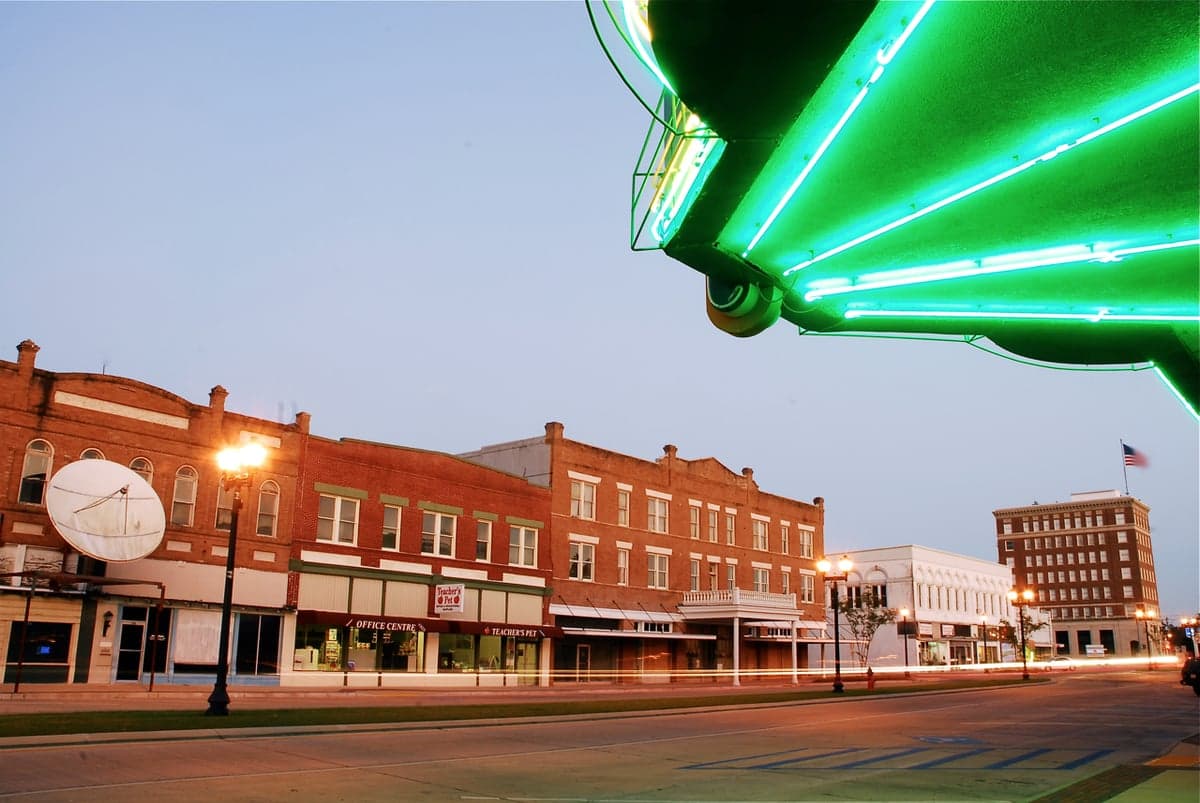
Photo: Wikipedia
Strategic Assessment of Crowley, LA
Meaningful friction. Expect exposure to either population pressure, blast zones, or natural disaster risk. Consider buying a retreat property.
What does the Strategic Assessment tell us?
Our Strategic Assessment grades tactical survivability of an area. Major population centers, military targets, fallout zones, natural disasters, and border exposure all drive risk — lower exposure means a more defensible position in a crisis.
This is heavily inspired by Joel Skousen's Strategic Relocation book. Highly recommended you checkout the book ($)What does this tell us?
Our Strategic Assessment grades tactical survivability of an area. Major population centers, military targets, fallout zones, natural disasters, and border exposure all drive risk — lower exposure means a more defensible position in a crisis.
This is heavily inspired by Joel Skousen's Strategic Relocation book. Highly recommended you checkout the book ($)Strategic Pillars

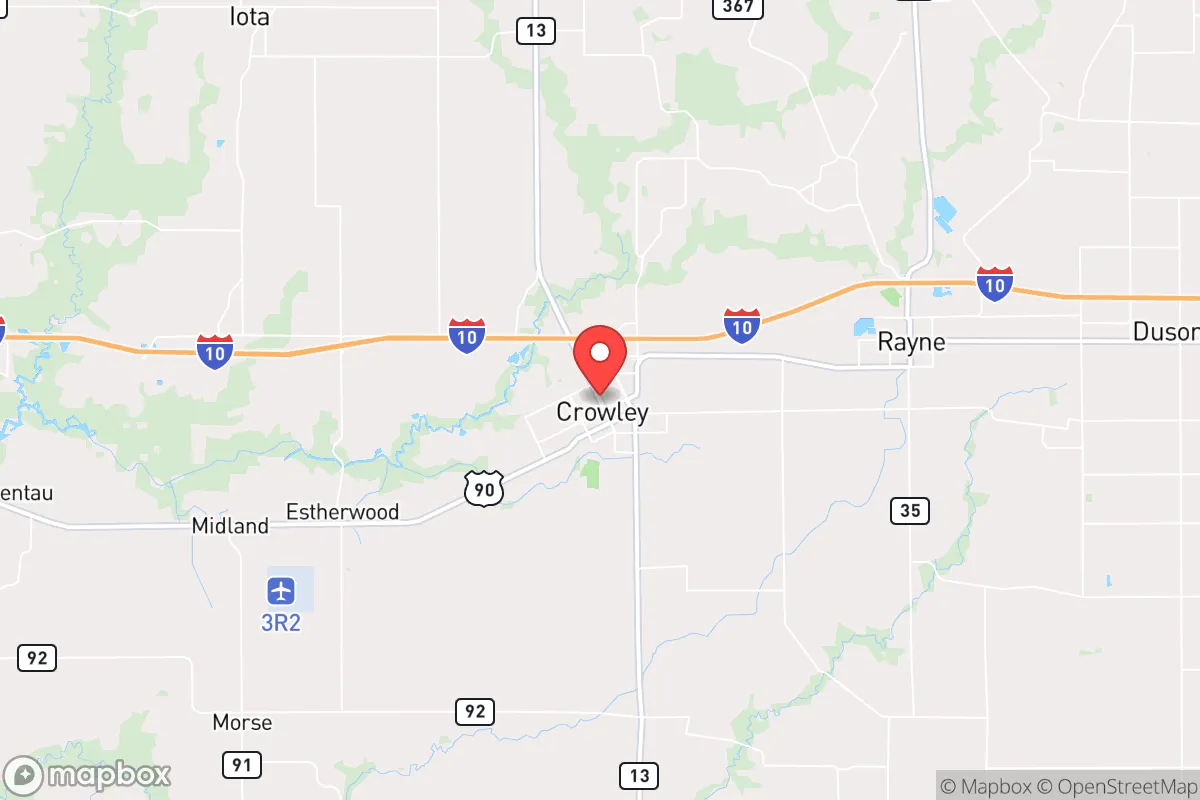
Key Distances
Regional Safe Places
Below is our recommended "safe zones" in Louisiana and the surrounding area based on our strategic heuristics. For most people, it's unrealistic to live in a “safe zone” full-time due to work, family or other personal reasons. They tend to be more rural. However, many of these areas are perfect for second homes and retreat properties that double as a vacation home or even a short-term rental.

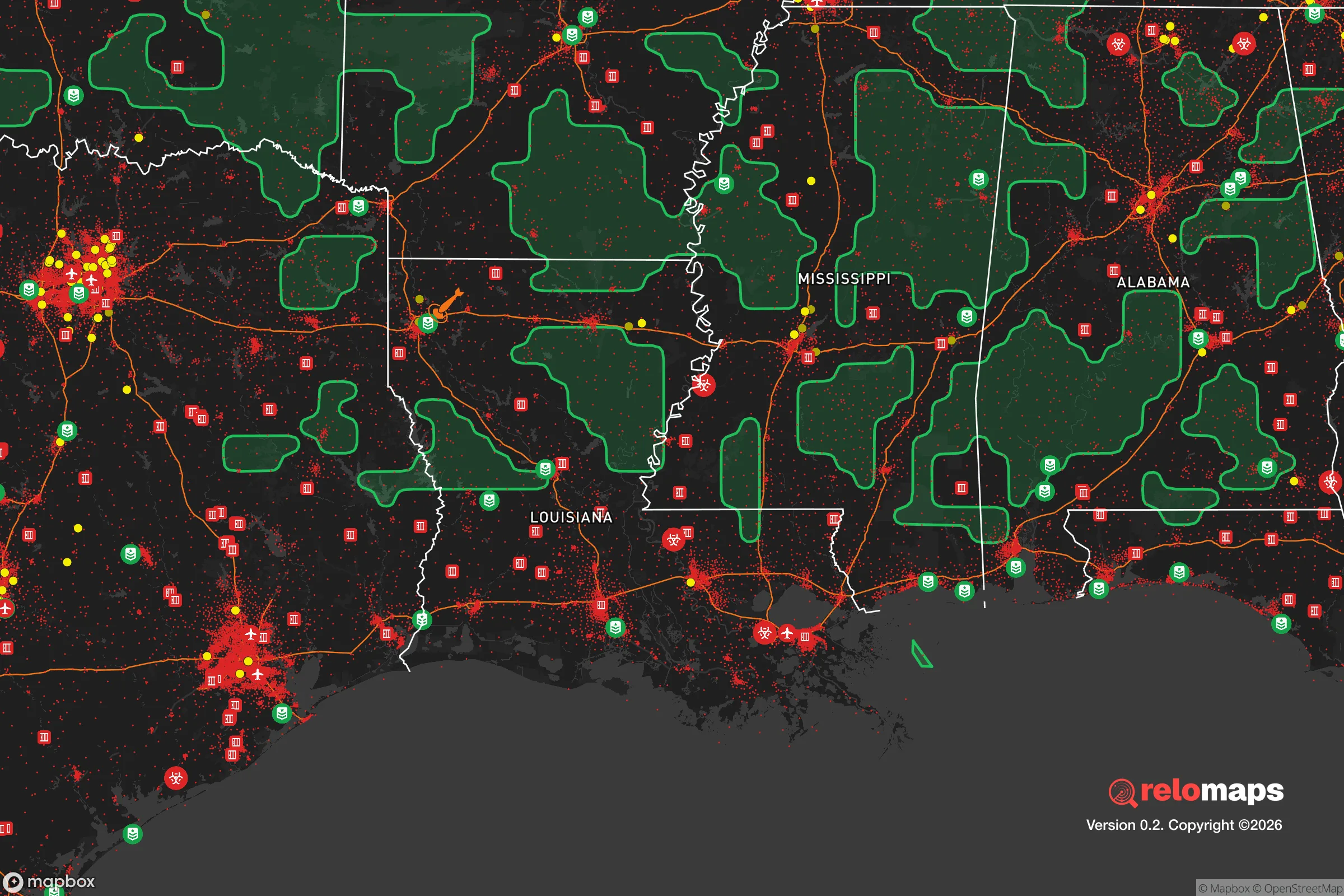


Important Note: For informational purposes only. This does not mean nothing bad ever happens in the green zones. Please use common sense. This is based on public data and modeled with AI. We tried to take a conservative approach but mistakes happen. We update this regularly as new information becomes available.
Solar Generator Recommendations
Backup power matters more here than in safer locations. We've picked three solar generators across budgets and capacity tiers — start with the budget unit if you only need a few essentials, or step up if you want to run a fridge and HVAC for days at a time.

Jackery Portable Power Station Explorer 300
Budget OptionPower on the Go: Weighing only 11 lbs, it's convenient to set up and store with book-sized foldable solar panels

BLUETTI Portable Power Station AC180
Designed for both indoor and outdoor scenarios, AC180 is highly capable as it has a robost capacity and continuous output power.

EF ECOFLOW DELTA Pro Ultra Power Station
Upgraded PickEcoFlow DELTA Pro Ultra is a whole-home energy system designed to grow with your family. Integrated with the Smart Home Panel 2, it scales to meet your evolving energy needs — keeping your home powered, intelligent, and secure through every stage of life.
We earn a commission, at no additional cost to you.
Strategic Assessment Analysis
Crowley, Louisiana, sits in a strategic sweet spot for those prioritizing resilience and self-sufficiency. Located in Acadia Parish, roughly 25 miles west of Lafayette and 50 miles north of the Gulf Coast, this small city of about 13,000 offers a blend of agricultural stability, low population density, and relative isolation from major metropolitan chaos. Its position along the I-10 corridor provides a critical evacuation route, while the surrounding flat, fertile land supports local food production and water access. For a relocator with a prepper mindset, Crowley’s key advantage is its ability to function as a semi-independent node—close enough to regional resources but far enough from the likely flashpoints of civil unrest or disaster fallout.
Geographic position and natural advantages for long-term survival
Crowley’s geography is defined by its location in the Cajun Prairie region, a flat, open landscape that historically supported rice and crawfish farming. This is not a mountainous retreat, but it offers distinct survival benefits. The area sits atop the Chicot Aquifer, one of the largest freshwater sources in the South, providing reliable groundwater for wells—critical if municipal systems fail. The nearby Mermentau River and Bayou Queue de Tortue offer additional surface water for filtration and irrigation. The climate is humid subtropical, with mild winters and long growing seasons, allowing for year-round gardening and livestock grazing. The lack of significant elevation changes means no landslide risks, and the region is far enough inland to avoid the worst of hurricane storm surge, though tropical systems remain a threat. For a conservative-minded relocator, this means a place where you can dig in, grow food, and access water without relying on fragile supply chains. The surrounding agricultural economy—dominated by rice, soybeans, and cattle—also means local knowledge of farming and animal husbandry is readily available, a practical asset for building self-reliance.
Risks, exposures, and proximity to fallout-relevant landmarks
No location is without vulnerabilities, and Crowley’s risks are worth weighing carefully. The most immediate threat is hurricane and tropical storm activity, with the Gulf Coast about 50 miles south. While Crowley is far enough inland to avoid direct storm surge, it can still experience damaging winds, flooding from heavy rain, and prolonged power outages. The area’s flat terrain also means slow drainage, so low-lying neighborhoods near Bayou Plaquemine Brule can flood after sustained rainfall. For a prepper, this means investing in elevated storage, sump pumps, and a robust backup power system is non-negotiable. On the man-made risk side, Crowley’s proximity to Lafayette (25 miles east) and Baton Rouge (70 miles east) is a double-edged sword. These cities are regional hubs for healthcare, supplies, and employment, but they also represent potential epicenters for civil unrest, supply chain disruptions, or disease outbreaks. In a mass casualty event or societal breakdown, I-10 could become a chokepoint for refugees fleeing eastward, putting Crowley in a potential path of secondary chaos. Additionally, the Louisiana Offshore Oil Port (LOOP) and numerous petrochemical facilities along the Mississippi River corridor—roughly 80 miles east—are high-value targets for sabotage or accidents. A major release or explosion could send toxic plumes or disrupt fuel supplies, though prevailing winds typically carry such hazards away from Crowley. The area also has a small but present risk from industrial rail accidents, given the Union Pacific line running through town. For a strategic relocator, these risks are manageable with proper planning—but they require acknowledgment, not denial.
Practical resilience for a relocator: food, water, energy, and defensibility
For the individual or family looking to build a resilient homestead, Crowley offers several concrete advantages. Food production is the standout: the surrounding parish is one of the top rice-producing regions in the country, and local farmers markets and co-ops provide direct access to grains, vegetables, and meat. The long growing season allows for three-season gardening, and the soil, while clay-heavy, can be amended with compost. Raising chickens, goats, or even a small cattle herd is feasible on modest acreage outside city limits. Water security is strong, with the Chicot Aquifer providing deep, reliable groundwater. Drilling a private well is a standard practice here, with costs typically under $5,000 for a residential setup. Surface water from bayous is also available but requires filtration and boiling. Energy resilience is more challenging. The local grid is prone to outages during storms, and natural gas is the primary heating fuel. Solar panels are viable given the region’s 215 sunny days per year, but battery storage is essential for nighttime and cloudy periods. Propane generators are a common backup. Defensibility is moderate: the flat, open terrain offers limited natural cover, but the low population density means fewer neighbors to worry about. Rural properties with tree lines or drainage ditches provide some concealment. The local law enforcement presence is small but functional, and the community’s culture of self-reliance—rooted in Cajun and Creole traditions—means neighbors are more likely to help than to loot. For a single individual, a small acreage with a well, solar panels, and a garden is achievable on a modest budget. For families, the local schools are adequate, and the cost of living is roughly 15% below the national average, freeing up capital for preps.
The overall strategic picture for Crowley is one of calculated trade-offs. It is not a remote mountain bunker, nor is it a fortified compound. It is a working agricultural town with real, practical advantages for those willing to put in the work. The risks—hurricanes, proximity to larger cities, and industrial infrastructure—are real but manageable with proper planning. The strengths—abundant water, fertile land, low cost of living, and a culture of self-sufficiency—are harder to find in most of the country. For a conservative-leaning relocator concerned about societal fragility, Crowley offers a viable middle ground: close enough to civilization to access resources, far enough to avoid the worst of the fallout. The key is to arrive prepared, not to expect the town to save you. Build your well, stock your pantry, and get to know your neighbors. In a crisis, that combination of local knowledge and personal readiness is what separates those who thrive from those who merely survive.

* Values derived from national, state, county, city and local statistics and may differ in a specific area. Last updated: 2026-05-01T01:50:43.000Z
Narrative content on this page is AI-generated and may contain mistakes. Verify any details that matter before acting on them.
ReloMaps may earn a commission from affiliate links at no extra cost to you.

