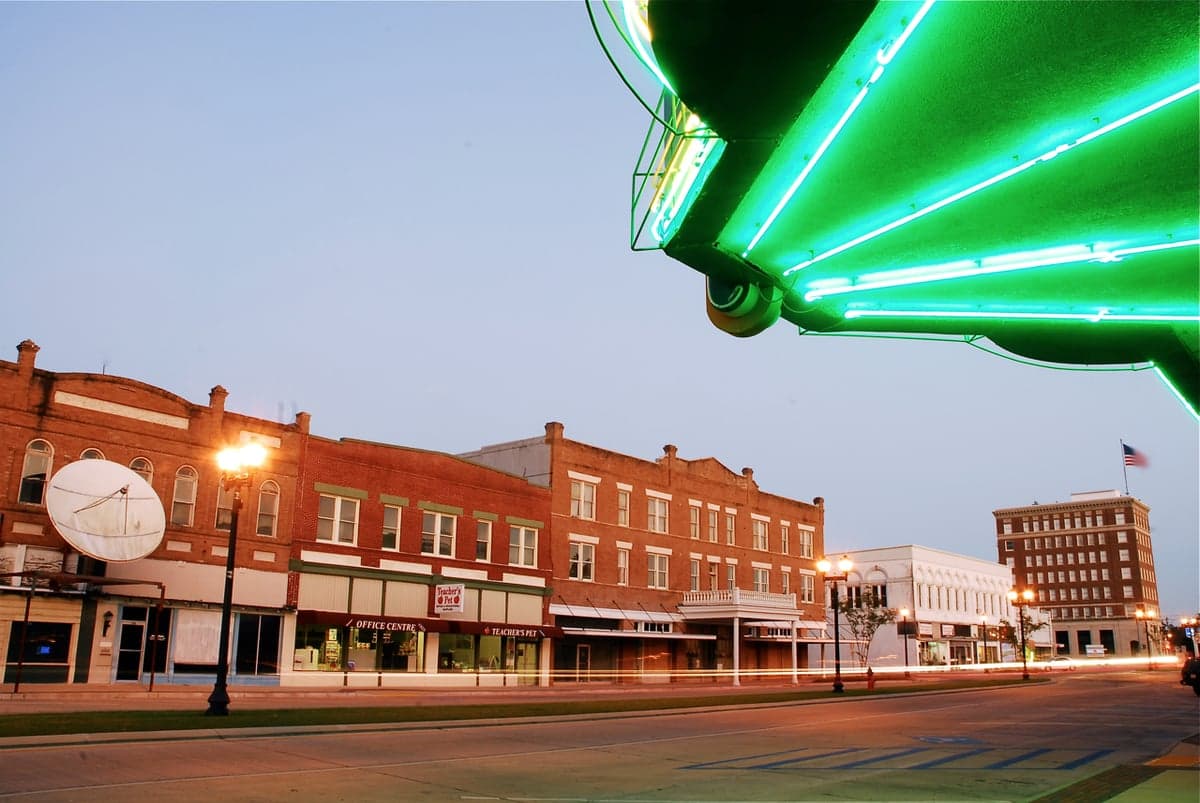
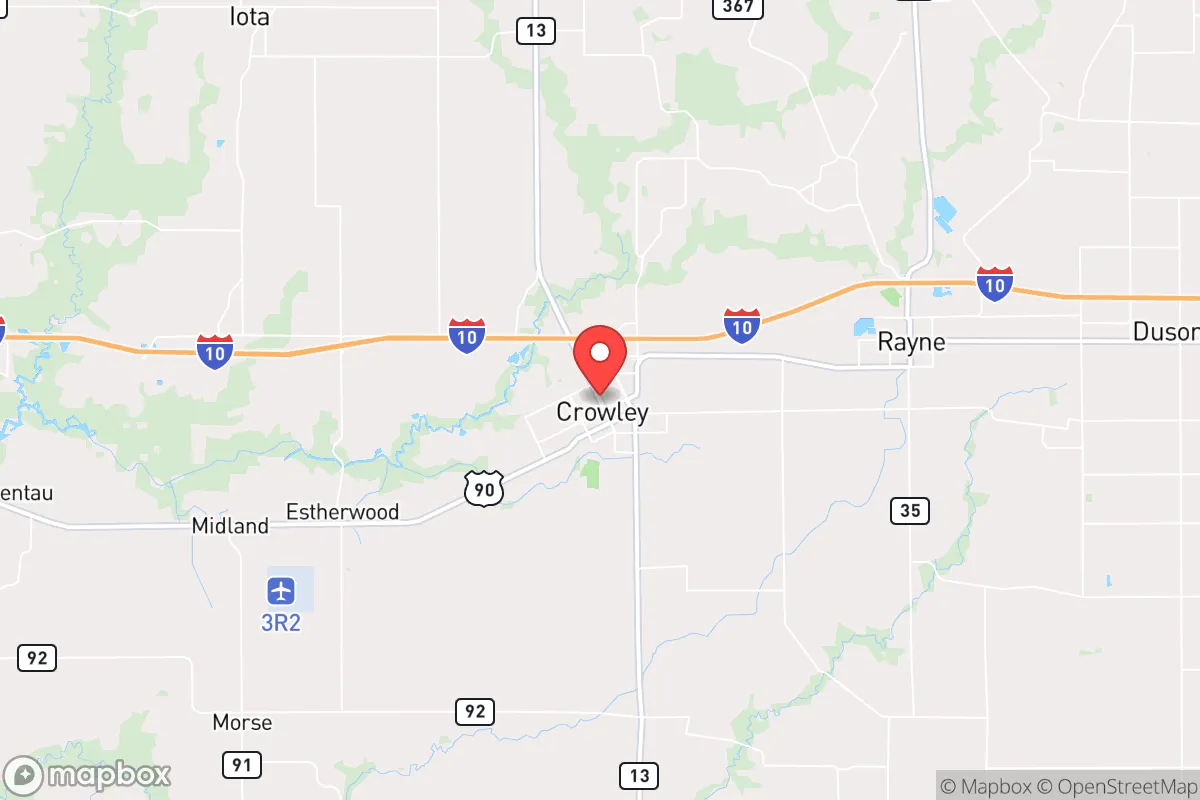
Photo: Wikipedia
Demographics of Crowley, LA
Affluence Level in Crowley, LA
A low-income area with significant economic hardship. Household wealth and educational attainment are well below national averages.
People of Crowley, LA
The people of Crowley, Louisiana, today form a small, predominantly native-born community of 11,554 residents, characterized by a strong Black and White demographic core and an exceptionally low foreign-born population of just 0.1%. The city’s identity is rooted in its agricultural heritage and a quiet, family-oriented pace of life, with a notably low college attainment rate of 19.3% reflecting a workforce historically tied to farming, oil, and local service industries. Crowley remains a place where generational roots run deep, and its population is overwhelmingly American-born, with minimal recent international immigration shaping its character.
How the city was settled and grew
Crowley was founded in 1887 as a railroad town on the prairie of Acadiana, deliberately established by the Louisiana Western Railroad as a stop on its line between Lafayette and the Texas border. The original population was drawn by the promise of fertile land for rice farming, an industry that exploded after the railroad enabled large-scale irrigation and shipping. The first wave of settlers were white Anglo-American and Cajun farmers, who built the core of the city around the railroad depot in what is now Downtown Crowley. By the early 1900s, the rice boom attracted a second wave: African American laborers from the rural Deep South, who came to work the fields and levees. They established their own community in the North Crowley neighborhood, historically known as the city’s Black residential district, where churches and small businesses anchored daily life. A smaller wave of Italian and Lebanese immigrants arrived around 1900, settling near the commercial corridor of Parkerson Avenue and opening grocery stores and dry goods shops that served the farming economy. By 1950, Crowley’s population had stabilized around 10,000, with these three groups—white Cajun/Anglo, Black, and a tiny white ethnic enclave—forming the city’s social fabric.
Modern era (post-1965)
After the 1965 Hart-Cellar Act, Crowley saw virtually no new international immigration. The foreign-born share today is 0.1%, meaning the city’s demographic story since the 1960s has been one of domestic migration and internal shifts. The most significant change has been the suburbanization of white residents to newer subdivisions on the city’s outskirts, particularly in the South Crowley area near the I-10 corridor, where larger homes and newer schools drew families away from the older downtown core. Meanwhile, the Black population, which stood at 26.5% in the latest data, has remained concentrated in North Crowley and parts of East Crowley, though some middle-class Black families have moved into previously all-white subdivisions. The Hispanic share is a mere 2.0%, and the East/Southeast Asian share is 0.0%, reflecting the city’s lack of attraction for post-1965 immigrant streams. The Indian-subcontinent population is negligible at 0.3%. The net effect is a city that has grown more racially polarized by geography, with white flight to the south and east, and a stable, aging Black population in the north. The college-educated share of 19.3% is well below the national average, indicating that many younger, educated residents leave for Lafayette or Houston after high school.
The future
Crowley’s population is projected to remain flat or decline slightly over the next decade, as the city lacks the job growth or housing stock to attract new residents. The community is tribalizing into distinct enclaves rather than homogenizing: South Crowley will likely continue to attract white families seeking newer homes and lower crime, while North Crowley remains predominantly Black and older. The foreign-born share is unlikely to rise significantly, as the city offers few economic opportunities for immigrants compared to larger Louisiana metros. The Hispanic population may grow modestly from its 2.0% base, driven by agricultural labor in surrounding rice and crawfish fields, but this will be a slow trickle. The biggest demographic risk is population aging and outmigration of young adults, which could shrink the tax base and strain local schools. For someone moving in now, Crowley offers a stable, low-cost, deeply rooted community where neighbors have known each other for generations, but it is not a place of rapid demographic change or new diversity.
In short, Crowley is becoming a quieter, older, and more geographically divided small city—a place where the past still shapes the present, and where new arrivals will find a community that values stability over growth. For conservative-leaning families seeking a low-crime, affordable, and culturally familiar environment, Crowley’s slow pace and homogeneous population may be a draw, but those looking for economic dynamism or ethnic diversity will find little of either.

* Values derived from national, state, county, city and local statistics and may differ in a specific area. Last updated: 2026-05-01T01:50:43.000Z
Narrative content on this page is AI-generated and may contain mistakes. Verify any details that matter before acting on them.
ReloMaps may earn a commission from affiliate links at no extra cost to you.

