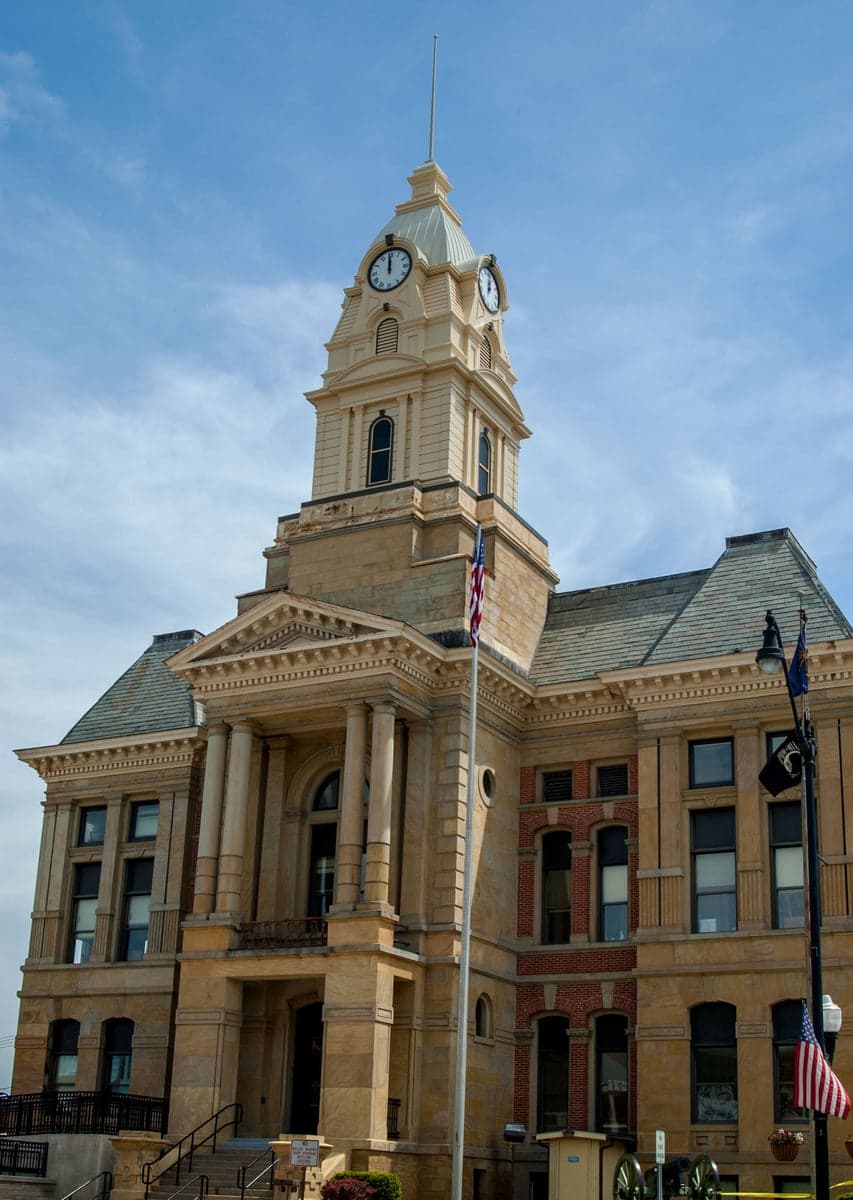
Photo: Wikipedia
Political ClimatePolitical Climate in Crawfordsville, IN
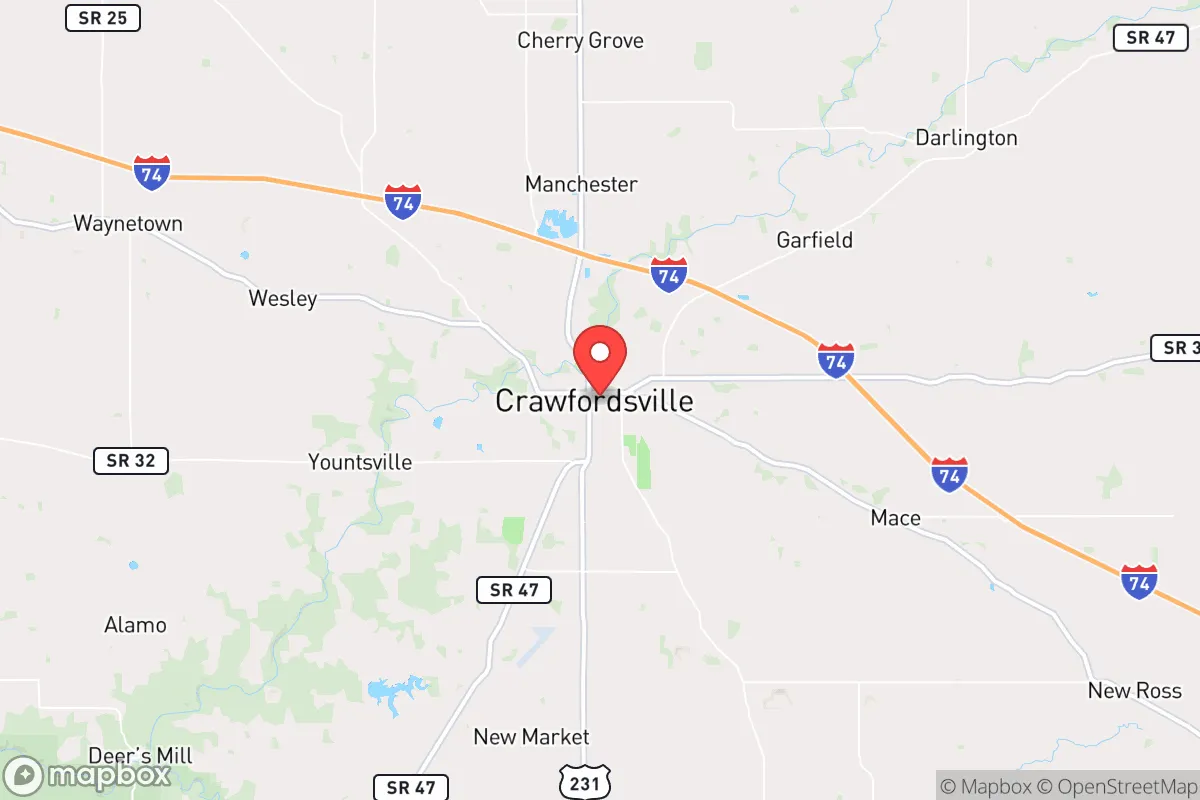
District shown is the primary district for this city’s centroid. Cities may span multiple districts.
Local Political AnalysisPolitical Analysis of Crawfordsville, IN
Crawfordsville has long been a reliably conservative stronghold, and that hasn't changed. With a Cook Partisan Voting Index (PVI) of R+15, the city and surrounding Montgomery County vote about six points more Republican than the state of Indiana as a whole, which sits at R+9. If you've lived here a while, you've seen that lean hold steady through the Trump years and beyond — it's not a place that flips, even in wave elections. The local trajectory is stable red, with no signs of a shift toward the center or left in the near future.
How it compares
Indiana as a whole is already a solidly Republican state, but Crawfordsville is noticeably deeper red. That R+15 rating puts it in the same ballpark as nearby conservative hubs like Lafayette (Tippecanoe County, R+13) and Kokomo (Howard County, R+16), but it's a different world from Bloomington (Monroe County, D+8) or even Indianapolis (Marion County, D+19). Drive an hour east to Frankfort or an hour west to Danville, and you'll find similar politics — but head south to Terre Haute (Vigo County, R+5) and the margin tightens noticeably. In practical terms, that means Crawfordsville's elections are rarely competitive at the local level, and Republican primaries often decide who holds office.
What this means for residents
For conservative residents, the political climate is comfortable and familiar. Local government, school boards, and county commissions are reliably Republican, and policy tends to reflect that — lower taxes, limited regulation, and a general skepticism of state-level mandates from Indianapolis. For liberal residents, the reality is different: you're likely in the minority, and your vote carries less weight in most local races. That doesn't mean you can't be involved — there are active Democratic precinct committees and a small but engaged progressive community — but you'll need to be comfortable being outnumbered. Socially, most people get along fine regardless of party; Crawfordsville isn't the kind of place where politics dominates every conversation, but it does shape the local culture in subtle ways, from church involvement to gun rights attitudes.
Culturally, Crawfordsville stands apart from Indiana's more liberal enclaves in a few key ways. You'll see more Second Amendment signage, more church parking lots full on Sunday mornings, and a general preference for local control over state or federal intervention. The city's identity is tied to Wabash College and its small-town manufacturing roots, which gives it a slightly more educated and moderate feel than some of the deeper rural counties to the north and west. But don't mistake that for a political shift — the college's presence hasn't meaningfully moved the needle. Looking ahead, Crawfordsville will likely stay R+15 or even drift a point or two redder as rural Indiana continues to diverge from the growing urban and suburban areas around Indianapolis and Bloomington. For anyone moving here, the takeaway is simple: if you're conservative, you'll feel right at home; if you're liberal, you'll find your people, but you'll be swimming against the current.

State Political ClimatePolitical Climate in Indiana
State Political AnalysisPolitical Environment in the State
Indiana has been a reliably Republican state for decades, carrying a Cook PVI of R+9, meaning it votes about nine points more Republican than the nation as a whole. The GOP holds a supermajority in both chambers of the state legislature, and no Democrat has won a statewide race since Joe Donnelly’s Senate victory in 2012. Over the last 10-20 years, the state has shifted rightward, driven by the exurban growth around Indianapolis and the consolidation of rural and small-town voters behind the GOP, while Democrats have become increasingly concentrated in a handful of urban counties and college towns.
Urban vs. rural divide
The political map of Indiana is a classic study in contrast. The Indianapolis metro area, anchored by Marion County, is the state’s Democratic stronghold — Joe Biden won Marion County by 27 points in 2020. But the surrounding ring of suburban and exurban counties — Hamilton, Hendricks, Johnson, and Boone — are deeply Republican. Hamilton County, home to Carmel and Fishers, voted for Donald Trump by 18 points in 2020, though it has shown slight signs of suburban moderation in recent cycles. Lake County in the northwest corner, part of the Chicago metro area, is another Democratic bastion, while neighboring Porter County is a perennial swing county that has trended red. The state’s other urban centers — Fort Wayne (Allen County), Evansville (Vanderburgh County), and South Bend (St. Joseph County) — lean Republican overall, though the cities themselves are more competitive. The vast rural expanse of central and southern Indiana, including counties like Knox, Daviess, and Dubois, votes overwhelmingly Republican, often by margins of 40 points or more. Bloomington, home to Indiana University, is a notable blue outlier in the southern part of the state, consistently voting Democratic by double digits.
Policy environment
Indiana’s policy environment reflects its Republican dominance. The state has a flat income tax rate of 3.15%, one of the lowest in the Midwest, and no inheritance or estate tax. Property taxes are capped at 1% of assessed value for owner-occupied homes, 2% for rental properties, and 3% for commercial property, a constitutional amendment approved by voters in 2010. The state is a right-to-work state, meaning workers cannot be required to join a union or pay dues as a condition of employment. Indiana also has some of the most permissive gun laws in the country: permitless carry was enacted in 2022, and the state has a strong preemption law that prevents local governments from enacting their own firearm ordinances. On education, Indiana has a robust school choice program, including vouchers that can be used at private and religious schools, and a growing network of charter schools. The state’s election laws require a government-issued photo ID to vote, and early voting is available for 28 days before an election, though no-excuse absentee voting was eliminated in 2023. Indiana does not have a state-level data privacy law comparable to California or Virginia, and its medical marijuana program is limited to CBD oil for a narrow set of conditions, with no recreational cannabis.
Recent policy direction
The last few years have seen Indiana’s legislature move decisively on several fronts. In 2022, the state passed a near-total abortion ban, with exceptions only for rape, incest, and to save the mother’s life, though the law was temporarily blocked by the courts before being upheld by the Indiana Supreme Court in 2023. On education, the state expanded its voucher program in 2023 to make nearly all families eligible, regardless of income, and passed a law requiring schools to notify parents of any changes to a student’s health or well-being, including gender identity. In 2024, the legislature passed a bill banning transgender girls from participating in K-12 sports, overriding the governor’s veto. On gun rights, the permitless carry law passed in 2022 was followed by a 2023 law prohibiting the state from enforcing any federal gun regulations that don’t exist under state law. Property rights were strengthened in 2023 with a law limiting the use of eminent domain for economic development. On voting, the 2023 law eliminating no-excuse absentee voting was paired with stricter signature verification requirements for mail-in ballots. The state has not expanded Medicaid beyond the 2015 HIP 2.0 program, which includes work requirements and premiums for some enrollees.
Civil unrest & political movements
Indiana has seen its share of political activism, though large-scale civil unrest has been relatively rare. The 2020 protests following George Floyd’s death were significant in Indianapolis, with several nights of demonstrations and property damage, but the state did not see the sustained unrest of larger cities. The abortion ban has energized both sides: pro-choice groups have held regular rallies at the Statehouse, while anti-abortion organizations have pushed for further restrictions. Immigration politics have been less volatile than in border states, though there have been flashpoints in communities like Logansport and Goshen, which have seen growing Latino populations. There is no sanctuary city policy in Indiana; in fact, a 2011 state law requires local law enforcement to cooperate with federal immigration authorities. Election integrity has been a recurring theme in Republican politics, with the 2023 voting law framed as a response to concerns about mail-in ballot fraud, though no widespread fraud has been documented. The state has seen a modest but vocal movement around the concept of “constitutional carry” and Second Amendment sanctuary counties, with over half of Indiana’s counties passing resolutions declaring themselves such. On the left, the Indiana Democratic Party has struggled to maintain a foothold outside of Marion and Lake counties, though grassroots groups have organized around climate, labor, and racial justice issues.
Projection
Over the next 5-10 years, Indiana is likely to remain solidly Republican, but the margins may narrow slightly as the Indianapolis suburbs continue to diversify and attract younger, more moderate residents. The growth of the tech and life sciences sectors in the Indianapolis area, particularly in the I-69 corridor between Indianapolis and Bloomington, could bring in a more educated and potentially more Democratic-leaning population. However, the rural and small-town areas that drive the state’s Republican majority are not shrinking as fast as in some other Midwestern states, and the GOP’s structural advantages — gerrymandered legislative districts, a strong party infrastructure, and a cultural alignment with conservative values — are likely to persist. The biggest wild card is the abortion issue: if the current ban remains in place, it could continue to mobilize Democratic voters in the suburbs, but it’s unlikely to flip the state as a whole. A new resident moving in now should expect a state where conservative policies are the norm, but where the urban centers and college towns offer a counterbalance, and where the political conversation is shaped by the tension between a growing, diversifying Indianapolis and a deeply conservative hinterland.
For someone relocating to Indiana, the bottom line is that the state offers a stable, low-tax environment with a strong Republican tilt, but the experience varies dramatically by location. A family moving to Carmel or Fishers will find excellent schools, safe neighborhoods, and a conservative-leaning but increasingly diverse community, while a single person moving to downtown Indianapolis or Bloomington will encounter a more liberal social environment and a vibrant cultural scene. The state’s politics are unlikely to surprise anyone who pays attention to national trends, but the local flavor — from the influence of the university in Bloomington to the manufacturing heritage of Fort Wayne — adds texture to the political landscape. Whether you’re looking for a place where your vote will feel impactful or where the policy environment aligns with your values, Indiana offers a clear, if not always comfortable, fit.
* Values derived from national, state, county, city and local statistics and may differ in a specific area. Last updated: 2026-08-09T10:25:13.000Z
Narrative content on this page is AI-generated and may contain mistakes. Verify any details that matter before acting on them.
ReloMaps may earn a commission from affiliate links at no extra cost to you.

