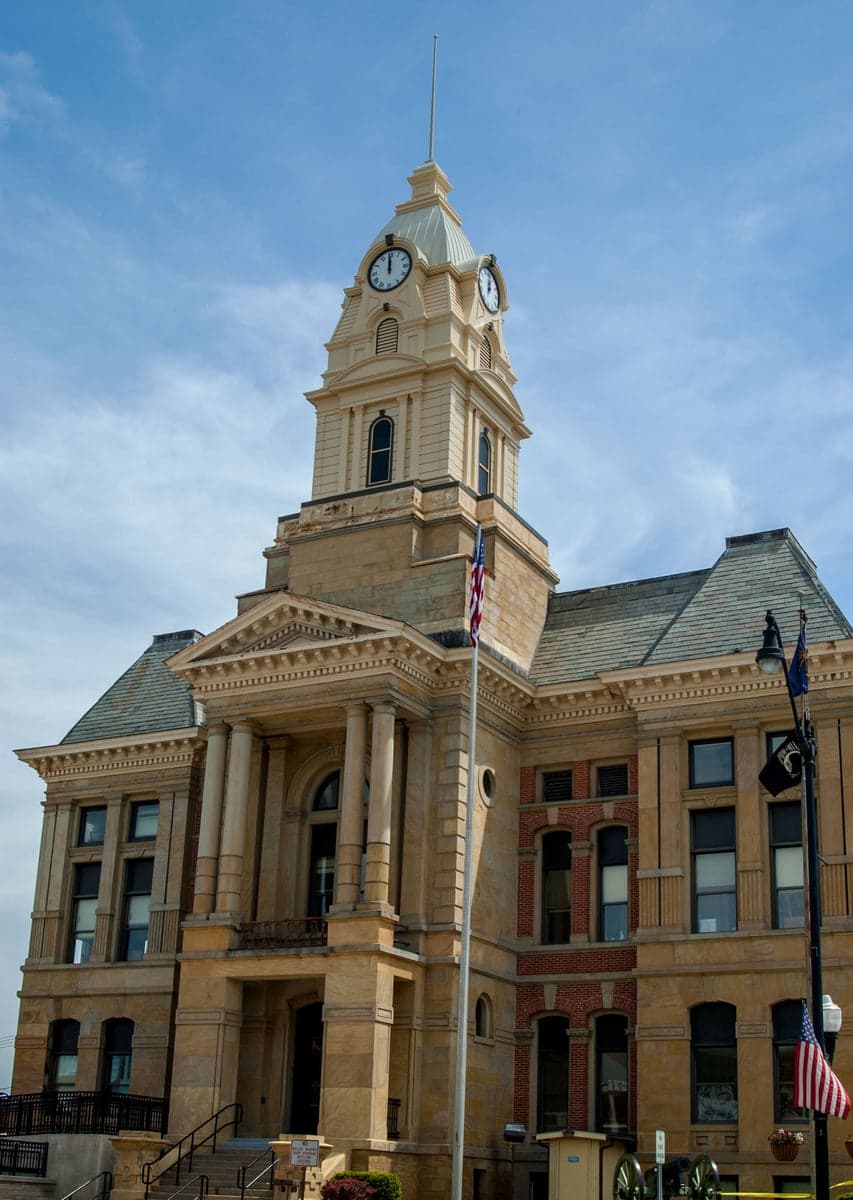
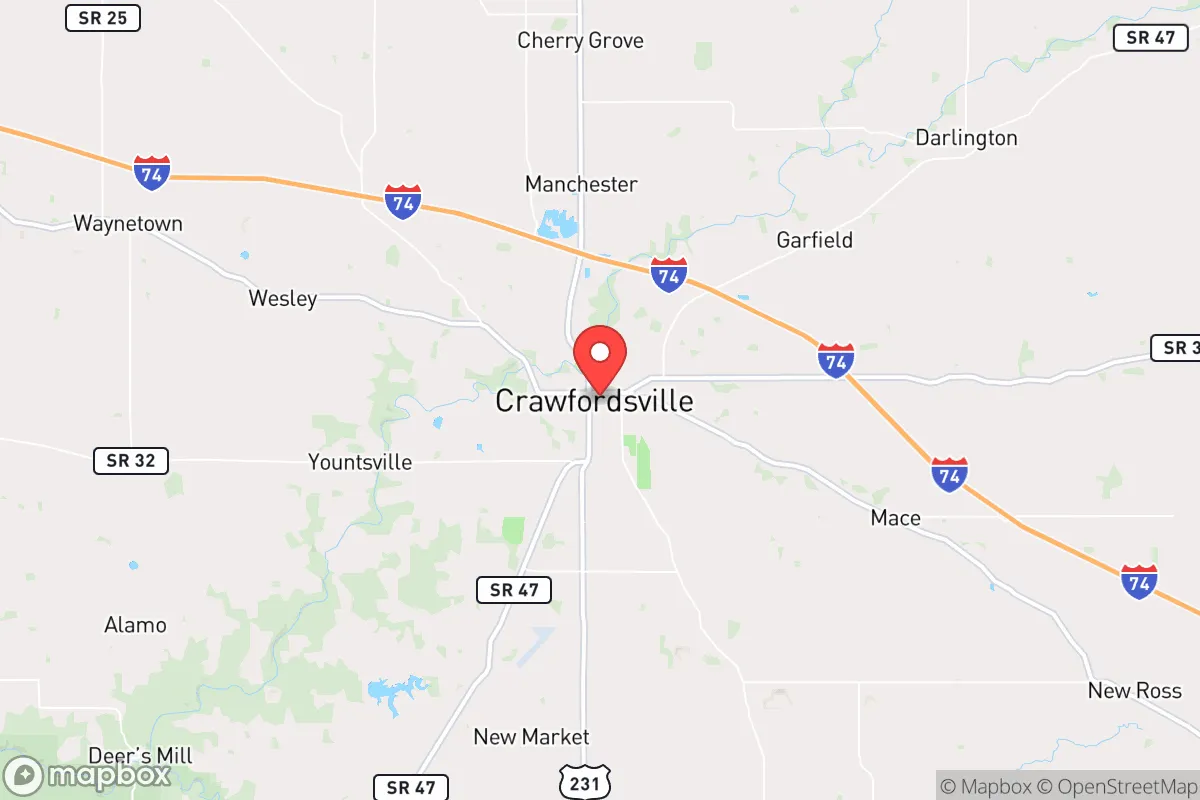
Photo: Wikipedia
Demographics of Crawfordsville, IN
Affluence Level in Crawfordsville, IN
A below-average socioeconomic profile. Incomes, home values, and educational attainment trail the U.S., with higher poverty and unemployment.
People of Crawfordsville, IN
The people of Crawfordsville, Indiana, today number 16,408, forming a community that is predominantly white (85.6%) with a growing Hispanic population (8.6%) and a small but present Black (1.0%), East/Southeast Asian (0.2%), and Indian subcontinent (0.5%) presence. The city is notably less diverse than the national average, with a foreign-born population of just 2.9% and a college-educated rate of 14.7% that trails state and national figures. Residents often describe Crawfordsville as a tight-knit, family-oriented manufacturing and college town, anchored by Wabash College and a strong sense of local identity. The population has remained relatively stable over recent decades, with modest shifts reflecting broader Midwestern trends of slow growth and gradual diversification.
How the city was settled and grew
Crawfordsville was founded in 1823 as the seat of Montgomery County, named after U.S. Treasury Secretary William H. Crawford. The original settlers were primarily of English, Scottish, and German stock, drawn by the promise of fertile farmland and the newly opened Indiana frontier. The arrival of the railroad in the 1850s transformed the town into a regional manufacturing and shipping hub, attracting a wave of Irish and German immigrants who settled in working-class neighborhoods near the rail yards and factories. The Old Town district, centered around the courthouse square, became the commercial and civic heart, while the South End developed as a blue-collar area housing railroad workers and mill hands. By the early 20th century, Crawfordsville had grown into a prosperous industrial town, with foundries, machine shops, and a thriving downtown. The establishment of Wabash College in 1832 added an academic layer, drawing faculty and students from across the Midwest and creating the College Hill neighborhood, a leafy enclave of historic homes and fraternity houses that remains distinct today.
Modern era (post-1965)
After the 1965 Immigration and Nationality Act, Crawfordsville saw only modest demographic change compared to larger Indiana cities. The Hispanic population began to grow in the 1990s and 2000s, driven by employment in manufacturing and agriculture, with many families settling in the East Side neighborhoods near industrial parks and along the U.S. 231 corridor. The Black population, historically small, has remained concentrated in the West End area, a legacy of mid-century housing patterns. East/Southeast Asian and Indian subcontinent residents are few and widely dispersed, often connected to Wabash College or local healthcare facilities. The city's overall population has hovered near 16,000 for decades, as suburbanization drew some residents to outlying areas like Linden and New Market, while the core city retained its character. The Mill Street corridor has seen some reinvestment, but the city has not experienced the rapid suburban expansion seen in Indianapolis suburbs to the east.
The future
Crawfordsville's population is projected to remain relatively stable, with slow growth driven by Hispanic and mixed-race households, while the white population is expected to decline slightly due to aging and out-migration of younger adults. The Hispanic share, currently 8.6%, is likely to rise toward 12-15% over the next two decades, with new arrivals and second-generation families settling in the East Side and South End neighborhoods, where housing is more affordable. The Black, Asian, and Indian subcontinent populations are expected to remain small, barring a major employer relocation or refugee resettlement program. The city's cultural identity is gradually shifting from a predominantly white, Protestant, manufacturing town to a more diverse, service-oriented community, though change is slow. Wabash College continues to attract a small but steady stream of international students and faculty, adding a cosmopolitan thread to the local fabric. For someone moving in now, Crawfordsville offers a stable, affordable, and family-friendly environment with a strong sense of place, but those seeking rapid demographic change or a highly diverse community will find it elsewhere.
In sum, Crawfordsville is a slowly diversifying Midwestern town where the white majority remains dominant, the Hispanic community is the fastest-growing segment, and other groups are present in very small numbers. The city's future likely holds gradual demographic evolution rather than transformation, making it a predictable choice for families and individuals who value stability, affordability, and a close-knit community over urban diversity and rapid change.

* Values derived from national, state, county, city and local statistics and may differ in a specific area. Last updated: 2026-08-09T10:25:13.000Z
Narrative content on this page is AI-generated and may contain mistakes. Verify any details that matter before acting on them.
ReloMaps may earn a commission from affiliate links at no extra cost to you.

