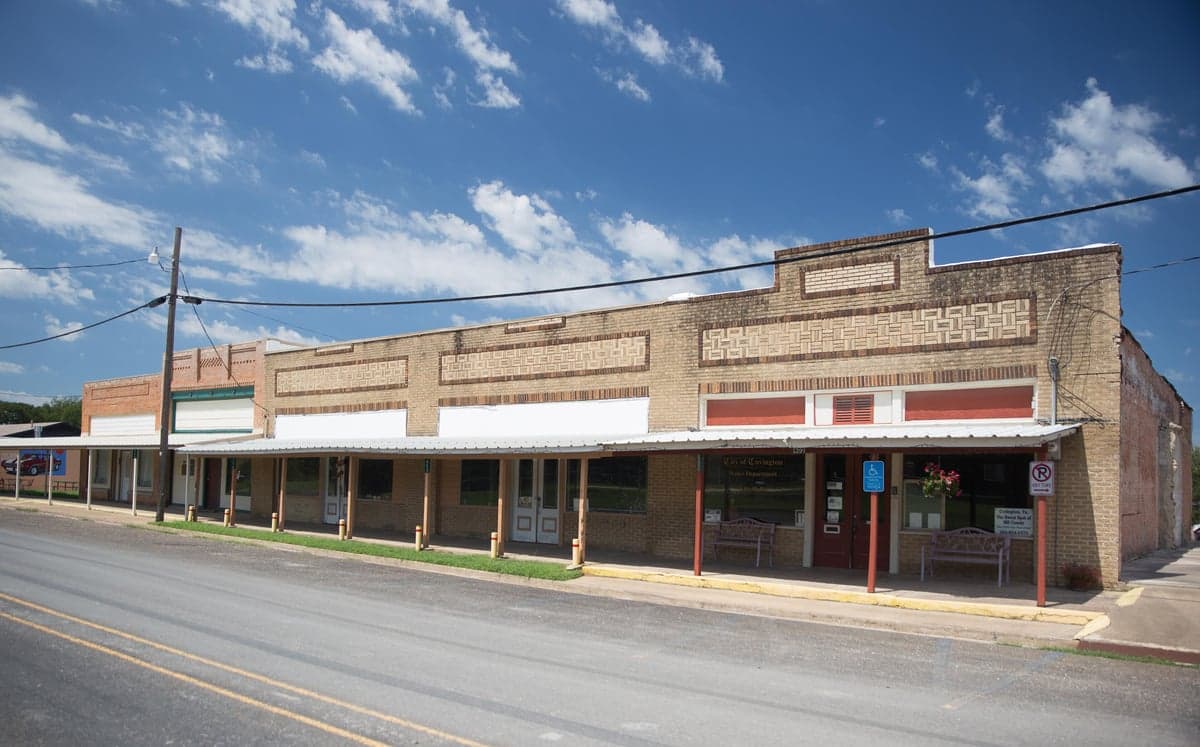
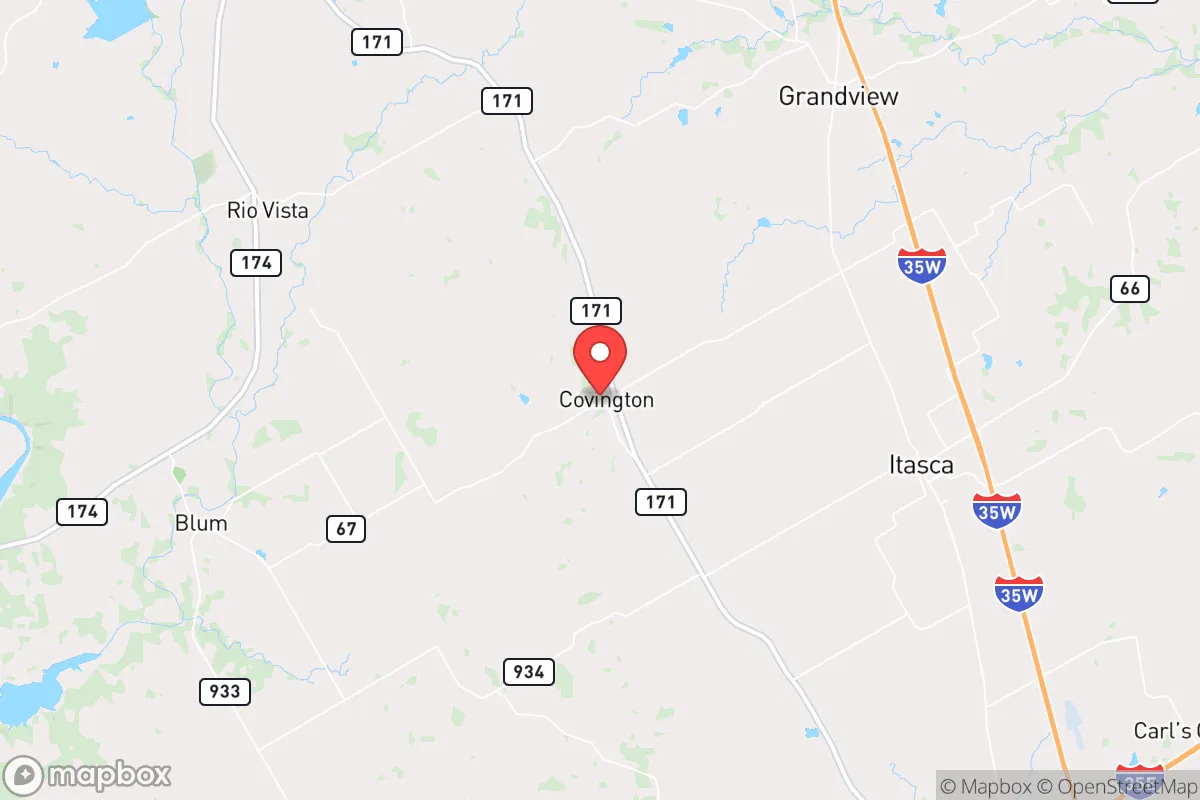
Photo: Wikipedia
Personal Sovereignty in Covington, TX
Strong independent fundamentals that actively favor personal liberty and low regulation.
What does Personal Sovereignty tell us?
Personal Sovereignty measures your capacity for self-reliance and independence with minimal government friction. Higher scores mean fewer barriers between you and the way you want to live... but it assumes you have the space you need and good neighbors.
What does this tell us?
Personal Sovereignty measures your capacity for self-reliance and independence with minimal government friction. Higher scores mean fewer barriers between you and the way you want to live... but it assumes you have the space you need and good neighbors.
State Policy
Energy independence: Net exporter (220% of energy produced in-state)
Personal Liberty
Homesteading

Personal Liberty Analysis
Covington, Texas, offers a personal sovereignty environment shaped by the state's strong preemption laws and a local culture that prizes individual decision-making. As the seat of Hill County, this community of roughly 1,300 residents operates under Texas's broad framework of limited government, where property rights, self-defense, and low taxation are baseline expectations rather than privileges. For a relocation researcher or family weighing autonomy, Covington represents a place where the default posture is "allowed unless explicitly prohibited," with local ordinances generally deferring to state-level protections for gun rights, parental authority, and property use.
Tax burden and regulatory posture in Hill County
The tax environment in Covington is defined by Texas's absence of a state income tax and a relatively lean local government structure. Hill County's property tax rate hovers around 0.65% to 0.75% of assessed value, depending on the specific taxing entities (county, school district, and any special districts). This places Covington below the national average for effective property tax rates, though it is slightly higher than some neighboring rural counties due to the local school district's funding needs. Sales tax in Covington is capped at the state's 6.25% plus local options, typically totaling 8.25%, which funds basic services without the burden of a municipal income tax. Regulatory oversight is minimal: there is no city-level zoning code in Covington proper, meaning property use is governed primarily by Hill County's subdivision regulations and Texas's statewide building codes for new construction. No local business license is required for most home-based enterprises, and the county's permitting process for structures under 2,000 square feet is streamlined, often taking less than 30 days. This light-touch approach extends to vehicle inspections (Texas requires annual safety inspections but no emissions testing in Hill County) and environmental regulations, which are enforced at the state level rather than locally.
Self-defense and gun law specifics for Covington residents
Texas's firearm laws apply fully in Covington, with no additional local restrictions beyond state statutes. The city is in a "constitutional carry" state, meaning no permit is required to carry a handgun openly or concealed for anyone 21 or older who is not prohibited by state or federal law. For those who prefer a License to Carry (LTC), the process involves a background check and a four-to-six-hour training course, but it is not mandatory for most carry scenarios. Covington's rural setting means that discharge of firearms on private property is generally lawful within city limits, provided it does not violate local noise ordinances or endanger others—a significant advantage for target practice or pest control. The "castle doctrine" and "stand your ground" laws are in full effect: there is no duty to retreat before using deadly force in self-defense in any place where a person is lawfully present. For home defense, Texas law explicitly protects the use of force against intrudents, and Covington's low population density (roughly 1,300 residents spread over 1.1 square miles) means that law enforcement response times can be 15–30 minutes, making personal preparedness a practical necessity. No local gun registration, waiting periods, or magazine capacity limits exist, and private firearm sales between individuals are legal without a background check, though federal law applies to licensed dealers.
Self-reliance and homesteading viability: lot sizes, zoning, and off-grid feasibility
Covington's land-use environment strongly supports self-reliance and homesteading. The city has no formal zoning code, so agricultural uses, livestock keeping, and home-based businesses are permitted by default on residential lots. Typical lot sizes in the older parts of town range from 0.25 to 0.5 acres, while newer subdivisions and unincorporated Hill County parcels offer 1- to 5-acre lots at prices between $5,000 and $15,000 per acre as of 2026. Raising chickens, goats, and even larger livestock like cattle is common on parcels over one acre, with no permit required from the city (though Hill County may require a simple agricultural exemption for tax purposes). Off-grid living is feasible but requires attention to state and county regulations: rainwater harvesting is legal and encouraged under Texas's Water Code, with no permit needed for systems under 10,000 gallons. Solar panels and wind turbines are allowed without special permits, though connection to the ERCOT grid is standard for most homes. Septic systems require a Hill County permit and inspection (typically $200–$400), and composting toilets are legal if they meet state health standards. No county-level restrictions on tiny homes or RVs as primary residences exist, provided they meet the Texas Department of Licensing and Regulation's minimum safety requirements. The local climate (average 36 inches of rain annually) supports year-round gardening, and the growing season extends from March to November, making food self-sufficiency a realistic goal for motivated residents.
Personal liberties: parental rights, medical autonomy, speech, and property
Texas law provides a strong baseline for personal liberties in Covington, with state preemption limiting local government overreach. Parental rights are explicitly protected under Texas Family Code, which affirms parents' authority to direct their children's education, medical care, and moral upbringing. Covington is served by the Covington Independent School District (roughly 400 students), where school board meetings are generally low-conflict and parents have direct access to administrators. Homeschooling is straightforward: parents must provide a written curriculum covering reading, spelling, grammar, mathematics, and good citizenship, but no standardized testing or state approval is required. Medical autonomy is shaped by Texas's permissive stance on alternative treatments: no state vaccine mandate exists for adults, and while school vaccine requirements apply, philosophical exemptions are available for public school attendance. Covington has no local health ordinances that restrict medical choices beyond state law. Free speech is protected under the First Amendment, and Covington's small-town character means that public discourse is generally informal and unregulated—no local noise ordinances target political speech, and leafleting or public gatherings on public property do not require permits. Property rights are robust: no local rent control, no inclusionary zoning mandates, and no historic preservation overlays restrict what owners can do with their land. Eminent domain is governed by Texas's Property Code, which requires full compensation and a public purpose, and Hill County has not exercised it aggressively in recent years.
Overall, Covington offers a personal sovereignty profile that ranks among the strongest in North Texas for those prioritizing autonomy. The combination of no state income tax, constitutional carry, minimal zoning, and strong parental rights creates an environment where individual decision-making is the default. Compared to more regulated suburbs like Frisco or McKinney, Covington's lighter touch on property use and self-defense is a clear advantage for homesteaders and freedom-minded families. For a relocation researcher, the key trade-off is access to services: Covington's autonomy comes with fewer public amenities and longer drives to major employers (roughly 45 minutes to Waco, 90 minutes to Fort Worth), but for those who value self-reliance over convenience, it represents a genuine pocket of personal sovereignty in a state already known for its libertarian leanings.

* Values derived from national, state, county, city and local statistics and may differ in a specific area. Last updated: 2026-08-26T02:47:41.000Z
Narrative content on this page is AI-generated and may contain mistakes. Verify any details that matter before acting on them.
ReloMaps may earn a commission from affiliate links at no extra cost to you.

