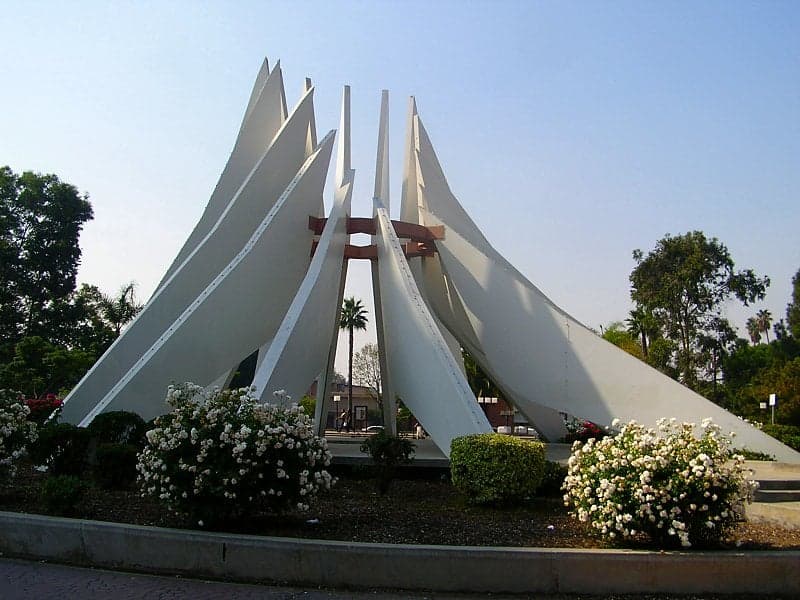
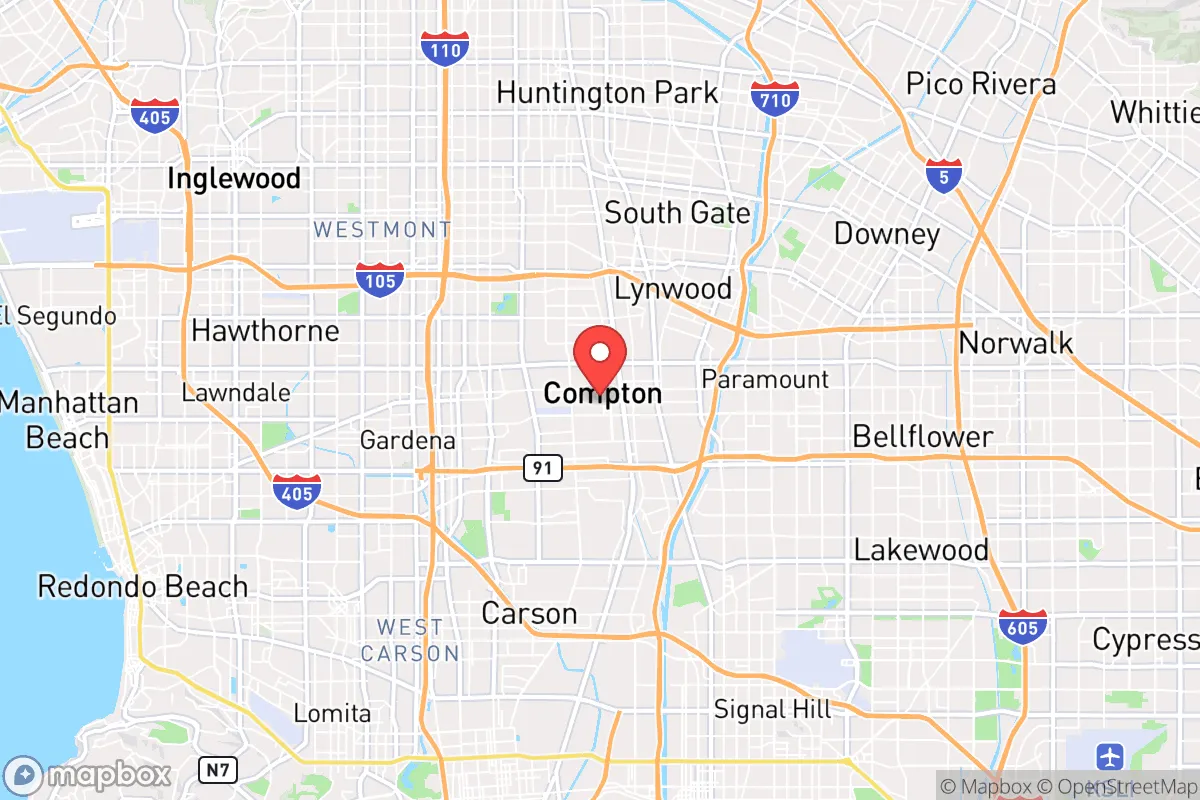
Photo: Wikipedia
Demographics of Compton, CA
Affluence Level in Compton, CA
A middle-class area roughly in line with national averages across income, home values, education, and employment.
People of Compton, CA
The people of Compton, California today form a densely packed, predominantly Hispanic and Black community of 93,525 residents, with a foreign-born population of 18.6% and a notably low college attainment rate of 10.9%. The city is 71.2% Hispanic, 24.9% Black, and 0.7% White, with East and Southeast Asian communities making up 1.1% and Indian subcontinent residents at 0.0%. This demographic profile reflects a city shaped by successive waves of migration, industrial opportunity, and suburban transformation, where distinct neighborhoods carry the legacy of each era.
How the city was settled and grew
Compton was founded in 1867 by Griffith D. Compton as a farming community on the Rancho San Pedro land grant, attracting white Protestant settlers from the Midwest who established small farms and ranches. The arrival of the Southern Pacific Railroad in the 1870s spurred growth, and by the early 1900s, the city had become a modest agricultural hub. The first major demographic shift came during the Great Migration (1910–1940), when Black families fleeing Jim Crow in the South began settling in the Richland Farms neighborhood, drawn by the promise of agricultural work and relatively affordable land. This area, with its large lots and equestrian zoning, became a rare foothold for Black homeownership in Southern California. By the 1940s, the Downtown Compton area also saw a growing Black population, as wartime industries at the nearby Port of Los Angeles and aircraft plants in Long Beach and Inglewood pulled in workers from Texas, Louisiana, and Arkansas. The post-World War II boom transformed Compton into a working-class suburb, with white families moving in alongside Black families, though racial covenants and redlining kept much of the city segregated through the 1950s.
Modern era (post-1965)
The Hart-Cellar Immigration Act of 1965 and the subsequent decline of manufacturing in the 1970s and 1980s reshaped Compton's population dramatically. White flight accelerated after the 1965 Watts Rebellion, with many white families leaving for the Antelope Valley and Orange County. Into this vacuum came a surge of Hispanic immigration, primarily from Mexico and Central America, who settled in neighborhoods like Willowbrook and South Central Compton. By 1990, the city had shifted from majority-Black to majority-Hispanic, a transition that continued through the 2000s. The Black population, which peaked at roughly 75% in the 1970s, has since declined to 24.9%, while the Hispanic share rose to 71.2%. The Lueder Park area and the East Compton district became centers of Hispanic residential and commercial life, with bodegas, panaderías, and Spanish-language churches replacing older storefronts. The foreign-born share of 18.6% reflects a mature immigrant community, with many second- and third-generation Hispanic families now established. The Black population, while smaller, remains concentrated in Richland Farms and parts of Downtown Compton, where historic churches and civic organizations maintain continuity with the city's earlier era.
The future
Compton's population is projected to remain predominantly Hispanic, with the Black share continuing a slow decline as younger Black families move to the Inland Empire and Antelope Valley for newer housing and lower crime rates. The Hispanic population is becoming more settled, with lower immigration rates and higher native-born shares, which may gradually increase educational attainment and household income. The city's college education rate of 10.9% is among the lowest in Los Angeles County, a structural challenge that limits upward mobility and keeps the population relatively young and working-class. Gentrification pressures from neighboring Long Beach and South Los Angeles are modest but present, with some new development in the Compton Creek corridor and near the Metro C Line stations, though displacement has been limited by the city's persistent reputation for crime and underinvestment. The East and Southeast Asian population of 1.1% is small and stable, concentrated in a few blocks near Willowbrook Avenue, with no significant growth expected. The Indian subcontinent population remains at 0.0%, reflecting the city's lack of professional-class housing stock and tech-sector employment.
For someone moving in now, Compton is a deeply established working-class community with strong family networks and cultural institutions, but with limited economic mobility and a demographic trajectory that is solidifying rather than diversifying. The city's identity is increasingly Hispanic, with a proud Black minority that remains influential in local politics and civic life, while the white and Asian populations are negligible. New residents should expect a dense, urban environment with a young population, modest housing stock, and a community that values local roots over newcomer influx.

* Values derived from national, state, county, city and local statistics and may differ in a specific area. Last updated: 2026-08-13T19:15:11.000Z
Narrative content on this page is AI-generated and may contain mistakes. Verify any details that matter before acting on them.
ReloMaps may earn a commission from affiliate links at no extra cost to you.

