Photo: Wikipedia
Demographics of Columbus, GA
Affluence Level in Columbus, GA
A below-average socioeconomic profile. Incomes, home values, and educational attainment trail the U.S., with higher poverty and unemployment.
People of Columbus, GA
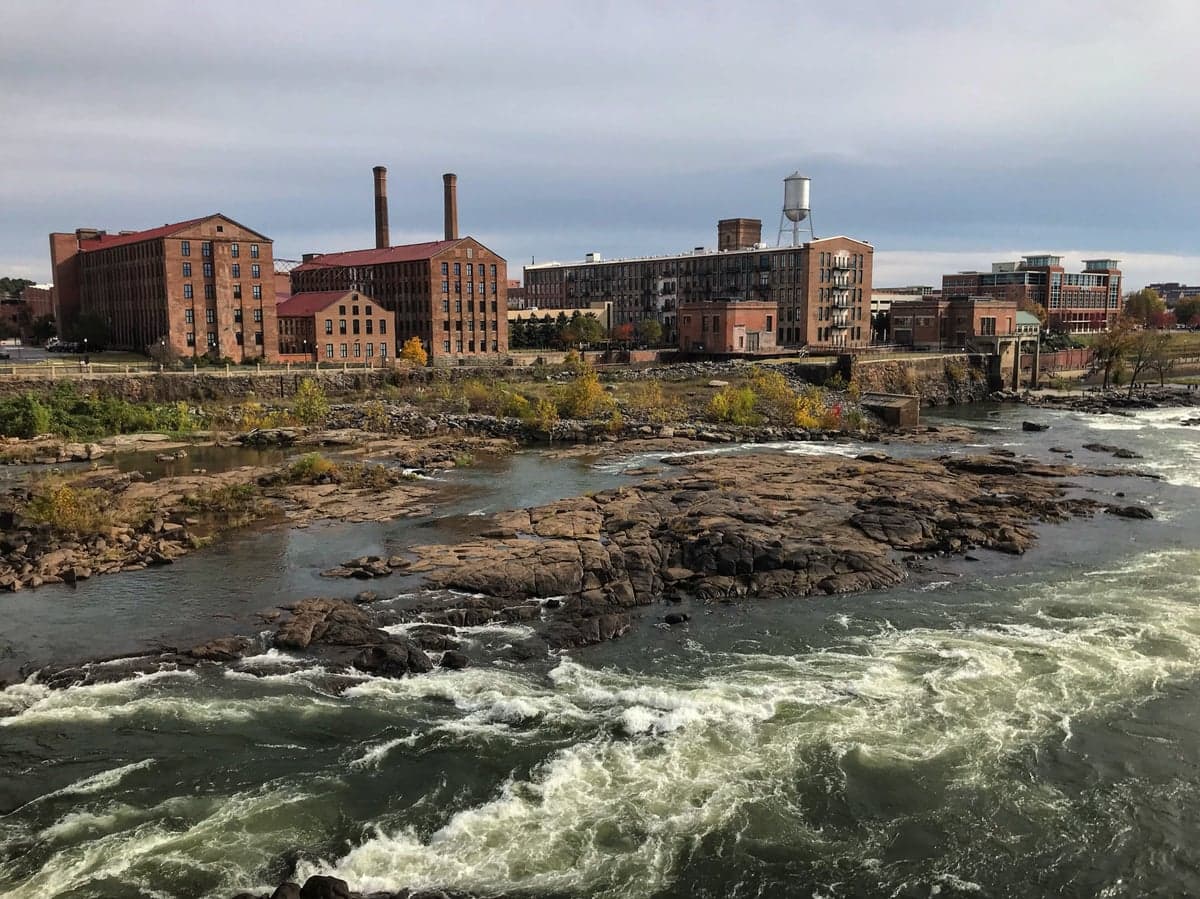
The people of Columbus, Georgia today form a majority-minority population of 204,383, defined by a Black plurality at 45.9% and a White population at 37.4%, with a small but growing Hispanic share of 8.3% and a notably low foreign-born rate of 2.3%. The city carries a distinctive identity as a historic industrial and military hub on the Chattahoochee River, where a deep-rooted Black middle class coexists with a significant military-connected population from nearby Fort Moore (formerly Fort Benning). The city's character is one of pragmatic Southern resilience, with a college attainment rate of 29.7% and a population that remains overwhelmingly native-born, giving Columbus a more insular, locally anchored feel than many other Georgia cities of similar size.
How the city was settled and grew
Columbus was founded in 1828 as a planned river port at the fall line of the Chattahoochee, designed to be the western terminus of a railroad from Savannah. The original White settlers were largely planters and merchants from the Georgia and South Carolina Lowcountry, drawn by the promise of cotton shipping and water-powered mills. The city's early wealth was built on enslaved Black labor, which by 1860 made up nearly half the population. After the Civil War, freedmen established several historic Black neighborhoods that remain central to the city's identity today. Liberty District, just east of downtown, became the commercial and civic heart of the Black community, anchored by the Liberty Theatre and numerous Black-owned businesses. Carver Heights, developed in the early 20th century, became a middle-class Black enclave, home to educators, small business owners, and professionals. The industrial boom of the late 19th and early 20th centuries—textile mills, iron works, and the arrival of the railroad—drew waves of White rural migrants from surrounding counties, settling in mill villages like Bibb City (a company town built by the Bibb Manufacturing Company) and North Highlands. These neighborhoods were ethnically homogeneous, largely Anglo-Saxon Protestant, with small pockets of Irish and German immigrants who worked in the mills. By 1950, Columbus was a biracial city of roughly 80,000, rigidly segregated by law and custom, with Black residents confined to the eastern and southern fringes.
Modern era (post-1965)
The post-1965 era brought profound demographic change, driven not by foreign immigration but by domestic migration and suburbanization. The 1965 Hart-Cellar Act had minimal impact on Columbus—the foreign-born share remains just 2.3% today, far below the national average. Instead, the major shift was the expansion of Fort Benning (now Fort Moore) during the Vietnam War and the subsequent drawdown of the Cold War, which brought a steady stream of military families from across the country, many of whom retired in Columbus. This military presence created a transient but influential population concentrated in Midland and North Columbus, areas near the base that saw rapid suburban development from the 1970s onward. Simultaneously, White flight to the northern suburbs accelerated after school desegregation in the 1970s, reshaping the city's racial geography. The Black population, which had been largely confined to the east side, expanded westward and southward into neighborhoods like South Columbus and East Highland. The Hispanic population, though small at 8.3%, began to grow noticeably in the 1990s and 2000s, driven by construction and service-sector jobs, with a visible concentration in the Victory Drive corridor and parts of East Columbus. The East/Southeast Asian community (1.3%) and Indian-subcontinent community (1.2%) are small but established, with families often connected to the medical and academic sectors, living primarily in the North Columbus suburbs near the hospital district.
The future
The population of Columbus is trending toward greater racial and ethnic diversity, but at a slower pace than the national average. The White share has declined steadily from over 50% in 1990 to 37.4% today, while the Hispanic share has grown from under 2% to 8.3% in the same period. The Black plurality is projected to remain stable or increase slightly, as the city continues to attract Black professionals from smaller towns in the Black Belt and from Atlanta's expensive suburbs. The foreign-born population, however, is unlikely to surge—Columbus lacks the gateway-city infrastructure and job diversity that drive large-scale immigration. The city is not homogenizing into a single melting pot; rather, it is tribalizing into distinct enclaves. North Columbus and Midland remain predominantly White and military-affiliated, Carver Heights and Liberty District retain their historic Black identity, and Victory Drive is emerging as a Hispanic commercial corridor. The next 10-20 years will likely see continued suburban expansion northward toward Harris County, while the urban core may see modest gentrification as downtown redevelopment attracts younger, college-educated residents. The military connection will remain the single most stabilizing demographic force, ensuring a steady influx of new residents even as natural population growth slows.
Columbus is becoming a more diverse but still deeply segmented city, where a person's neighborhood often signals their race, class, and connection to the military. For a conservative-leaning individual or family moving in now, the city offers a stable, affordable environment with a strong sense of local identity, but one where the social fabric is woven from distinct, self-contained communities rather than a single civic culture. The low foreign-born rate and high native-born share mean that newcomers will find a population that is rooted, traditional, and slow to change—qualities that appeal to those seeking continuity over flux.

* Values derived from national, state, county, city and local statistics and may differ in a specific area. Last updated: 2026-04-29T20:16:23.000Z
Narrative content on this page is AI-generated and may contain mistakes. Verify any details that matter before acting on them.
ReloMaps may earn a commission from affiliate links at no extra cost to you.

