Photo: Wikipedia
Demographics of Rio Grande County
Affluence Level in Rio Grande County
A middle-class area roughly in line with national averages across income, home values, education, and employment.
People of Rio Grande County
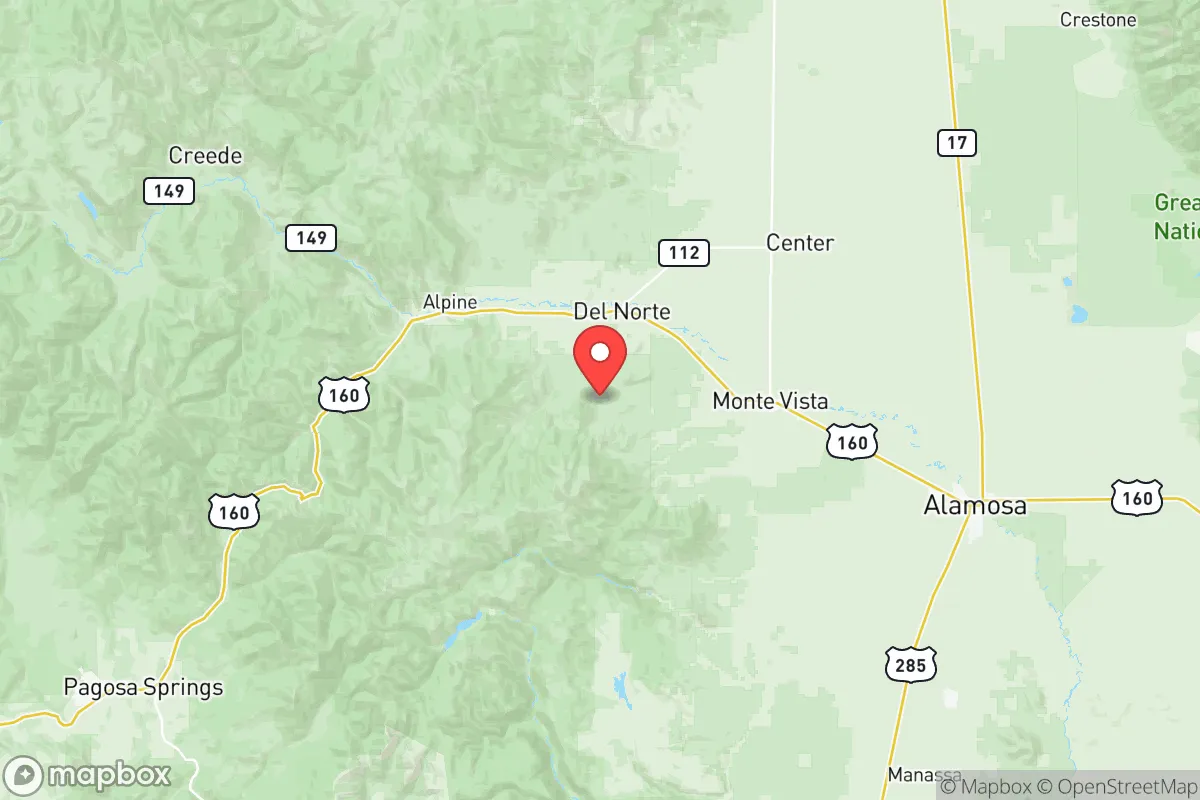
The people of Rio Grande County today number roughly 11,400 and are defined by a deep-rooted Hispanic heritage combined with an Anglo ranching and farming tradition. The county spans the northern San Luis Valley, one of Colorado’s oldest continuous European-settled regions, and its character remains distinctly rural—with Monte Vista serving as the commercial and administrative hub, Del Norte as a historic gateway, and South Fork as a retirement and recreation draw. Density is low, identity markers lean toward agricultural self-reliance and Catholic church life among the Hispanic majority, and the political culture is mixed: conservative on fiscal matters, with a strong libertarian streak typical of high-country farming communities.
Settlement & growth (pre-1960)
Long before American sovereignty, the San Luis Valley was home to Ute bands who used it as winter hunting grounds; the Colorado Ute tribes remain present in the state though their reservation is on the Southern Ute and Ute Mountain lands to the south. Spanish and Mexican exploration and land grants began reaching the valley by the late 1700s, and the first permanent Hispanic settlements in what is now Rio Grande County appeared around the 1850s, when families from the Taos and Santa Fe areas moved north following the Rio Grande. These settlers—often genízaro (detribalized Native Americans Hispanicized in New Mexico) and mestizo—founded Del Norte in the 1850s as a Mexican-era plaza, and later Monte Vista as farming expanded after the Civil War. Their economy centered on irrigated subsistence farming and sheep grazing, and Spanish-language traditions, acequia irrigation, and Catholic feast days took root that persist today.
The American period began in earnest after the Treaty of Guadalupe Hidalgo (1848) and the Colorado Gold Rush (1859), but it was the arrival of the Denver and Rio Grande Railway in the 1880s that triggered a second wave of settlement. Anglo ranchers and homesteaders—many from the Midwest and Upper South—poured in, drawn by cheap land and the railroad’s promise of market access. They established cattle ranches around South Fork and built the town of Homelake (originally a farming cooperative). Mining in the nearby San Juan Mountains also brought a transient, mostly Anglo workforce, but the real economic engine became irrigated potato and alfalfa farming. By 1910, the county’s Hispanic and Anglo populations were roughly equal, though the two groups lived in separate but adjacent neighborhoods—Anglos in the north side of Monte Vista and Hispanics in the south side, a separation that lasted well into the mid-20th century. Japanese immigrant laborers arrived in the 1910s to work sugar beet fields, but their numbers were small and most left after the 1920s; the 4.2% foreign-born share today is overwhelmingly from Mexico and Central America. The Dust Bowl and Great Depression slowed in-migration, and the county’s population peaked around 1920 and then gradually declined as agricultural consolidation pushed young people out.
Modern era (post-1965)
The 1965 Hart-Cellar Act had little direct effect on Rio Grande County because it attracted few new overseas immigrants—its foreign-born percentage (4.2% in 2023) has remained low. Instead, post-1965 demographic change came from within. The Hispanic population, overwhelmingly U.S.-born of deep New Mexican and Colorado roots, began a slow but steady reassertion as a cultural majority. By the 1990s, Hispanic residents made up about a third of the county; by the 2020 census they reached 40.6%. Meanwhile, the non-Hispanic White share fell from roughly 70% in 1980 to 55.2% today—partly due to out-migration of younger Anglos seeking urban careers and partly due to higher Hispanic birth rates. The Monte Vista and Del Norte public schools now serve student bodies that are over 60% Hispanic, and Spanish is widely spoken in stores and churches. South Fork, by contrast, has remained predominantly White, attracting retirees from Colorado’s Front Range and other states who value the low cost of land and recreational access to the Rio Grande National Forest. This split is not antagonistic—local politics and civic life are fairly cooperative, with neither tribe nor enclave tribalism dominating—but social circles and church attendance often follow ethnic lines. The Black population is negligible at 0.4%, and East/Southeast Asian residents make up only 0.1%, concentrated in a handful of families affiliated with the South Fork tourism sector. There is no measurable Indian subcontinent community. Domestic migration since 2000 has been modest: a trickle of remote workers and retirees drawn to the valley’s dry climate and open space, but the county lost 1.2% of its population between 2010 and 2020, primarily through out-migration of young adults.
The future
Projecting forward, Rio Grande County’s population is likely to stabilize near its current size, with the Hispanic share continuing to rise slowly—possibly approaching 50% by 2040—before plateauing as overall birth rates converge. The White population will continue to age and shrink, especially as the Anglo ranching families’ children leave for Denver or Colorado Springs. Neither homogenization nor tribalization fully describes the trend: the county is gradually becoming more Hispanic in ethnic identity and more bilingual in daily life, but without the formation of insular enclaves. The small inflow of remote workers and second-home buyers (mostly Anglo and concentrated in South Fork) is unlikely to transform the region’s cultural identity, as the agricultural economy and family-centered Hispanic traditions remain dominant in Monte Vista and Del Norte. The next decade will likely see continued out-migration of education-seeking youth, offset slightly by in-migration of budget-conscious retirees and outdoor enthusiasts. The college-educated share (31.1%) is slightly below the state average, reflecting the limited white-collar job base; if broadband access improves, more remote workers could settle in, nudging the share upward.
Rio Grande County is becoming a stable, binational-rooted rural community—overwhelmingly Hispanic in heritage, conservative in values, and agricultural in rhythm. For someone moving in now, especially a parent, the trade-offs are clear: strong community ties and low crime rates balanced against limited economic opportunity and a social landscape where Spanish and English mix naturally. The region is not experiencing rapid cultural upheaval but a slow, organic reaffirmation of its oldest roots.

* Values derived from national, state, county, city and local statistics and may differ in a specific area. Last updated: 2026-06-01T12:35:59.000Z
Narrative content on this page is AI-generated and may contain mistakes. Verify any details that matter before acting on them.
ReloMaps may earn a commission from affiliate links at no extra cost to you.

