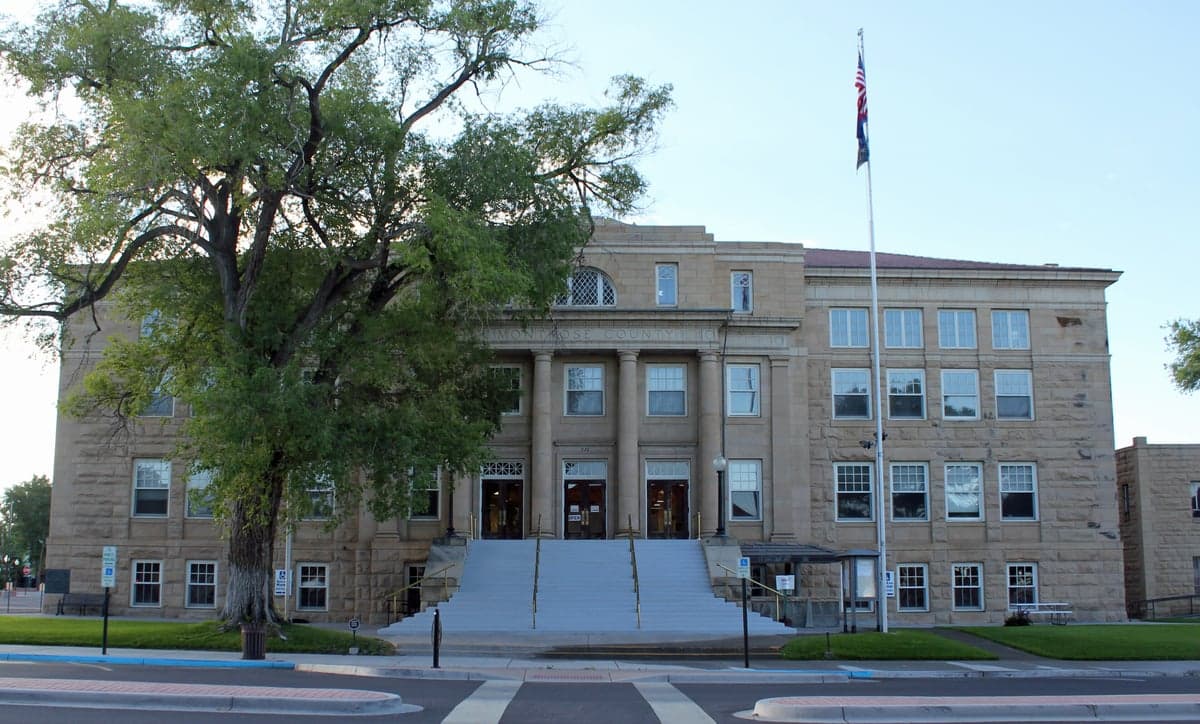
Photo: Wikipedia
Political ClimatePolitical Climate in Montrose County
Showing district-level results — no local-only data available.
Local Political AnalysisPolitical Analysis of Montrose County
Montrose County has been a reliably Republican stronghold for decades, but the margins are tightening in a way that mirrors the broader political shifts happening across Colorado’s Western Slope. The county carries a Cook Partisan Voting Index of R+5, meaning it votes about five points more Republican than the national average, but that’s a far cry from the deep-red dominance you’d see in places like Moffat or Rio Blanco counties to the north. In the 2020 presidential election, Donald Trump won Montrose County by about 18 points—down from a 28-point margin in 2016—and that trend has continued into 2024, where the gap narrowed further to roughly 15 points. The county seat, Montrose, is the real bellwether: its precincts around the historic downtown and the newer developments near the airport have been trending purple, while the outlying communities like Olathe, Nucla, and Naturita remain solidly red. The unincorporated areas along the Uncompahgre River and the San Juan Mountains foothills are where you’ll find the most conservative voters, often turning out 70% or more for Republican candidates.
How it compares
Compared to Colorado as a whole, Montrose County is a clear outlier. The state has shifted from a classic swing state to a solidly blue one over the past two decades, driven by explosive growth along the Front Range—Denver, Boulder, and the I-25 corridor. Montrose County, by contrast, has seen slower, more deliberate growth, and its electorate has remained older, whiter, and more rural than the state average. While Colorado’s Cook PVI isn’t officially calculated at the state level, the state voted for Joe Biden by 13.5 points in 2020 and Kamala Harris by about 11 points in 2024, making it roughly D+10 to D+12 in practical terms. That means Montrose County is about 15 to 17 points more Republican than the state average. The gap is most visible in policy: Montrose County commissioners have passed resolutions opposing state-level gun control measures and sanctuary city policies, while the city council in Montrose itself has been more cautious, often deferring to local business interests over ideological battles. The county’s rural precincts vote more like Utah or Wyoming, while the town of Montrose increasingly votes like a smaller version of Grand Junction—still red, but with a growing blue undercurrent among younger professionals and remote workers.
What this means for residents
For conservative residents, Montrose County remains a comfortable place to live politically. Local elections are dominated by Republicans, the county GOP is well-organized, and conservative values are reflected in everything from school board decisions to land-use policies. The county has resisted adopting statewide renewable energy mandates, and the local economy still leans heavily on agriculture, energy extraction, and outdoor recreation—industries that tend to favor limited regulation. For liberal residents, the picture is more nuanced. You won’t find much overt hostility, but you will find a community where progressive views are a distinct minority. The town of Montrose has a small but active Democratic club, and the local Indivisible chapter has grown since 2016, but their influence is limited to city-level issues like affordable housing and downtown development. Statewide ballot measures—like the 2024 initiative to enshrine abortion rights in the Colorado constitution—passed comfortably statewide but lost in Montrose County by about 10 points, a reminder that cultural divides persist even as the county’s overall partisan lean softens.
The cultural and policy distinctions in Montrose County are most visible in how the community balances growth with tradition. The county has become a magnet for out-of-state transplants, many from California and Texas, who are drawn to the lower cost of living and outdoor lifestyle. These newcomers tend to be more moderate or even liberal, and they’re slowly shifting the political center of gravity in the Montrose city limits. But the county’s rural precincts are holding firm, and the tension between the two is playing out in local zoning debates, water rights disputes, and school funding decisions. The long-term trajectory points toward a county that remains Republican but becomes more competitive at the local level, especially as the town of Montrose continues to grow and diversify. For now, the best way to understand Montrose County’s politics is to look at the map: the blue dots are getting bigger, but the red sea around them isn’t receding anytime soon.

State Political ClimatePolitical Climate in Colorado
State Political AnalysisPolitical Environment in the State
Colorado has shifted from a quintessential purple swing state to a solidly blue-leaning state over the past two decades, though it retains a fiercely independent and libertarian streak that makes it distinct from coastal liberal strongholds. Democrats now control every statewide office and both chambers of the legislature, a dominance cemented by rapid population growth in the Denver metro and along the Front Range, while the rural eastern plains and Western Slope have grown more Republican and resentful of the state's direction. The 2024 presidential election saw Colorado vote for the Democratic candidate by roughly 8 points, a margin that has been remarkably stable since 2016, but the real story is the geographic and cultural chasm between the booming urban corridor and the rest of the state.
Urban vs. rural divide
The political map of Colorado is essentially a story of two states. The Front Range urban corridor — Denver, Boulder, Aurora, and the suburbs of Jefferson and Arapahoe counties — drives the state's blue lean, with Boulder County routinely delivering 70-80% of its vote to Democrats. The Denver metro area alone accounts for over half the state's population, and its growth has been fueled by transplants from California, Texas, and the Midwest who tend to be younger, more educated, and more liberal. Meanwhile, the eastern plains counties like El Paso County (Colorado Springs) remain reliably red, though even Colorado Springs has been trending slightly more competitive as its tech and defense sectors attract a more diverse workforce. The Western Slope, including Mesa County (Grand Junction), is deeply conservative and has become a hotbed of anti-state-government sentiment, with some counties exploring secession rhetoric and "Greater Idaho" style movements. The mountain resort counties like Summit and Pitkin (Aspen) are wealthy and liberal, creating a patchwork where a 20-minute drive can take you from a deep blue ski town to a deep red ranching community.
Policy environment
Colorado's policy environment is a mixed bag that reflects its purple roots and blue present. The state has a flat income tax rate of 4.4%, which was actually reduced from 4.55% by a 2024 ballot measure, and the Taxpayer's Bill of Rights (TABOR) still constrains state spending growth, though it has been significantly eroded by court rulings and ballot measures over the years. Property taxes are relatively low compared to the national average, but recent legislative changes have allowed for faster growth in assessments, sparking backlash from homeowners. The regulatory posture is generally business-friendly for tech and renewable energy, but oil and gas extraction faces some of the strictest regulations in the country, including 2,000-foot setback requirements from homes and schools passed in 2019. Education policy is a flashpoint: the state has seen a surge in school choice and charter schools, but also a major push for progressive curricula and LGBTQ+ inclusive policies that have alienated conservative parents. Healthcare is dominated by a strong Medicaid expansion and a state-run insurance exchange, but premiums remain high. Election laws are among the most accessible in the nation, with universal mail-in voting and same-day registration, which Republicans argue benefits Democrats but which also produces high turnout across the board.
Recent policy direction
The last five years have seen Colorado's legislature move aggressively on a range of hot-button issues that relocators should weigh carefully. On gun rights, the state passed a 2023 law raising the purchase age for all firearms to 21 and a 2024 law banning so-called "assault weapons" and large-capacity magazines, making it one of the strictest states in the country for gun owners. Self-defense law remains relatively strong with a "Make My Day" castle doctrine, but there is no permitless carry. On parental and education rights, the state has moved in the opposite direction from many red states: a 2023 law requires schools to allow transgender students to use facilities matching their gender identity, and a 2024 law prohibits school districts from notifying parents if a child changes their name or pronouns at school. Medical and bodily autonomy is fully protected, with abortion codified into state law and no gestational limits, and the state has become a haven for out-of-state patients seeking gender-affirming care. Property rights are a growing concern, with the state's 2023 "land use" reform bill preempting local zoning to force higher density housing near transit, which has angered suburban homeowners. Privacy and surveillance law is relatively strong, with a comprehensive Colorado Privacy Act, but facial recognition bans have been limited. Voting and ballot access is extremely easy, with automatic voter registration and mail ballots sent to every active voter, though this has led to concerns about ballot harvesting and signature verification that remain unresolved.
Civil unrest & political movements
Colorado has a long history of political activism that can flare into visible conflict. The 2020 protests in Denver over George Floyd's murder were among the largest in the country per capita, leading to property damage and a lasting rift between city leadership and law enforcement. On the right, the Weld County area north of Denver has been a center of the "constitutional sheriff" movement, with local officials refusing to enforce certain state gun laws and sanctuary policies for the Second Amendment. Immigration politics are a major fault line: Denver has declared itself a sanctuary city, and the state has laws limiting cooperation with ICE, but the 2023-2024 surge of migrants bused from Texas overwhelmed the city's shelter system and sparked a backlash even among some liberal residents. Election integrity remains a live issue, with Republican activists in El Paso County and Mesa County pushing for hand-count audits and challenging Dominion voting machines, leading to a high-profile case where a county clerk was indicted for allegedly allowing unauthorized access to voting equipment. A new resident would notice the "Don't California My Colorado" bumper stickers and the palpable tension between the state's libertarian heritage and its increasingly progressive governance.
Projection
Over the next 5-10 years, Colorado is likely to continue its leftward drift, but at a slower pace as the state reaches a demographic ceiling. The Denver metro is still growing, but housing costs are pushing younger families to outlying areas like Pueblo and Colorado Springs, which could shift some suburban districts back toward the center. The rural-urban divide will likely widen, with more counties on the Eastern Plains and Western Slope exploring "secession" or "rural autonomy" measures that are mostly symbolic but reflect deep alienation. The biggest wild card is the state's housing crisis: if the land-use reforms succeed in building more density, it could keep the state affordable and attract more diverse newcomers; if they fail, the state could become a playground for the wealthy, hollowing out its middle class and potentially shifting the electorate. A conservative moving to Colorado now should expect to live in a state where their vote for president or Senate is unlikely to matter, but where local and county elections can still be competitive, especially in the suburbs and exurbs. A liberal moving in should expect a state that is friendly to their values but increasingly expensive and strained by growth.
For a new resident, the bottom line is that Colorado offers a high quality of life with world-class outdoor access and a strong economy, but the political climate is one of deepening polarization where your experience will vary dramatically depending on whether you settle in Boulder, Colorado Springs, or Grand Junction. The state's tax burden is moderate, its election system is efficient, and its social policies are progressive, but if you value gun rights, parental notification laws, or local control over land use, you will find yourself on the losing side of most legislative battles. The best advice is to choose your county carefully and understand that Colorado's political identity is still being fought over, even if the statewide outcome is no longer in doubt.
* Values derived from national, state, county, city and local statistics and may differ in a specific area. Last updated: 2026-08-08T12:42:46.000Z
Narrative content on this page is AI-generated and may contain mistakes. Verify any details that matter before acting on them.
ReloMaps may earn a commission from affiliate links at no extra cost to you.

