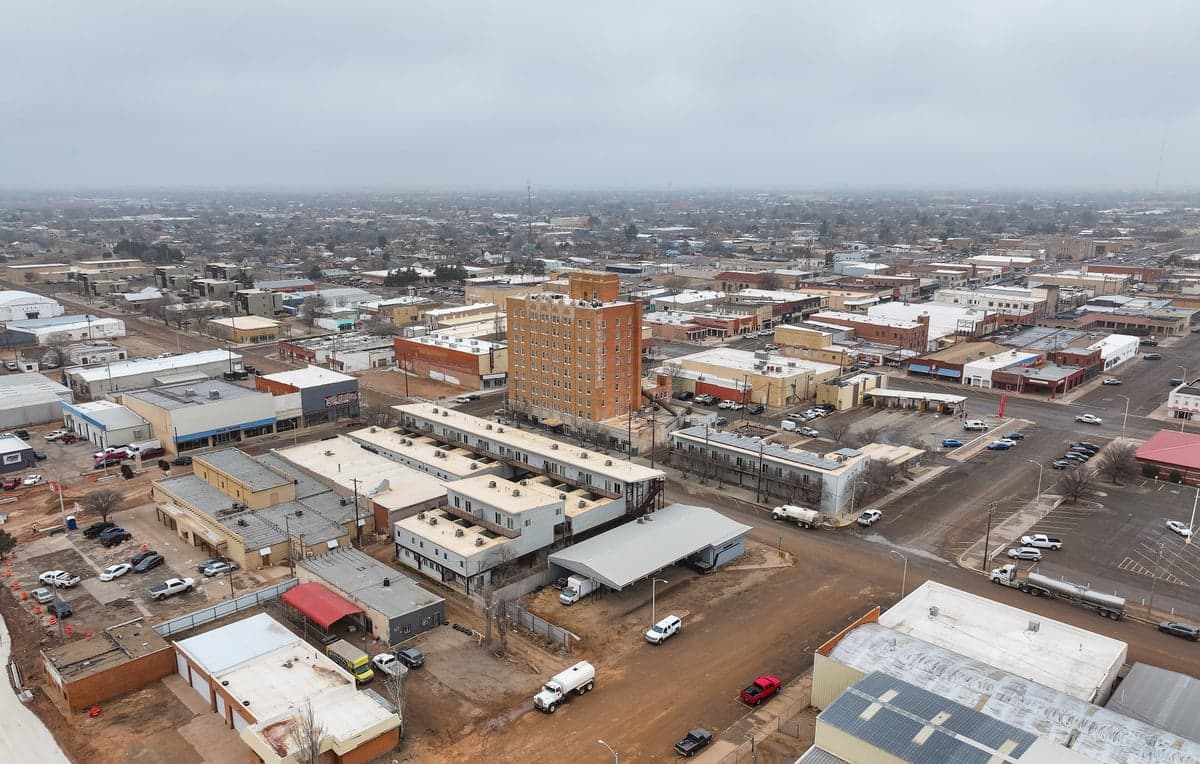
Photo: Wikipedia
Personal Sovereignty in Clovis, NM
Viable for self-reliance. Generally workable, though some barriers may limit total independence.
What does Personal Sovereignty tell us?
Personal Sovereignty measures your capacity for self-reliance and independence with minimal government friction. Higher scores mean fewer barriers between you and the way you want to live... but it assumes you have the space you need and good neighbors.
What does this tell us?
Personal Sovereignty measures your capacity for self-reliance and independence with minimal government friction. Higher scores mean fewer barriers between you and the way you want to live... but it assumes you have the space you need and good neighbors.
State Policy
Energy independence: Net exporter (250% of energy produced in-state)
Personal Liberty
Homesteading

Personal Liberty Analysis
For individuals and families prioritizing personal sovereignty, Clovis, New Mexico offers a notably permissive environment compared to much of the West, though it operates within a state that has a mixed record on individual liberties. The city’s rural character, combined with New Mexico’s relatively light regulatory touch in key areas like property use and self-defense, creates a baseline of autonomy that is increasingly rare. However, the state-level political landscape—with its periodic flirtations with progressive taxation and energy mandates—means that Clovis’s sovereignty advantage is more about what the local culture and geography permit than what state law guarantees. For the survivalist or prepper mindset, the key question is whether the local buffer of conservative governance and low population density can insulate you from broader trends of government overreach.
Tax burden and regulatory posture for individuals and small operators
New Mexico’s state-level tax burden is moderate, but Clovis benefits from a local cost structure that keeps the overall load manageable. The state imposes a graduated income tax with a top marginal rate of 5.9% on income over $210,000—higher than Texas but lower than California or New York. Property taxes are a standout advantage: New Mexico’s effective property tax rate is among the lowest in the nation, averaging around 0.55% of assessed value, and Clovis’s local levies keep it near that floor. For a survivalist or prepper, this means holding land and improvements is not penalized annually, which directly supports self-reliance goals like building a homestead or maintaining a large property. Sales tax in Clovis is roughly 8.4% (state plus local), which is noticeable but not crushing. The regulatory posture at the city level is business-friendly, with no onerous zoning or licensing hurdles for small-scale operations like home-based food production, repair services, or light manufacturing. State-level regulations, such as the Energy Transition Act, push for renewable energy mandates, but enforcement in rural areas like Clovis is lax, and the local utility—Xcel Energy—still relies heavily on natural gas and coal. For someone wanting to minimize government entanglement in daily economic life, Clovis’s low property tax and permissive local zoning are strong draws.
Self-defense and gun law specifics in a rural New Mexico context
New Mexico is a shall-issue state for concealed carry permits, and since 2021, permitless (constitutional) carry is legal for anyone 21 or older who can legally possess a firearm. This means in Clovis, you can carry openly or concealed without a government permission slip—a critical factor for those who view self-defense as a natural right, not a privilege. The state does not have a red flag law, which is a significant advantage over many Western states; there is no mechanism for law enforcement to seize firearms based on anonymous complaints or temporary risk orders. Magazine capacity is unrestricted, and there is no state-level assault weapons ban. However, federal background checks apply at licensed dealers, and private sales are not subject to state-level checks. Clovis’s proximity to Texas (just 10 miles from the state line) also means that residents can easily access the more robust gun culture and legal protections of Texas, including its stronger castle doctrine and stand-your-ground laws. New Mexico’s own castle doctrine is solid—no duty to retreat in your home or vehicle—but it is less explicit than Texas’s for public spaces. For the prepper, the practical reality is that Clovis sits in a region where firearm ownership is near-universal, and local law enforcement is generally supportive of the Second Amendment. The biggest risk is state-level political shifts: the governor has pushed for gun control measures in the past, but they have consistently failed in the legislature due to rural opposition. For now, Clovis offers one of the strongest self-defense environments in the Southwest.
Self-reliance and homesteading viability: lot sizes, zoning, and off-grid feasibility
Clovis’s zoning code is remarkably permissive for a city of its size (roughly 38,000 residents), especially in the outlying areas and unincorporated Curry County. Standard residential lots in the city limits range from 6,000 to 10,000 square feet, but moving just a few miles outside town, you can find parcels of 1 to 20 acres with minimal restrictions. The city does not prohibit backyard chickens, goats, or beekeeping within residential zones, though there are nuisance ordinances that limit noise and odor. For the serious homesteader, the real opportunity lies in the surrounding county: no building permits are required for agricultural structures, and there is no county-wide zoning that restricts uses like rainwater catchment, solar panel installation, or composting toilets. Off-grid feasibility is high, but with caveats. The region averages about 16 inches of rain per year, so rainwater harvesting is possible but requires large cisterns (5000+ gallons) for year-round supply. Well drilling is permitted, with typical depths of 200-400 feet to reach the Ogallala Aquifer, and the cost runs $15-$25 per foot. Solar is viable—Clovis gets over 270 sunny days per year—and net metering is available through Xcel Energy, though the state’s renewable mandates could eventually complicate grid-tied systems. For the prepper wanting true independence, the combination of cheap land, lax zoning, and abundant groundwater makes Clovis a top-tier choice for establishing a self-sufficient homestead without constant government interference.
Personal liberties: parental rights, medical autonomy, speech, and property
New Mexico’s record on parental rights is mixed. The state has no explicit parental rights statute like Florida’s, and the public school system is heavily unionized and progressive-leaning. However, Clovis Municipal Schools are more conservative than the state average, and the local school board has resisted controversial curriculum mandates. Homeschooling is straightforward: you file a simple notice with the state, and there are no standardized testing requirements or curriculum approvals. Medical autonomy is a weaker point. New Mexico has broad vaccine mandates for school attendance (though philosophical exemptions are allowed), and the state expanded Medicaid aggressively under the ACA. For those wary of government health overreach, the lack of a robust medical freedom framework at the state level is a concern. However, Clovis’s rural isolation means that enforcement of state health mandates is often lax, and many local healthcare providers are independent. Free speech is well-protected under the state constitution, and there are no hate speech laws that chill political expression. Property rights are strong: New Mexico has no statewide rent control, no inclusionary zoning mandates, and no forced annexation laws that allow cities to seize rural land without consent. The biggest property threat is the state’s interest in water rights—the Ogallala Aquifer is regulated, and new wells require a permit, but existing rights are protected. For the conservative individualist, Clovis offers a high degree of personal liberty in daily life, with the main friction points being state-level health mandates and education policy, both of which can be mitigated by homeschooling and choosing private healthcare.
In the broader landscape of American personal sovereignty, Clovis stands out as a place where the practical realities of rural life—low population density, a conservative local culture, and minimal zoning—create a buffer against the encroachments of state-level overreach. It is not a libertarian utopia; the state government still taxes income, mandates certain vaccines, and controls water rights. But compared to the regulatory thickets of the Pacific Northwest, the Northeast, or even parts of Colorado, Clovis offers a survivalist or prepper a workable foundation for self-reliance. The land is cheap, the gun laws are permissive, the taxes are low, and the neighbors are likely to share your values. If your strategy is to find a place where you can live largely unbothered by government, with room to build, grow, and defend, Clovis deserves a serious look—especially if you’re willing to navigate the state-level politics that occasionally threaten to intrude.

* Values derived from national, state, county, city and local statistics and may differ in a specific area. Last updated: 2026-05-01T04:24:37.000Z
Narrative content on this page is AI-generated and may contain mistakes. Verify any details that matter before acting on them.
ReloMaps may earn a commission from affiliate links at no extra cost to you.

