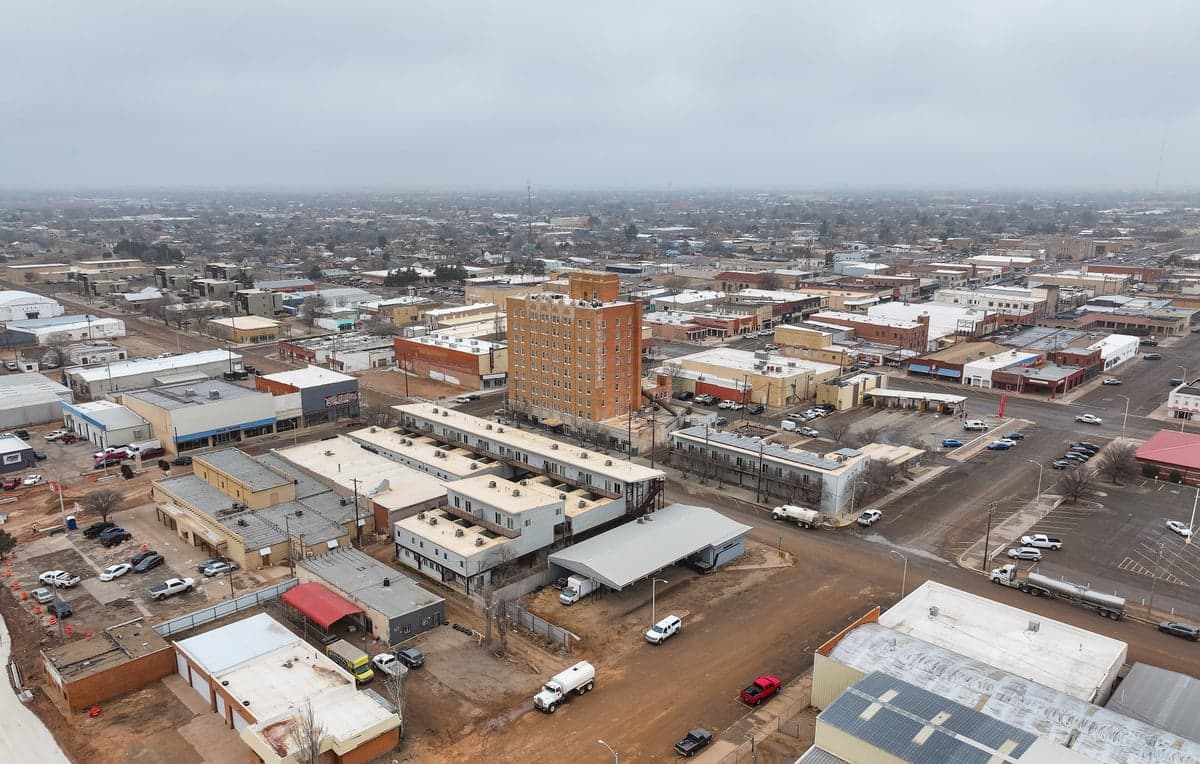
Photo: Wikipedia
Demographics of Clovis, NM
Affluence Level in Clovis, NM
A below-average socioeconomic profile. Incomes, home values, and educational attainment trail the U.S., with higher poverty and unemployment.
People of Clovis, NM
The people of Clovis, New Mexico, today form a community of roughly 38,153 residents defined by a near-even split between Hispanic (49.1%) and White (39.8%) populations, with smaller Black (5.1%), East/Southeast Asian (1.0%), and Indian subcontinent (0.4%) communities. The city’s identity is rooted in its railroad and agricultural heritage, with a blue-collar, family-oriented character reflected in a median age of 32 and a below-average college attainment rate of 21.3%. Clovis remains a relatively affordable, conservative-leaning hub in eastern New Mexico, where military ties to Cannon Air Force Base and a growing Hispanic majority are reshaping its cultural and economic landscape.
How the city was settled and grew
Clovis was founded in 1906 as a railroad town on the High Plains, named after the first king of the Franks by the Santa Fe Railway. The original population was drawn by railroad construction and maintenance jobs, followed by agriculture—especially cotton farming and cattle ranching—which required seasonal and permanent labor. The earliest settlers were Anglo-American railroad workers and farmers, many of whom built homes in the Old Town district near the rail yards, where modest wood-frame houses still stand. By the 1920s, Hispanic laborers from southern New Mexico and Texas arrived to work the cotton fields, settling in the La Casita neighborhood east of the tracks, a historically Hispanic enclave that remains a cultural anchor. The 1930s and 1940s brought Dust Bowl refugees from Oklahoma and Texas, who clustered in the North Plains area, a working-class district of small homes and trailers. Cannon Air Force Base, established in 1942 as Clovis Army Air Field, drew military families and civilian support staff, creating the Base Housing area and the adjacent Thunderbird subdivision, which today houses many active-duty personnel and veterans. By 1950, Clovis had grown to over 17,000 residents, overwhelmingly White and Hispanic, with a small Black population concentrated near the railroad corridor.
Modern era (post-1965)
After the 1965 Immigration and Nationality Act, Clovis saw a steady increase in Hispanic immigration, primarily from Mexico and Central America, drawn by agricultural and meatpacking jobs. The Hispanic share rose from roughly 30% in 1970 to 49.1% today, with many new arrivals settling in the Southside neighborhood, a low-income area south of the railroad tracks where rental housing and mobile homes predominate. The White population, once a clear majority, declined from over 70% in 1970 to 39.8% today, as younger Anglos left for college or jobs in larger cities, while older residents aged in place in the Colonial Park and Sunset Terrace neighborhoods, which remain predominantly White and middle-class. The Black population, historically small, grew modestly from 3% in 1970 to 5.1% today, with families concentrated in the Eastside area near the old railroad depot. The East/Southeast Asian community (1.0%) is largely composed of Filipino and Vietnamese families connected to Cannon Air Force Base, living in the Base Housing and Thunderbird subdivisions. The Indian subcontinent community (0.4%) is tiny but growing, with a few families in professional roles at the base or the local hospital, scattered across newer subdivisions like Mesa Verde. Suburbanization since the 1990s has been limited; Clovis has expanded outward with new tract homes on the west side, but most growth has been infill within existing neighborhoods.
The future
The population of Clovis is heading toward a Hispanic majority, likely exceeding 55% by 2040, driven by higher birth rates and continued immigration from Mexico and Central America. The White population will continue to shrink in absolute numbers, while the Black and East/Southeast Asian communities are expected to remain stable, sustained by military and base-related employment. The Indian subcontinent community may grow slowly as healthcare and tech jobs expand, but will remain a small fraction. The city is not tribalizing into distinct enclaves—neighborhoods are relatively integrated, though Southside and La Casita remain heavily Hispanic, while Colonial Park and Sunset Terrace are predominantly White. The foreign-born share (5.6%) is below the national average, suggesting that assimilation is occurring, with second- and third-generation Hispanic residents increasingly identifying as American rather than immigrant. The next 10–20 years will likely see Clovis become a majority-Hispanic, working-class city with a stable military presence, limited economic diversification, and a conservative political culture that reflects its rural, family-oriented roots.
For someone moving to Clovis now, the city offers an affordable, safe, and community-oriented environment where Hispanic and Anglo cultures are increasingly blending, but where economic opportunities remain tied to agriculture, the military, and service industries. The population is stable but aging, with younger families drawn by low housing costs and a slower pace of life, while the growing Hispanic majority is reshaping local politics, schools, and cultural events. Clovis is becoming a more diverse, working-class community that retains its conservative, family-first character—a place where newcomers can find a tight-knit, affordable home base in eastern New Mexico.

* Values derived from national, state, county, city and local statistics and may differ in a specific area. Last updated: 2026-05-01T04:24:37.000Z
Narrative content on this page is AI-generated and may contain mistakes. Verify any details that matter before acting on them.
ReloMaps may earn a commission from affiliate links at no extra cost to you.

