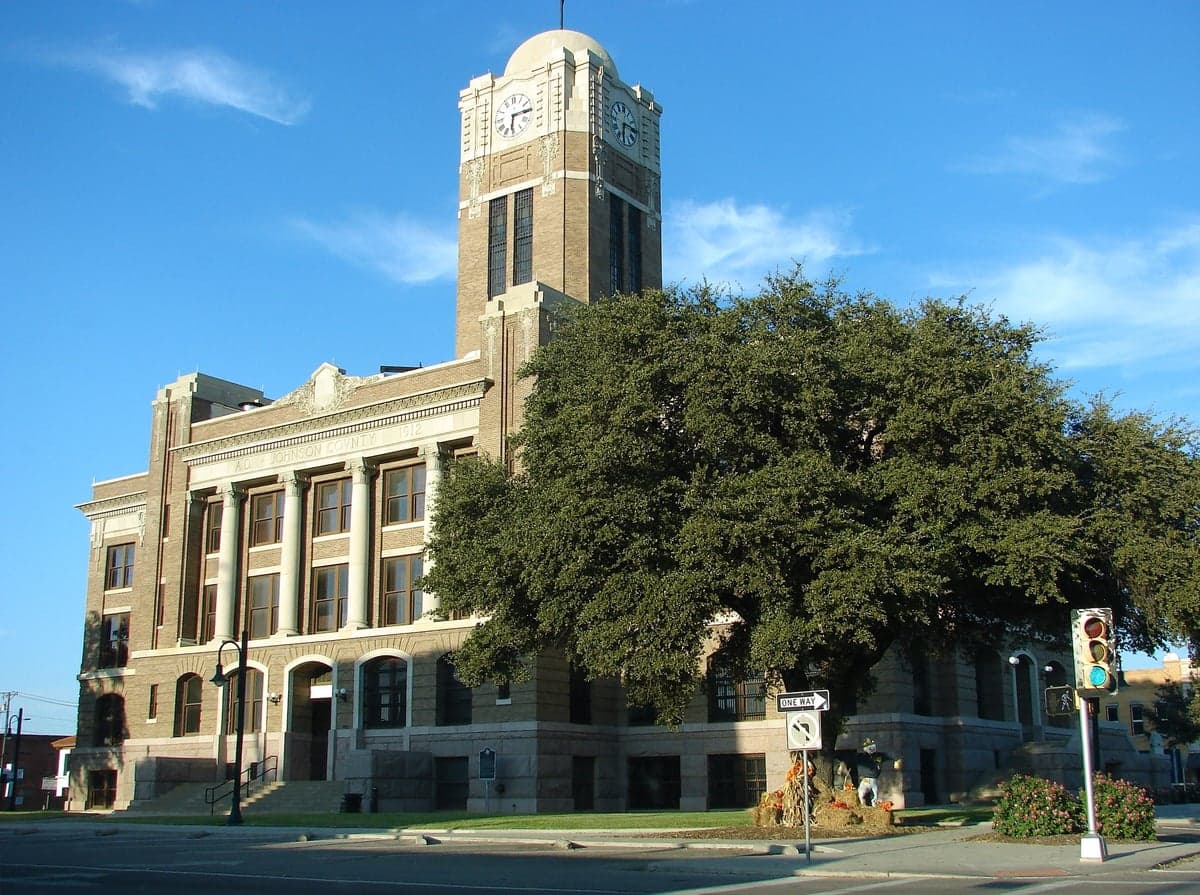

Photo: Wikipedia
Political ClimatePolitical Climate in Cleburne, TX
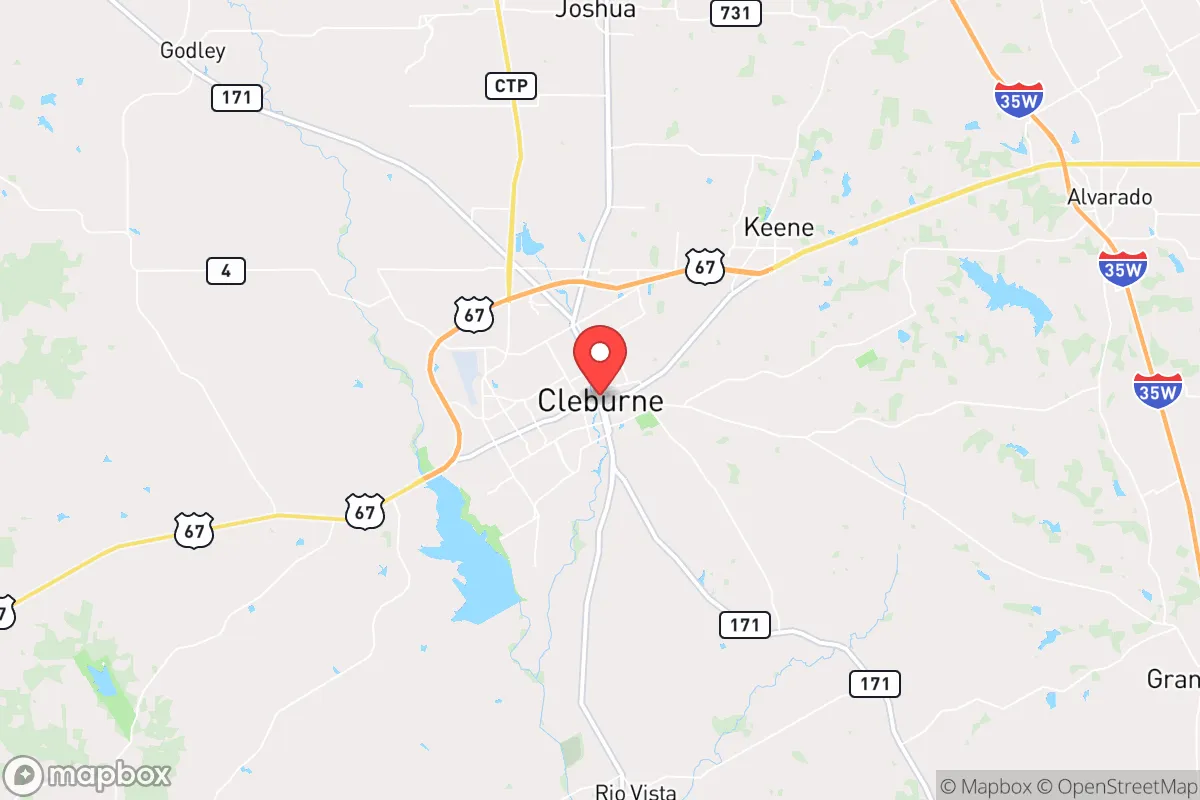
District shown is the primary district for this city’s centroid. Cities may span multiple districts.
Local Political AnalysisPolitical Analysis of Cleburne, TX
Cleburne, Texas, has long been a rock-solid conservative stronghold, and that hasn’t changed much—at least not yet. With a Cook PVI of R+18, this Johnson County seat votes about 18 points more Republican than the national average, and you can feel it in the air. In the 2024 election, the county went for the GOP candidate by a comfortable margin, and local races rarely see a serious Democrat challenge. But I’ve lived here long enough to notice the winds shifting, and while Cleburne itself remains deeply red, the growing influence of the Dallas-Fort Worth metroplex is starting to creep in, bringing with it some progressive ideas that would have been unthinkable a decade ago.
How it compares
Drive 30 minutes east to Burleson, and you’ll find a similar conservative vibe, though it’s a bit more suburban and polished. Head north to Fort Worth, and the contrast is stark—Tarrant County has been trending purple for years, with pockets of deep blue in the city core. South of Cleburne, towns like Hillsboro and Whitney are even more rural and reliably red, but they don’t have the same exposure to DFW’s cultural spillover. What sets Cleburne apart is its balance: it’s conservative without being isolated, but that proximity to the metroplex means we’re seeing more transplants who don’t share the same values. The local school board and city council races are where you really see the tension—longtime residents pushing back against policies that feel like government overreach, while newcomers advocate for things like diversity initiatives or zoning changes that prioritize density over property rights.
What this means for residents
For folks who value personal freedoms and limited government, Cleburne is still a safe bet—for now. The city council has resisted mask mandates and vaccine passports, and the county sheriff’s office takes a firm stance on Second Amendment rights. Property taxes are a sore spot, but that’s Texas-wide, not a local failing. What worries me is the slow creep of progressive ideology into local institutions. The school district, for example, has faced pressure to adopt critical race theory-inspired curriculum, and while it’s been beaten back so far, it takes constant vigilance. If you’re moving here to escape the overreach you see in blue states, you’ll find kindred spirits, but don’t assume it’s a permanent fortress. The 2020 census showed Johnson County growing by nearly 20%, and many of those new arrivals are from California or the Northeast. They bring money and development, but they also bring voting habits that could flip a close race in a decade or two.
Culturally, Cleburne still feels like a small town where neighbors know each other and church attendance is high. The annual Johnson County Frontier Days and the Cleburne Railroaders minor league baseball games are community staples that reinforce a traditional, family-oriented lifestyle. But there’s a quiet battle being fought over what that lifestyle will look like in 10 years. The push for more affordable housing has led to apartment complexes that some residents feel change the character of the neighborhoods. And while the city has avoided the worst of the woke policies you see in Austin or Dallas, the pressure is mounting. If you’re looking for a place where you can live free from government meddling in your daily life, Cleburne is still a good choice—just keep an eye on the local elections and get involved, because the fight for the soul of this town is far from over.

State Political ClimatePolitical Climate in Texas
State Political AnalysisPolitical Environment in the State
Texas has been a reliably Republican state for the past three decades, with the GOP holding every statewide office and both legislative chambers since the mid-1990s. The dominant coalition is a mix of rural conservatives, suburban moderates, and a growing number of Hispanic voters who lean right on economic and social issues. However, the 10-20 year trajectory shows a slow but steady shift: Donald Trump won Texas by 9 points in 2016, 5.6 points in 2020, and roughly 5.5 points in 2024, while down-ballot races in suburbs like Collin County (north of Dallas) and Fort Bend County (southwest of Houston) have tightened considerably. The state is not flipping blue anytime soon, but the margin is compressing as urban centers grow and in-migration from blue states accelerates.
Urban vs. rural divide
The political map of Texas is a stark checkerboard. The big metros—Houston, Dallas, San Antonio, and Austin—are deep blue islands in a sea of red. Harris County (Houston) went for Biden by 13 points in 2020, and Travis County (Austin) by a staggering 52 points. Meanwhile, the rural Panhandle, East Texas, and West Texas are overwhelmingly Republican: Lubbock County voted +44 for Trump, and Amarillo’s Potter County was +35. The real battleground is the suburbs. Collin County, once a GOP stronghold, went from +26 Trump in 2016 to +14 in 2020, and Fort Bend County flipped from +6 Trump in 2016 to +5 Biden in 2020. The Rio Grande Valley, historically Democratic, has been trending right—Zapata County flipped from +33 Clinton in 2016 to +5 Trump in 2020, a 38-point swing. This urban-rural split means state policy is driven by rural and suburban Republicans, but the growing urban population is slowly eroding that advantage.
Policy environment
Texas has no state income tax, which is the single biggest policy draw for conservatives. Property taxes are high—averaging 1.6% of home value—but the state legislature passed SB 2 in 2023, which capped appraisal increases at 10% and provided $18 billion in property tax relief. The regulatory posture is famously business-friendly: no state-level minimum wage above the federal $7.25, right-to-work laws, and a tort reform system that caps non-economic damages in medical malpractice cases at $250,000. On education, Texas passed HB 3 in 2019, boosting teacher pay and funding, but also SB 1479 in 2023, which banned critical race theory in public schools and required the display of “In God We Trust” in classrooms. Healthcare is a mixed bag: Texas has the highest uninsured rate in the nation (18%), and the state has refused Medicaid expansion under the ACA. Election laws tightened with SB 1 in 2021, which banned 24-hour and drive-through voting, added ID requirements for mail ballots, and gave poll watchers more access. For a conservative, this is a state that generally respects local control and limits government overreach, but the property tax burden and lack of school choice are ongoing frustrations.
Trajectory & freedom
On the freedom front, Texas has been moving in a decidedly more liberty-oriented direction over the past five years. HB 1927 (2021) made Texas a permitless carry state for handguns, allowing law-abiding adults to carry without a license. SB 8 (2021) banned abortions after a fetal heartbeat is detected, effectively ending most abortions in the state. HB 25 (2023) banned gender transition procedures for minors, and SB 14 (2023) restricted transgender athletes from competing in women’s sports. On parental rights, HB 3979 (2021) and SB 3 (2023) gave parents more control over curriculum and library materials. However, there are concerning trends: HB 20 (2023) created a state-level censorship board for social media platforms, which some see as government overreach into private speech. The Texas Privacy Act (2023) also expanded data collection requirements for tech companies. The net trajectory is toward more personal liberty on guns, life, and family issues, but with a creeping tendency to regulate private platforms and data—a mixed bag for a true libertarian.
Civil unrest & political movements
Texas has seen its share of political flashpoints. The 2020 George Floyd protests in Austin, Dallas, and Houston were large and occasionally violent, with Austin seeing over $10 million in property damage. The Texas Capitol in Austin has been a recurring site for both left-wing and right-wing rallies, including the 2021 “People’s March” against the abortion ban and the 2022 “Texas Freedom Rally” for gun rights. Immigration politics are a constant: Operation Lone Star, launched by Governor Greg Abbott in 2021, deployed state troopers and National Guard to the border, busing migrants to blue cities like New York and Chicago. This has created a visible law enforcement presence in border towns like El Paso and Eagle Pass. Sanctuary city policies are banned statewide under SB 4 (2017), which allows police to ask about immigration status during lawful stops. Secession rhetoric is mostly fringe, but the Texas Nationalist Movement has gained some traction online, though no serious legislative push. Election integrity remains a hot topic: the 2020 election saw no major fraud in Texas, but SB 1 was passed in response to voter concerns, and the 2022 midterms ran smoothly. A new resident will notice the heavy police presence at the border and the occasional protest in Austin, but daily life is generally calm and orderly.
Projection
Over the next 5-10 years, Texas will likely remain Republican but with a shrinking margin. In-migration from California, New York, and Illinois is bringing more moderate and left-leaning voters to the suburbs of Dallas-Fort Worth, Houston, and Austin. The Hispanic vote, particularly in the Rio Grande Valley, is trending right, but the sheer volume of blue-state transplants may offset that. The state legislature will likely pass more school choice legislation (vouchers or education savings accounts), further property tax compression, and possibly a state-level data privacy law. The biggest wildcard is the border: if the federal government fails to secure it, Texas will continue its own enforcement, which could lead to federal lawsuits and a growing state-federal tension. For a conservative moving in now, expect a state that remains broadly free on guns, taxes, and family policy, but with a slowly diversifying electorate that will make statewide races closer. The 2026 gubernatorial race will be a key bellwether—if Abbott wins by less than 5 points, the 2030s could see competitive statewide elections.
For a new resident, the bottom line is this: Texas is still one of the most freedom-oriented states in the country, especially on taxes, gun rights, and parental control. You’ll pay no income tax, carry a handgun without a permit, and send your kids to a school that displays “In God We Trust.” But the political winds are shifting—the suburbs are getting bluer, the cities are growing, and the state government is increasingly willing to regulate private platforms and data. If you’re moving here for the freedom, you’ll find it, but keep an eye on the 2028 and 2030 cycles. The Texas you’re moving to today may not be the Texas of 2035.
* Values derived from national, state, county, city and local statistics and may differ in a specific area. Last updated: 2026-04-18T19:45:08.000Z
Narrative content on this page is AI-generated and may contain mistakes. Verify any details that matter before acting on them.
ReloMaps may earn a commission from affiliate links at no extra cost to you.

