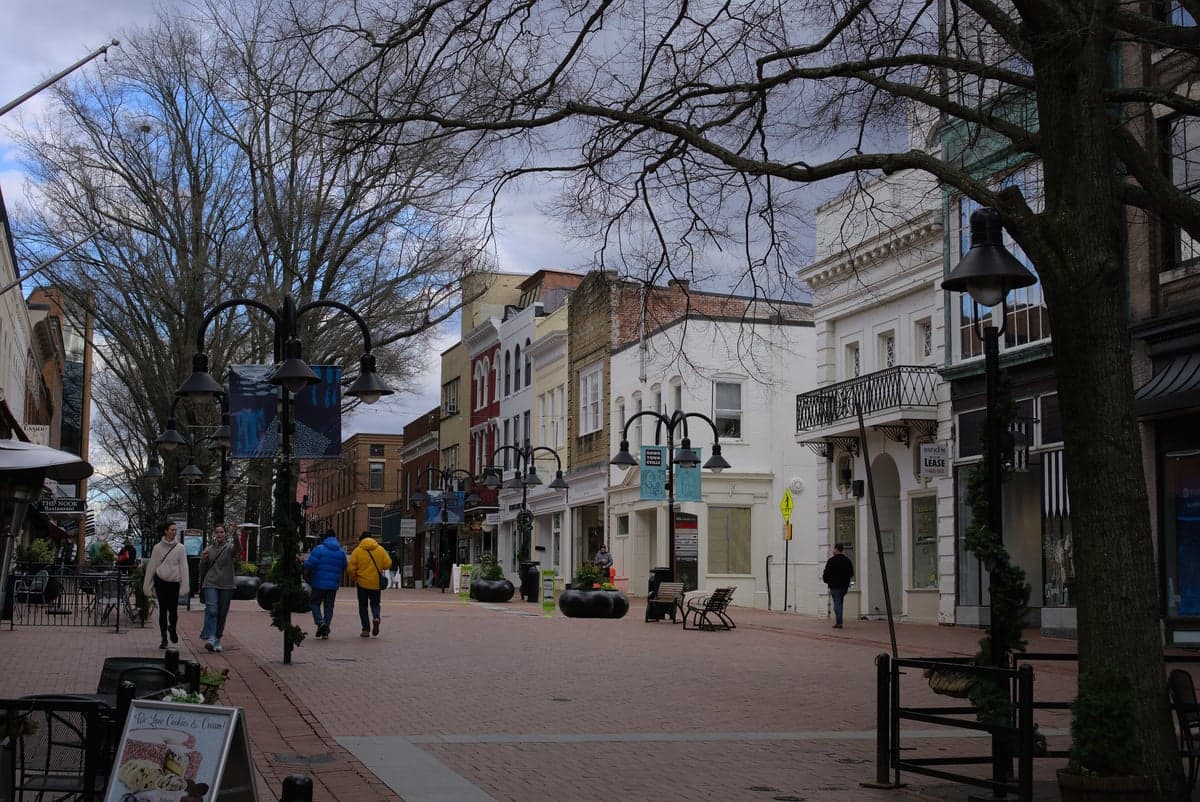
Photo: Wikipedia
Political ClimatePolitical Climate in Charlottesville, VA
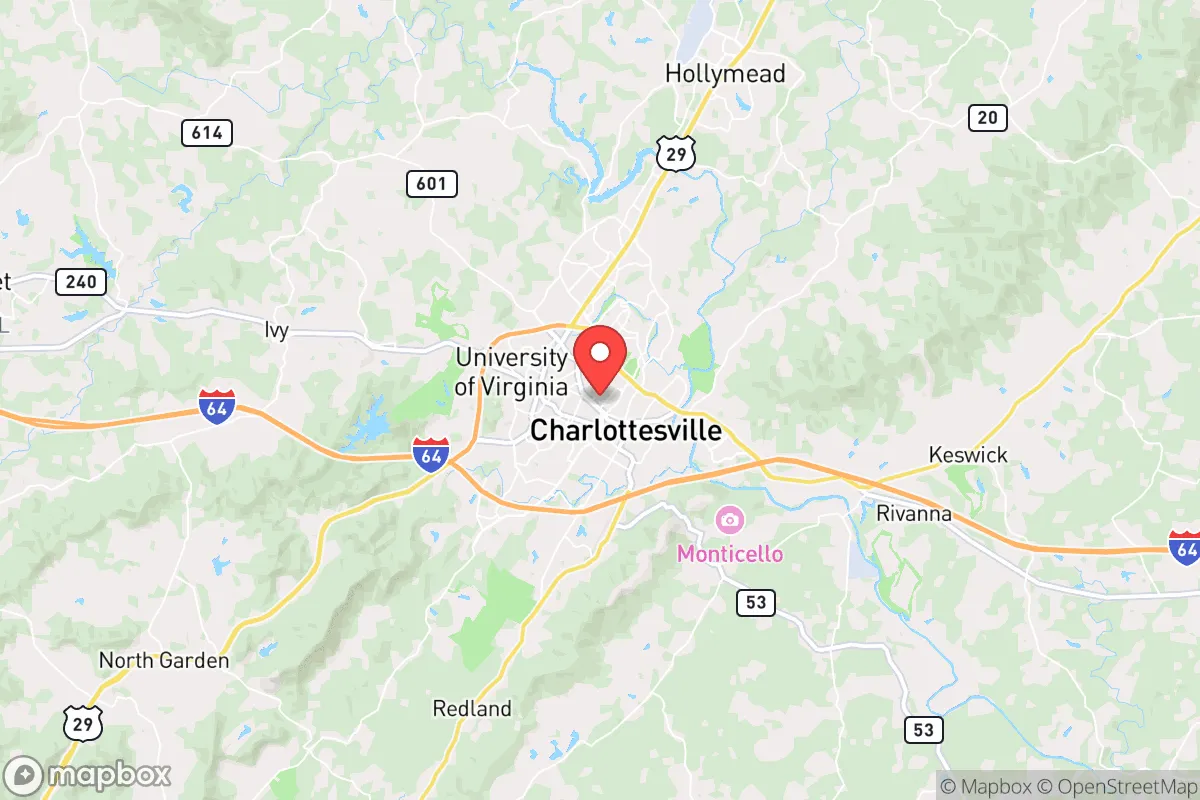
District shown is the primary district for this city’s centroid. Cities may span multiple districts.
Local Political AnalysisPolitical Analysis of Charlottesville, VA
Look, I’ve lived in Charlottesville long enough to remember when this town had a more balanced, live-and-let-live vibe. But the political climate here has shifted hard and fast. The city itself is now a deep-blue stronghold, while the surrounding Albemarle County and rural areas lean more conservative. The Cook PVI for the broader region sits at R+6, which tells you the real story: Charlottesville is an island of progressive politics in a sea of red, and that gap is only widening.
How it compares
Drive 20 minutes outside the city limits, and you’re in a different world. Towns like Crozet, Scottsville, and even parts of Greene County still vote reliably Republican, with local governments that keep taxes lower and regulations looser. Inside Charlottesville, though, the city council has pushed through a series of zoning overhauls, rent control measures, and police oversight boards that feel like a direct response to the 2017 Unite the Right rally. The result? A local government that’s increasingly comfortable telling you how to use your property, what you can build, and even how your kids’ school curriculum is shaped. Compare that to nearby Waynesboro or Staunton, where the county supervisors still believe in limited government and personal responsibility. The contrast is stark, and it’s why a lot of families I know have quietly moved east toward Fluvanna or Louisa counties.
What this means for residents
If you value personal freedoms—like choosing your own healthcare, deciding how to educate your kids, or running a small business without a dozen new permits—Charlottesville’s trajectory is concerning. The city has embraced a “progressive” agenda that often means more government oversight, not less. For example, the local school board has adopted critical race theory-inspired curricula and gender identity policies that bypass parental input. Meanwhile, the city council has floated proposals to limit short-term rentals and impose new energy mandates on homeowners. These aren’t hypotheticals; they’re real policies that chip away at your right to live your life without a bureaucrat’s approval. The silver lining? The surrounding counties still offer a refuge, with lower property taxes and a more hands-off approach. But if you’re moving here expecting a classic Virginia small-town feel, you’ll find that feel is fading fast inside the city limits.
One cultural distinction that stands out is Charlottesville’s self-image as a “welcoming” community, which often translates into a one-size-fits-all political orthodoxy. The annual Tom Tom Founders Festival and the Virginia Film Festival are great, but they’re also heavily curated to reflect progressive values. If you’re a conservative or even a moderate, you’ll find fewer public spaces where your views are treated as legitimate. The local paper, the Daily Progress, leans left, and the University of Virginia’s influence amplifies that tilt. My advice? If you’re thinking of relocating here, look at the county lines carefully. The city might be a tough fit for anyone who values personal liberty over collective mandates. But the broader region still has pockets where common sense and freedom are the norm—you just have to know where to look.

State Political ClimatePolitical Climate in Virginia
State Political AnalysisPolitical Environment in the State
Virginia has shifted from a reliably purple swing state to a solidly blue-leaning commonwealth over the past 15 years, driven largely by explosive growth in the Washington D.C. suburbs. The Democratic coalition now dominates statewide elections, with Republicans holding only a narrow majority in the House of Delegates after the 2023 elections and no statewide office since 2009. The 2024 presidential race saw Virginia go blue by roughly 5 points, a margin that would have been unthinkable in the 2000s when the state was a top-tier battleground.
Urban vs. rural divide
The political map of Virginia is a tale of two commonwealths. The urban crescent stretching from Northern Virginia through Richmond to Hampton Roads is overwhelmingly Democratic. Fairfax County alone, with over 1.1 million residents, delivers a Democratic margin larger than the entire state's Republican vote in many races. Arlington and Alexandria are among the most liberal jurisdictions in the South. Meanwhile, rural and exurban areas remain deeply Republican. Southwest Virginia, the Shenandoah Valley, and Southside Virginia vote 65-75% Republican. The real battlegrounds are the fast-growing exurbs like Loudoun County, which flipped from red to deep blue between 2008 and 2020, and Prince William County, now reliably Democratic. Chesterfield County outside Richmond has moved from solid red to competitive, while Virginia Beach remains a swing area within the larger blue Hampton Roads region.
Policy environment
Virginia's policy landscape has shifted dramatically leftward since Democrats took full control of state government in 2020. The state income tax is a flat 5.75% for individuals, with a standard deduction that has increased modestly. Sales tax is 5.3% statewide, with local add-ons. Property taxes are set locally and vary widely—Loudoun County's rates are about 1.2% of assessed value, while rural counties like Pittsylvania are under 0.6%. The regulatory environment has become more burdensome under recent Democratic administrations, with aggressive environmental mandates and a push for electric vehicle infrastructure. Education policy has been a flashpoint: Governor Youngkin's 2022 executive order on parental rights in education was a major victory for conservatives, but the state's Department of Education remains heavily influenced by progressive teacher unions. Healthcare is dominated by the expansion of Medicaid under the 2018 bipartisan compromise, which now covers over 600,000 Virginians. Election laws have been tightened and loosened in cycles: no-excuse absentee voting and same-day registration were enacted under Democrats, while Republicans have pushed for voter ID requirements that remain in place.
Trajectory & freedom
Virginia's trajectory on personal freedom is mixed and concerning for conservatives. On the positive side, the state has a strong right-to-work law and is a shall-issue concealed carry state with no permit required for open carry. However, the 2020 Democratic legislature passed a slew of gun control measures: universal background checks, a red flag law, a one-handgun-per-month limit, and a ban on assault weapons for those under 21. The 2021 election of Governor Youngkin halted further restrictions, but the gun control framework remains in place. On parental rights, Youngkin's executive order and the 2022 model policies requiring parental notification of sexually explicit content in schools were a significant win, but local school boards in blue areas like Fairfax County have largely ignored them. Medical freedom took a hit with the state's COVID-19 vaccine mandates for state employees and healthcare workers, though these were later rescinded. Property rights are under pressure from the state's aggressive land use planning in Northern Virginia, where localities have imposed upzoning and affordable housing mandates that limit what homeowners can do with their land. The 2023 repeal of the grocery tax was a small victory for taxpayers, but overall state spending has grown faster than inflation and population combined.
Civil unrest & political movements
Virginia has been a battleground for political movements on both sides. The 2017 Unite the Right rally in Charlottesville and the subsequent violence made the city a national symbol of racial and political division. The 2020 George Floyd protests in Richmond led to the removal of Confederate statues on Monument Avenue, with the Robert E. Lee statue being taken down in 2021 after a lengthy legal battle. The 2021 Loudoun County school board meetings became a national flashpoint for parental rights, with parents protesting critical race theory and sexually explicit books in school libraries. Immigration politics are less visible than in border states, but Northern Virginia's sanctuary policies—Fairfax County and Arlington limit cooperation with ICE—have drawn criticism from conservatives. Election integrity remains a live issue: the 2020 election in Virginia was certified without major controversy, but the 2021 gubernatorial race saw Republicans win despite Democratic advantages in early voting, leading to ongoing debates about absentee ballot procedures. The 2023 legislative session saw a push for a constitutional amendment on abortion rights, which failed but signaled the issue's salience.
Projection
Over the next 5-10 years, Virginia is likely to continue its leftward drift, but at a slower pace than the 2010s. The key demographic driver is the continued growth of Northern Virginia, which is adding 50,000-70,000 new residents annually, most of whom are younger, more diverse, and more liberal. The exurban counties like Loudoun and Prince William are now reliably blue, and the trend is spreading to Stafford and Spotsylvania. Rural Virginia is shrinking and aging, losing population and political clout. The state's electoral map will likely shift further blue in presidential years, but gubernatorial races remain competitive—Youngkin's 2021 win shows that a well-funded, moderate Republican can still win by focusing on education and economic issues. The state's tax burden is likely to increase as Democratic majorities push for more spending on education and social programs. Gun rights will continue to erode incrementally, and parental rights will remain a contested issue at the local level. The biggest wildcard is the potential for a national Republican wave that could flip the state legislature in 2025 or 2027, but the underlying demographic trends favor Democrats in the long run.
For a conservative considering a move to Virginia, the bottom line is this: you can still find strong communities in the Shenandoah Valley, Southside, and Southwest Virginia where your values are shared, but you will be living in a state where your vote for statewide office is increasingly irrelevant. The policy environment is trending left, and your property taxes and regulatory burdens will likely rise. If you work in or near D.C., the economic opportunities are unmatched, but be prepared for a cultural and political environment that is increasingly hostile to traditional values. The best bet for a conservative is to target a red county like Augusta, Rockingham, or Bedford, where local governance still reflects your priorities, while accepting that the state-level trajectory is not in your favor.
* Values derived from national, state, county, city and local statistics and may differ in a specific area. Last updated: 2026-05-01T16:35:26.000Z
Narrative content on this page is AI-generated and may contain mistakes. Verify any details that matter before acting on them.
ReloMaps may earn a commission from affiliate links at no extra cost to you.

