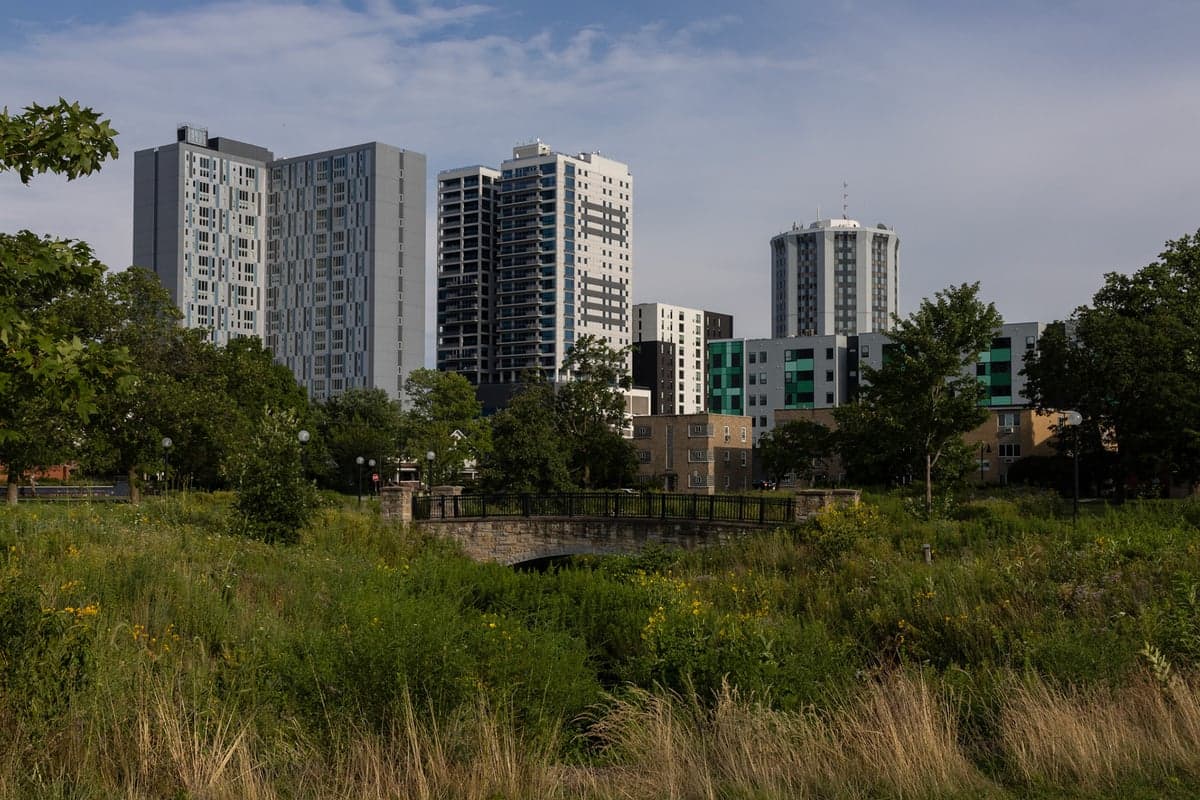
Photo: Wikipedia
Personal Sovereignty in Champaign, IL
Viable for self-reliance. Generally workable, though some barriers may limit total independence.
What does Personal Sovereignty tell us?
Personal Sovereignty measures your capacity for self-reliance and independence with minimal government friction. Higher scores mean fewer barriers between you and the way you want to live... but it assumes you have the space you need and good neighbors.
What does this tell us?
Personal Sovereignty measures your capacity for self-reliance and independence with minimal government friction. Higher scores mean fewer barriers between you and the way you want to live... but it assumes you have the space you need and good neighbors.
State Policy
Energy independence: Importer (45% of energy produced in-state)
Personal Liberty
Homesteading

Personal Liberty Analysis
Champaign, Illinois presents a complex and often contradictory environment for personal sovereignty, one that requires a clear-eyed, strategic assessment rather than a simple thumbs-up or thumbs-down. While the city itself is a classic college town dominated by the University of Illinois, its regulatory and tax climate is heavily shaped by state-level policies from Springfield that consistently rank among the most restrictive in the nation for individual autonomy. For a conservative-leaning individual or family prioritizing self-reliance, the core tension here is between a relatively affordable, low-density Midwestern lifestyle and a state government that actively erodes personal freedoms through taxation, gun control, and educational mandates. You can carve out a sovereign life here, but it will be a defensive, bunker-down posture against a hostile state apparatus, not a free-wheeling frontier existence.
Tax burden and regulatory posture: the cost of living under Springfield's thumb
The most immediate and relentless challenge to personal sovereignty in Champaign is the state-level tax burden. Illinois has a flat income tax rate of 4.95%, but that's just the entry fee. Property taxes in Champaign County are punishing, averaging roughly 2.1% to 2.3% of assessed value, which on a $250,000 home translates to over $5,500 annually. This is a direct, recurring claim on your property by the state, and it funds a school system and local government that you may not agree with philosophically. The state's sales tax, when combined with local levies, pushes past 9% in Champaign proper. There is no path to avoiding these; they are deducted from paychecks and escrow accounts automatically. From a prepper perspective, this means your financial buffer—the capital you'd use for land, supplies, or relocation—is constantly being siphoned. The regulatory posture is similarly heavy: Illinois is one of the few states with a progressive income tax structure (though currently flat), and it has a notoriously complex business regulatory environment. For anyone trying to operate a side business, a farm stand, or a trade, the licensing and reporting requirements are a constant friction. The state's pension debt crisis also looms, meaning tax rates are unlikely to decrease and may well increase, further squeezing the sovereign individual's resources.
Self-defense and gun law specifics: navigating a hostile legal landscape
This is the single most critical area where state overreach directly impacts personal sovereignty in Champaign. Illinois is not a gun-friendly state, and Champaign residents must navigate a dense thicket of restrictions. The state requires a Firearm Owners Identification (FOID) card to even possess a firearm or buy ammunition—a state-level registry that is an affront to the concept of a right. Furthermore, Illinois now has a ban on so-called "assault weapons" and high-capacity magazines, passed in 2023, which is currently being litigated but remains in effect. This directly limits the types of rifles and handguns a survivalist would consider essential for defense and stockpiling. Concealed carry is permitted, but only with a state-issued license that requires 16 hours of training and a background check, and the state has preempted local ordinances, meaning Champaign cannot be more restrictive than state law—but it also cannot be less restrictive. The practical reality: you can own handguns and shotguns for home defense, but building a serious defensive rifle collection is legally risky. Magazine capacity is capped at 10 rounds for long guns and 15 for handguns. For a prepper, this is a significant constraint on your ability to defend your property and family in a grid-down scenario. The legal climate also means that any defensive use of a firearm will be scrutinized intensely by a state legal system that is not sympathetic to self-defense claims.
Self-reliance and homesteading viability: lot sizes, zoning, and off-grid feasibility
Within the city limits of Champaign, true homesteading is nearly impossible. Standard residential lots are small—typically 0.15 to 0.25 acres—and zoning codes are restrictive. Keeping chickens is allowed with a permit, but roosters are banned, and slaughtering animals on your property is not permitted. Beekeeping is allowed but regulated. Gardening is fine, but you cannot run a commercial operation from a standard residential lot. The real opportunity for self-reliance lies in the unincorporated areas of Champaign County, particularly to the north and west of the city. There, you can find 5- to 20-acre parcels at prices that are still reasonable compared to the coasts or even the Denver suburbs. Zoning in these areas (typically A-1 Agricultural) allows for livestock, orchards, and even small-scale farming operations. However, off-grid feasibility is limited. The county requires a septic system permit and well water testing, and while solar panels are legal, net metering policies from the state-regulated utility (Ameren) are not particularly generous. Building codes in unincorporated areas are less onerous than in the city, but you still need permits for any structure over 200 square feet. The bottom line: you can achieve a significant degree of food sovereignty and energy independence on a rural parcel outside Champaign, but you will still be tied to the county's regulatory framework and property tax system. True off-grid living—with no permits, no taxes, no connection to the grid—is not legally feasible anywhere in Champaign County.
Personal liberties: parental rights, medical autonomy, speech, and property
This is where the state-level erosion of sovereignty is most apparent. Parental rights have been systematically undermined in Illinois. The state has a comprehensive sex education mandate that begins in kindergarten, and parents cannot opt their children out of specific lessons—only the entire curriculum. The state also has a "safe zones" law that restricts parental notification regarding a minor's gender identity or sexual orientation if the school believes it could lead to abuse. For a conservative parent, this is a direct assault on the family's authority. Medical autonomy is similarly constrained. Illinois has some of the most permissive vaccine mandates in the country for school attendance, and during the COVID-19 pandemic, the state imposed broad mandates that were enforced locally. There is no legal pathway to opt out of public health orders based on religious or philosophical grounds in many cases. Free speech is legally protected, but the cultural climate in Champaign—dominated by the university—is heavily left-leaning, meaning that expressing conservative views on public health, gender, or government overreach can lead to social ostracization or professional consequences, particularly for those employed by the university or major employers like Carle Health. Property rights are also weak. The state has a history of aggressive eminent domain use, and the property tax system itself is a form of ongoing government claim on your land. You do not truly own your property in Illinois; you rent it from the state, and the rent is due every year.
In the final analysis, Champaign offers a mixed but ultimately defensive posture for personal sovereignty. The city itself is a high-tax, high-regulation environment where state overreach is a constant factor in daily life—from the FOID card in your wallet to the property tax bill in your mailbox. The surrounding rural areas provide more breathing room for homesteading and self-reliance, but you cannot escape the long arm of Springfield. Compared to a state like Texas, Tennessee, or Idaho, Champaign is a significantly more hostile environment for a survivalist or prepper mindset. It is not a place to build a sovereign life from scratch; it is a place to hunker down, pay your taxes, keep your head down, and quietly build your own resilience within the cracks of the system. If you are looking for a location where the government actively respects your autonomy, look elsewhere. If you are willing to fight for every inch of your freedom within a deeply entrenched bureaucratic state, Champaign can work—but it will be a constant, grinding battle, not a liberation.

* Values derived from national, state, county, city and local statistics and may differ in a specific area. Last updated: 2026-05-03T20:24:07.000Z
Narrative content on this page is AI-generated and may contain mistakes. Verify any details that matter before acting on them.
ReloMaps may earn a commission from affiliate links at no extra cost to you.

