 Popular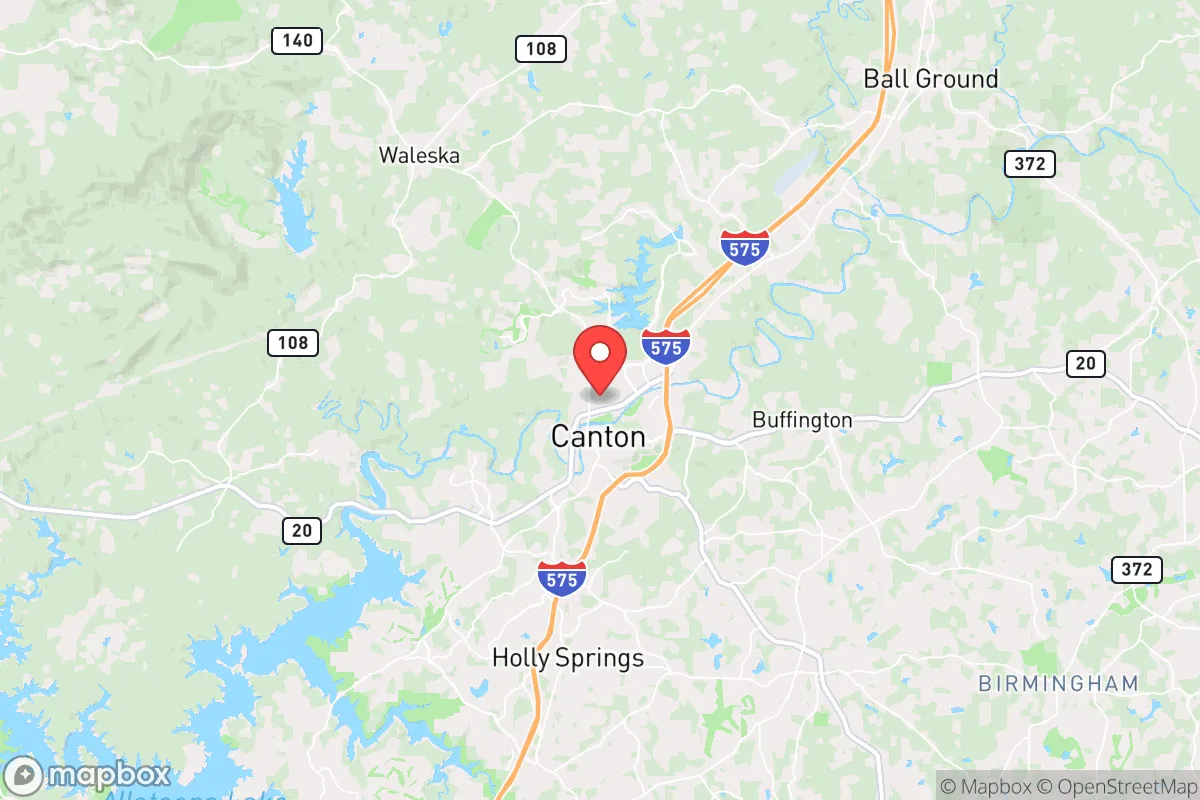
Photo: Wikipedia
Demographics of Canton, GA
Affluence Level in Canton, GA
A middle-class area roughly in line with national averages across income, home values, education, and employment.
People of Canton, GA
The people of Canton, Georgia today form a rapidly diversifying, family-oriented community of 34,587 residents, characterized by a white plurality (57.8%) alongside a substantial Hispanic population (24.1%) and a significant Black community (14.5%). The city’s identity is increasingly shaped by young families and commuters drawn to its Cherokee County location, balancing small-town roots with suburban growth. With 31.4% of adults holding a college degree, the population skews slightly more blue-collar than metro Atlanta averages, yet the foreign-born share of 9.4% signals a steady influx of new Americans, primarily from Latin America.
How the city was settled and grew
Canton’s human history begins with the Cherokee people, who inhabited the Etowah River valley until forced removal via the Trail of Tears in the 1830s. White settlers from the Upper South—primarily of English, Scots-Irish, and German descent—arrived soon after, drawn by land grants from the Georgia Land Lotteries of the 1830s and 1840s. The town was officially incorporated in 1833 as “Etowah,” later renamed Canton in 1834 to attract Swiss and German immigrants familiar with the “canton” system, though few actually came. The real population driver was the railroad’s arrival in the 1870s, which turned Canton into a regional hub for cotton, timber, and marble quarrying. The historic downtown district, centered around Main Street and the old train depot, became the heart of a white, native-born population that remained overwhelmingly rural and Protestant through the early 1900s. A small Black community formed in the Hickory Log area (south of downtown), working as sharecroppers and domestic laborers, while the white merchant class built homes in the North Canton neighborhood along Marietta Highway. By 1950, Canton’s population hovered around 2,500, almost entirely white and native-born, with a tiny Black minority segregated into the Riverbend district near the Etowah River.
Modern era (post-1965)
The post-1965 era transformed Canton’s population through two major forces: the Immigration and Nationality Act’s opening of Latin American migration, and Atlanta’s suburban sprawl pushing north along Interstate 575. The Hispanic population began arriving in the 1980s, initially as migrant farmworkers in Cherokee County’s poultry and agricultural industries, then settling permanently in the Bridgemill area (southwest Canton) and the Hickory Flat corridor (eastern Canton), where affordable housing and construction jobs concentrated. By 2000, Hispanics made up roughly 8% of Canton’s population; by 2020, that share had tripled to 24.1%, driven by family reunification and continued labor demand in construction, landscaping, and food processing. The Black population grew more modestly, from under 5% in 1990 to 14.5% today, with many families moving from metro Atlanta’s southern suburbs into newer subdivisions like Prominence Point and Oak Grove in search of lower crime rates and better schools. The white population, while still the majority, declined from over 85% in 1990 to 57.8% today, as native-born families aged in place or moved to exurban areas further north. East/Southeast Asian communities remain tiny (0.4%), concentrated among a few professional families in the River Green gated community, while Indian-subcontinent residents are statistically absent (0.0%). The foreign-born share of 9.4% is almost entirely Hispanic, with small numbers of European and East Asian immigrants.
The future
Canton’s population is heading toward a tri-ethnic equilibrium of roughly equal white, Hispanic, and Black shares within 20–30 years, assuming current growth rates hold. The Hispanic population is the fastest-growing segment, driven by high birth rates and continued migration from Mexico and Central America, and is likely to reach 30–35% by 2040. This group is not tribalizing into isolated enclaves but rather spreading across the Bridgemill and Hickory Flat areas, with second-generation families increasingly moving into previously white-dominated subdivisions like Prominence Point. The Black population is growing steadily but more slowly, as Cherokee County’s higher home prices filter out lower-income movers. The white population is plateauing in absolute numbers but declining in share, as younger white families often choose newer developments in Ball Ground or Waleska over Canton’s older housing stock. The city is not homogenizing into a single melting pot; instead, distinct neighborhoods retain ethnic character—downtown remains predominantly white and older, Hickory Log is heavily Black, and Bridgemill is majority Hispanic—but these boundaries are blurring as Canton’s school system and churches become more integrated. The next decade will likely see continued Hispanic growth, a stable Black share, and a slow white exodus to exurbs, making Canton a majority-minority city by 2045.
For someone moving in now, Canton is a city in demographic transition—still predominantly white and conservative, but increasingly Hispanic and Black, with a young, family-oriented character. The public schools are strong by metro Atlanta standards, and the cost of living remains below the national average, but the population is becoming more diverse and more suburban with each passing year. The city’s future is one of gradual integration, not fragmentation, making it a stable choice for families seeking a growing community with a clear sense of place.

* Values derived from national, state, county, city and local statistics and may differ in a specific area. Last updated: 2026-04-30T00:36:50.000Z
Narrative content on this page is AI-generated and may contain mistakes. Verify any details that matter before acting on them.
ReloMaps may earn a commission from affiliate links at no extra cost to you.

