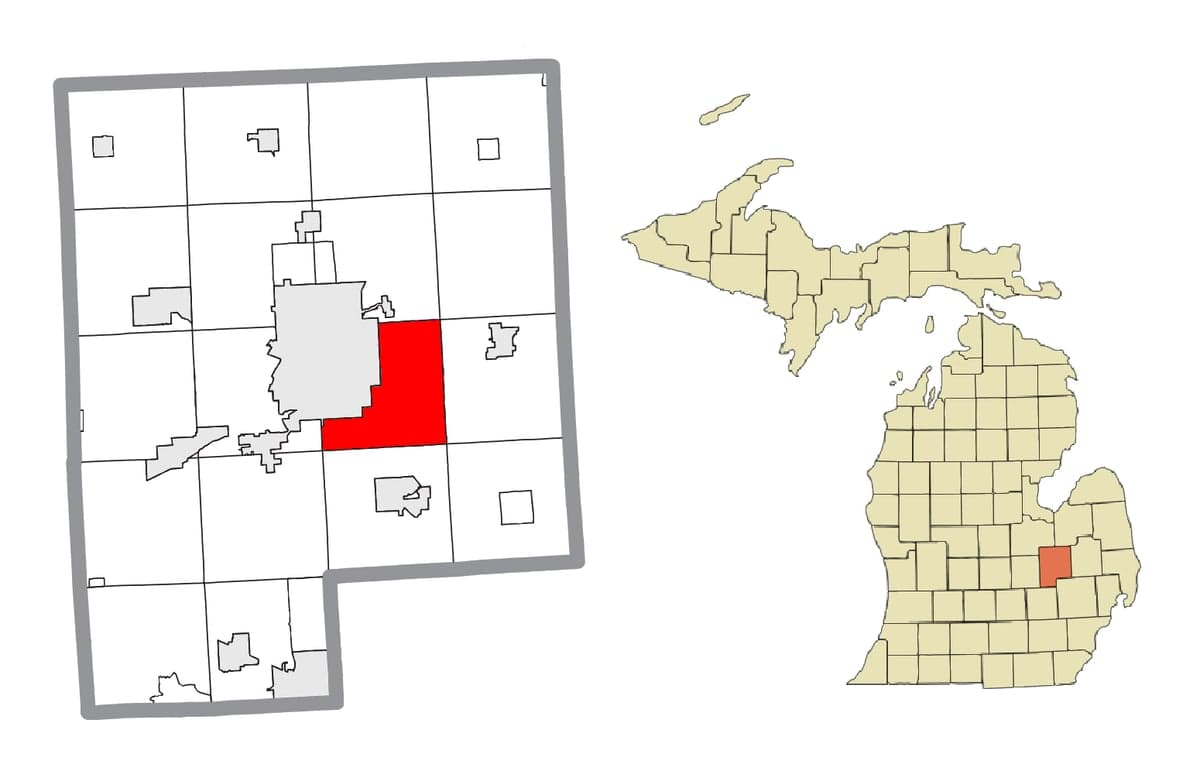
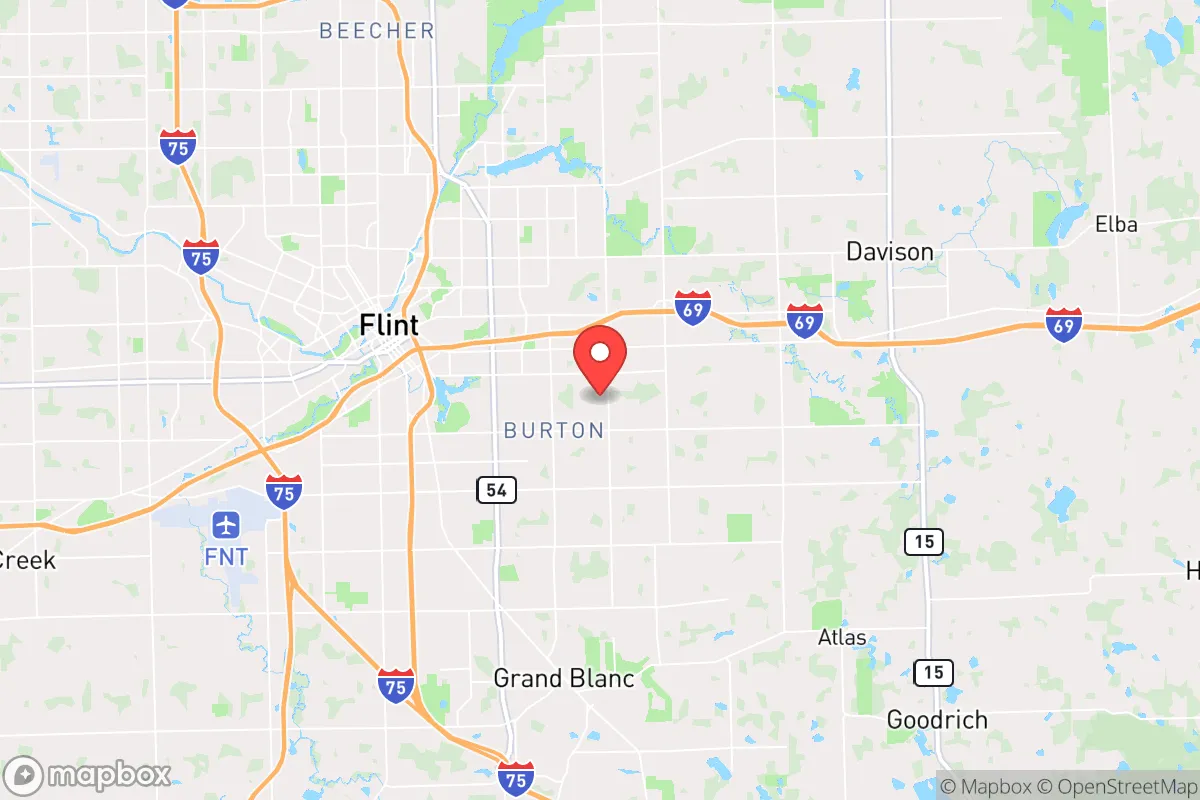
Photo: Wikipedia
Personal Sovereignty in Burton, MI
Strong independent fundamentals that actively favor personal liberty and low regulation.
What does Personal Sovereignty tell us?
Personal Sovereignty measures your capacity for self-reliance and independence with minimal government friction. Higher scores mean fewer barriers between you and the way you want to live... but it assumes you have the space you need and good neighbors.
What does this tell us?
Personal Sovereignty measures your capacity for self-reliance and independence with minimal government friction. Higher scores mean fewer barriers between you and the way you want to live... but it assumes you have the space you need and good neighbors.
State Policy
Energy independence: Importer (20% of energy produced in-state)
Personal Liberty
Homesteading

Personal Liberty Analysis
Burton, Michigan, offers a mixed but workable environment for personal sovereignty, where the practical realities of a working-class Genesee County suburb intersect with state-level policies that both enable and constrain individual autonomy. For those approaching relocation with a survivalist or prepper mindset, the key takeaway is that Burton provides a relatively low-cost base of operations, but it sits within a state whose regulatory and tax structures require careful navigation. The city itself does not impose the kind of aggressive local ordinances found in more progressive enclaves, but residents must contend with Michigan’s broader framework—particularly its tax burden and gun laws—which can either support or undermine a self-reliant lifestyle depending on how one plans to operate.
Tax burden and regulatory posture in Burton and Genesee County
Michigan’s tax structure is a double-edged sword for those prioritizing financial sovereignty. The state levies a flat 4.25% income tax on all individuals, which is moderate compared to high-tax states but still represents a direct claim on earnings that some preppers view as a constraint on personal wealth accumulation. Property taxes in Burton are notable: the city’s millage rate hovers around 50 mills, translating to roughly $5,000 annually on a $100,000 home—a significant recurring cost that eats into savings for supplies, land, or equipment. However, Genesee County’s overall property tax burden is lower than in wealthier southeast Michigan counties like Oakland or Washtenaw, making Burton a relatively affordable entry point. The regulatory posture at the local level is generally hands-off for standard residential activities, but Michigan’s state-level business regulations and environmental rules can complicate small-scale manufacturing or resource extraction. For a prepper, the key is that Burton’s zoning is lenient enough for most home-based projects, but any venture involving water rights, waste disposal, or construction beyond basic sheds will trigger state oversight. The lack of a local income tax in Burton is a small win, but the cumulative tax load—income, property, and sales (6%)—means that financial autonomy requires disciplined budgeting and, ideally, income streams that minimize taxable exposure.
Self-defense and gun law specifics for Burton residents
Michigan’s gun laws are a critical factor for anyone prioritizing self-defense and the right to keep and bear arms. The state is a “shall-issue” jurisdiction for concealed pistol licenses (CPL), meaning that as long as an applicant meets basic criteria—age 21, no disqualifying criminal record, completion of a safety course—the county gun board must issue the permit. This is a solid foundation for personal sovereignty, as it removes arbitrary discretion from local officials. However, Michigan also requires a purchase license for handguns (a background check through local law enforcement) and maintains a state-level firearms database, which some preppers view as an infringement on privacy. Open carry is legal without a permit for those 18 and older, but local ordinances in Burton do not restrict it further, so carrying a long gun openly is permissible on public property. Magazine capacity is not restricted by state law, and there is no ban on common semi-automatic rifles, which is favorable for those building a defensive arsenal. The major caveat is that Michigan has a “red flag” law (extreme risk protection order) that allows family members or law enforcement to petition a court to temporarily seize firearms if someone is deemed a danger. This law, enacted in 2023, introduces a vulnerability: a motivated neighbor or estranged relative could potentially trigger a confiscation order, undermining the security of a prepper’s stockpile. For Burton residents, the practical advice is to maintain a low profile regarding firearm ownership, avoid conflicts that could invite legal scrutiny, and consider legal trusts or other structures to protect assets. The city itself has no additional gun restrictions beyond state law, so the main sovereignty concern is the state-level framework, not local overreach.
Self-reliance and homesteading viability in Burton
For those looking to establish a degree of self-sufficiency through gardening, small livestock, or off-grid systems, Burton presents a mixed picture. Standard residential lots in the city range from one-quarter to one-half acre, which is sufficient for a substantial vegetable garden, a few fruit trees, and a small chicken coop—but not for larger livestock like goats or pigs without special permits. Zoning regulations in Burton are generally permissive for backyard agriculture, but the city’s code does restrict the number of poultry (typically up to six hens, no roosters) and prohibits swine and cattle in residential zones. This is a constraint for anyone aiming for serious food independence, but it’s workable for a family-scale operation. Off-grid feasibility is limited: Michigan’s building codes require connection to municipal water and sewer in most of Burton, and the city enforces occupancy standards that make living in a shed, RV, or container home without permits difficult. Solar panels are allowed but must comply with local electrical codes and utility interconnection rules, which can add bureaucratic hurdles. The real opportunity for self-reliance lies in the surrounding rural areas of Genesee County, where land is cheaper and zoning is looser—but that requires a commute or a separate property. For those committed to living within Burton’s city limits, the focus should be on maximizing what’s possible: intensive gardening, rainwater collection (legal but must not create nuisance), and energy efficiency upgrades. The city’s infrastructure is reliable, which is a double-edged sword—it reduces the need for backup systems but also creates dependency on municipal services that could fail in a crisis. A prepper in Burton should prioritize portable resources (food storage, water filtration, solar generators) that can function independently of the grid, rather than investing heavily in permanent off-grid modifications that may conflict with local codes.
Personal liberties in Burton: parental rights, medical autonomy, speech, and property
Burton sits within a state that has seen increasing tension between individual liberties and government mandates, particularly since the COVID-19 era. Parental rights are relatively strong in Michigan: the state does not have a universal vaccine mandate for schoolchildren, and parents can opt out of specific health requirements for religious or philosophical reasons. However, Michigan’s Department of Health and Human Services retains authority to impose emergency health orders, which could theoretically override local parental decisions during a declared crisis—a concern for those who distrust government overreach in medical matters. Medical autonomy is similarly mixed: Michigan has legalized recreational marijuana, which some view as a positive for personal choice, but it also maintains strict prescription drug monitoring and vaccine tracking systems that privacy-conscious individuals may find intrusive. Speech and assembly rights are protected under the First Amendment, and Burton has not enacted any local ordinances restricting public expression, though the city’s police department has been known to enforce noise and disorderly conduct laws in ways that could chill protest or public gatherings. Property rights are the strongest pillar of personal sovereignty in Burton: the city does not have rent control, and homeowners have broad latitude to modify their property within zoning limits. However, the threat of eminent domain exists for infrastructure projects, and Michigan’s “blight” laws have been used in the past to seize properties deemed neglected, which is a risk for those who prioritize functional but unkempt land. For a conservative-leaning individual, the overall liberty environment in Burton is workable but requires vigilance—local government is not aggressively hostile to personal freedoms, but state-level policies on health, education, and property create a framework that can be tightened during crises.
In the broader landscape of personal sovereignty, Burton occupies a middle ground that will appeal to those who want a low-cost, low-drama base without the extreme regulatory burdens of coastal states or the complete lack of infrastructure found in rural Montana or Idaho. The city’s affordability and permissive local stance on firearms and property use are genuine advantages, but Michigan’s state-level tax burden, red flag law, and potential for emergency health mandates are significant drawbacks for a survivalist mindset. Compared to similar Midwestern suburbs, Burton offers better sovereignty than high-tax, high-regulation areas like Illinois or Minnesota, but it falls short of the constitutional carry and minimal tax environments found in states like Texas or Wyoming. For a strategic relocation, Burton works best as a staging ground—a place to build resources and networks while keeping an eye on state-level political shifts that could erode the freedoms that currently exist. The prudent approach is to treat Burton as a functional but not ideal location for long-term self-reliance, with a plan to either adapt to future restrictions or relocate to a more sovereignty-friendly jurisdiction if conditions deteriorate.

* Values derived from national, state, county, city and local statistics and may differ in a specific area. Last updated: 2026-04-30T06:41:07.000Z
Narrative content on this page is AI-generated and may contain mistakes. Verify any details that matter before acting on them.
ReloMaps may earn a commission from affiliate links at no extra cost to you.

