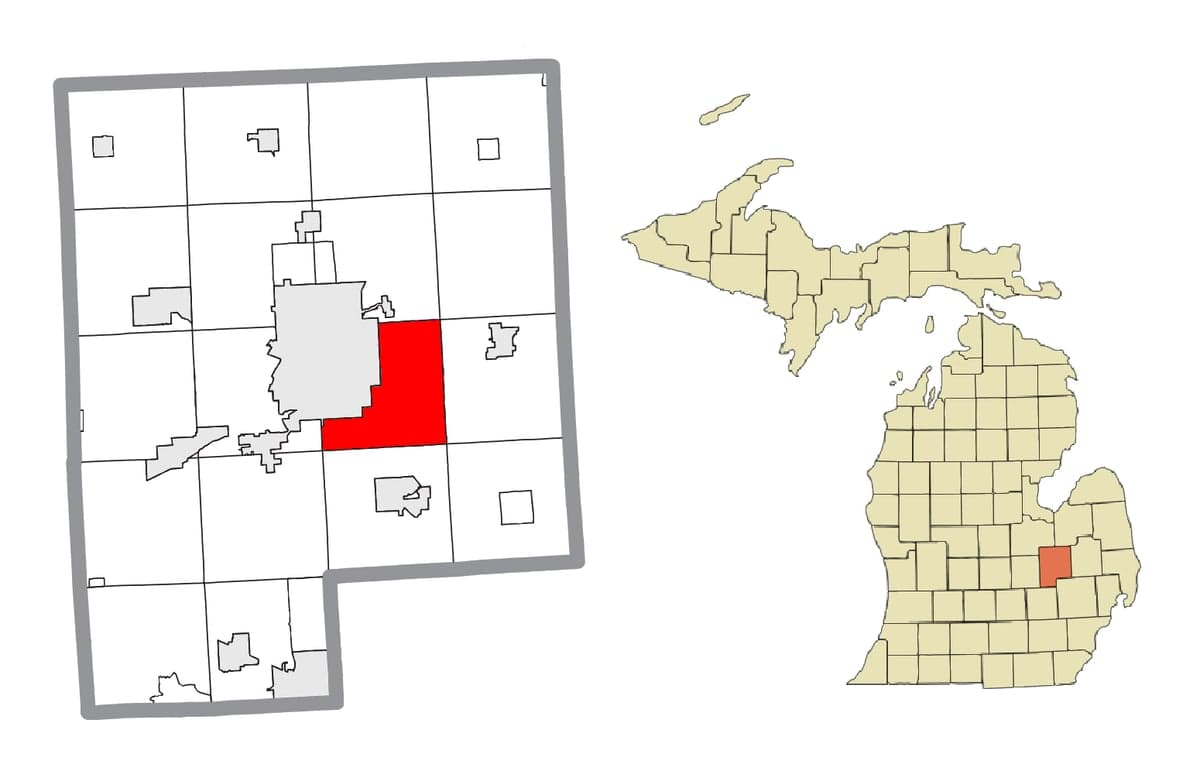
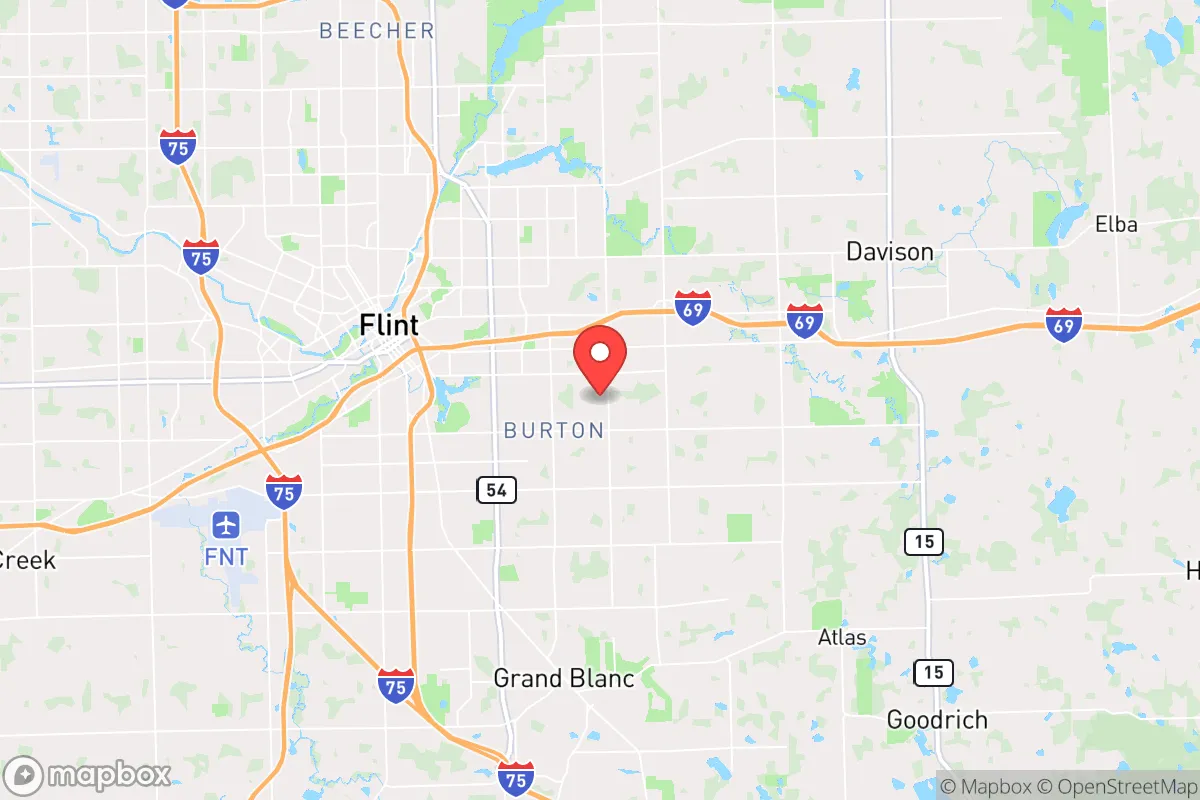
Photo: Wikipedia
Demographics of Burton, MI
Affluence Level in Burton, MI
A below-average socioeconomic profile. Incomes, home values, and educational attainment trail the U.S., with higher poverty and unemployment.
People of Burton, MI
Burton, Michigan, is a predominantly white, working-class city of 29,529 residents, characterized by a strong sense of local identity and a notably low foreign-born population of just 0.8%. The city’s demographic profile is overwhelmingly native-born, with 79.5% of residents identifying as white, 9.5% as Black, and 4.5% as Hispanic, while college-educated adults make up only 16.4% of the population. This is a community shaped by automotive and manufacturing roots, where family ties run deep and the population has remained remarkably stable in its ethnic composition for decades.
How the city was settled and grew
Burton’s human history begins not with a grand founding, but as a rural township carved from Genesee County’s farmland in the 1830s. The first settlers were primarily Yankee and German Protestant farmers drawn by the fertile soil and the promise of land under the federal land grant system. These early families, names like Bishop and Irish, established homesteads in what is now the Bishop Road and Irish Road corridors, areas that remain residential and retain a semi-rural feel. The real population surge came with the rise of General Motors in nearby Flint. From the 1910s through the 1950s, waves of white Appalachian migrants from Kentucky and Tennessee, alongside Polish and Italian immigrants, moved into Burton seeking factory work. They built modest homes in neighborhoods like Dort Highway and Center Road, creating a dense grid of single-family houses that still defines the city’s character. By 1960, Burton had transformed from a sleepy township into a blue-collar suburb, its population swelling as GM plants expanded.
Modern era (post-1965)
The post-1965 era saw Burton’s population stabilize and then slowly diversify, though the changes were modest compared to national trends. The 1965 Hart-Cellar Act had little direct impact here; the city’s foreign-born population remains negligible at 0.8%. Instead, the major demographic shift was domestic: as Flint experienced white flight and deindustrialization in the 1970s and 1980s, some Black families moved into Burton’s southern neighborhoods, particularly around Davison Road and Richfield Road. This influx raised the Black population to its current 9.5%, but the city never saw the rapid racial turnover of nearby Flint or Beecher. The Hispanic population, now 4.5%, grew more gradually, with families settling in the Belsay Road area, often working in local service industries and small manufacturing. East/Southeast Asian residents (0.3%) and Indian-subcontinent residents (0.4%) remain tiny enclaves, concentrated in newer subdivisions near I-69 and Vienna Road. The city’s overall population has been essentially flat since 2000, hovering around 29,000, as out-migration of younger adults to larger metro areas offsets any new arrivals.
The future
Burton’s population trajectory points toward continued stability and gradual aging, not rapid change. The city is not homogenizing into a single identity, but rather tribalizing into distinct, stable enclaves: the older, white, working-class core along Dort Highway and Center Road; the more diverse southern corridor near Davison Road; and a handful of newer subdivisions attracting a slightly more educated, younger cohort. The Hispanic population is likely to grow slowly, perhaps reaching 6-7% by 2040, as families expand and some new arrivals from other parts of Michigan move in. The Black population appears to have plateaued, with no major in-migration expected. The foreign-born share will likely remain under 2%, as Burton lacks the immigrant-friendly infrastructure and job diversity of larger cities. The biggest demographic pressure is aging: the median age is rising, and the city will need to attract younger families to prevent population decline. For now, the city remains a place where most residents were born in Michigan, and where the next generation will likely inherit their parents’ homes rather than be replaced by newcomers.
For someone moving in now, Burton offers a stable, affordable, and predominantly native-born community where change comes slowly. The city is becoming more of a bedroom suburb for commuters to Flint and Genesee County, rather than a destination for new immigrants or young professionals. The low college attainment rate and high homeownership rate suggest a place where practical skills and family ties matter more than credentials or diversity. If you value a quiet, predictable, and largely white working-class environment with deep local roots, Burton is a solid choice. If you seek rapid demographic change or a globally connected population, you will not find it here.

* Values derived from national, state, county, city and local statistics and may differ in a specific area. Last updated: 2026-04-30T06:41:07.000Z
Narrative content on this page is AI-generated and may contain mistakes. Verify any details that matter before acting on them.
ReloMaps may earn a commission from affiliate links at no extra cost to you.

