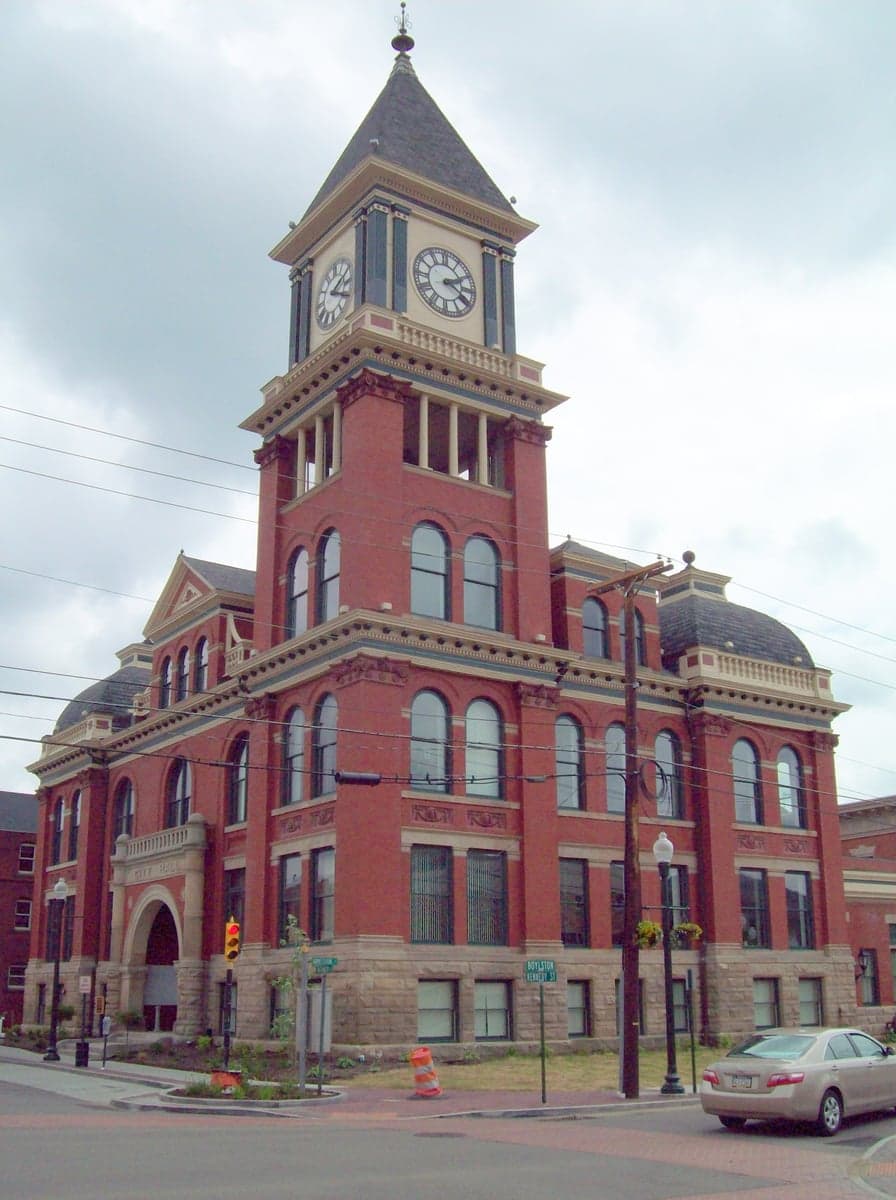
Photo: Wikipedia
Political ClimatePolitical Climate in Bradford, PA
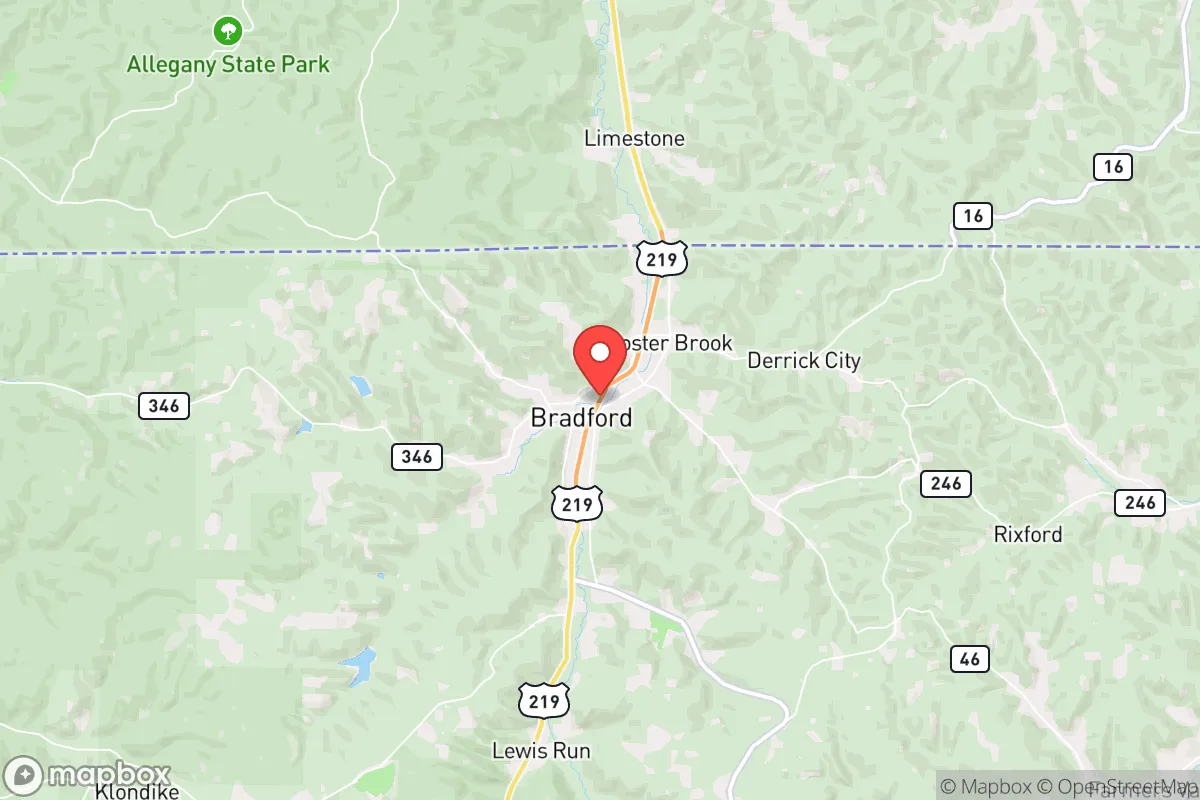
District shown is the primary district for this city’s centroid. Cities may span multiple districts.
Local Political AnalysisPolitical Analysis of Bradford, PA
Bradford, Pennsylvania, is a deeply conservative pocket in a state that has become one of the most fiercely contested battlegrounds in the country. With a Cook Partisan Voting Index (PVI) of R+19, the city and surrounding McKean County vote Republican by margins that are almost unheard of in modern Pennsylvania, which as a whole sits at a PVI of EVEN. This isn't a recent shift; Bradford has been reliably red for generations, rooted in its rural, working-class identity and its distance—both geographically and culturally—from the state's booming liberal centers. While the rest of Pennsylvania has seesawed between parties, Bradford has stayed the course, and if anything, the divide has only grown sharper since the 2016 election.
How it compares
The contrast between Bradford and the rest of Pennsylvania is stark. Drive an hour south to State College, home of Penn State University, and you'll find a PVI of roughly D+10—a 29-point swing from Bradford. Head west to Erie, a blue-collar city on the lake, and you'll see a D+5 lean, while the Philadelphia suburbs are solidly Democratic. Even within McKean County, Bradford is the most conservative node; smaller towns like Smethport and Kane lean red, but not with the same intensity. What sets Bradford apart is its lack of suburbanization or college-town influence. There's no major university, no tech corridor, and no influx of out-of-state transplants to moderate the politics. The economy here has long been tied to oil, gas, and manufacturing—industries that traditionally lean Republican—and the local culture prizes self-reliance and skepticism of big government. In statewide elections, Bradford's votes are a drop in the bucket, but they're a reliable bellwether for the rural, white, working-class base that has become the GOP's strongest pillar in Pennsylvania.
What this means for residents
For conservative residents, Bradford feels like a safe haven. Local government, school boards, and law enforcement are overwhelmingly Republican, and there's little pressure to moderate views. Gun rights are taken seriously, and the Second Amendment is a live issue in local conversation. Tax policy is generally conservative, and there's a strong sense of community self-governance. For liberal residents, life is more complicated. You're not likely to face open hostility, but you'll be in a clear minority. Political discussions at work or in bars can be one-sided, and national Democratic candidates rarely campaign here. That said, most people just get along. The area's small population—around 8,000 in the city—means everyone knows each other, and politics often takes a backseat to shared concerns like jobs, the opioid crisis, and keeping the local hospital open. There's a live-and-let-live attitude, as long as you don't try to push an agenda too hard.
Culturally, Bradford is distinct from the rest of Pennsylvania in a few key ways. The city has a notable Italian-American heritage, visible in its festivals and food, but the broader regional identity is Appalachian, not Philly or Pittsburgh. You won't hear the classic Pennsylvania Dutch influence here; instead, the accent and attitudes feel more like upstate New York. The local economy has struggled since the decline of the oil boom, and there's a palpable sense of being left behind by the state's growth in healthcare and tech. This fuels a deep distrust of Harrisburg and Washington, which translates into strong support for anti-establishment candidates on both sides of the aisle. In 2016, Bradford went heavily for Trump, and in 2020, it stayed that way, even as suburban areas around the state shifted blue. Looking ahead, the trajectory is clear: Bradford will remain a Republican stronghold, but its influence on state politics will continue to wane as Pennsylvania's population concentrates in the southeast. For residents, that means the local culture will stay conservative, but the state's policies—on everything from abortion to energy—will increasingly reflect the values of Philadelphia and Pittsburgh, not McKean County.

State Political ClimatePolitical Climate in Pennsylvania
State Political AnalysisPolitical Environment in the State
Pennsylvania is the ultimate swing state, with a Cook PVI of EVEN that perfectly captures its razor-thin margins in recent presidential elections. Over the past 20 years, the state has shifted from a reliable blue firewall (voting Democratic from 1992 to 2012) to a true battleground where both parties invest heavily, with Donald Trump winning it in 2016 by 44,000 votes and Joe Biden flipping it back in 2020 by just 80,000 votes. The dominant coalitions are a shrinking but still potent union-and-urban base in Philadelphia and Pittsburgh, balanced against a growing, energized conservative vote in the exurbs and rural small towns, plus a decisive suburban bloc in the collar counties around Philadelphia that has trended leftward. For a relocator, this means your vote genuinely matters here, and the state’s political identity is constantly being renegotiated.
Urban vs. rural divide
The political map of Pennsylvania is a textbook study in geographic polarization. Philadelphia and Pittsburgh are the Democratic anchors, delivering massive margins — Philadelphia alone gave Biden about 80% of its vote in 2020, while Allegheny County (Pittsburgh) went 60% for Biden. The suburban ring around Philadelphia — Bucks, Montgomery, Chester, and Delaware counties — has shifted sharply left over the past decade, driven by college-educated professionals moving from the city and nationalizing around issues like abortion access and gun safety. In contrast, the vast rural interior, including counties like Tioga, Bradford, and Fulton, votes 70-80% Republican, powered by a mix of farming, natural resource extraction, and cultural conservatism. The Lancaster area is a fascinating microcosm: the city itself leans left, but the surrounding Amish and Mennonite country is deeply red. The Scranton/Wilkes-Barre region (Lackawanna and Luzerne counties) is the classic bellwether — once solidly blue due to union coal miners, it flipped hard to Trump in 2016 and has stayed competitive, with working-class voters prioritizing economic populism and cultural issues over party loyalty.
Policy environment
Pennsylvania’s policy landscape is a mixed bag that reflects its purple status. The state income tax is a flat 3.07%, one of the lowest in the nation, and there is no tax on Social Security benefits, which appeals to retirees. However, property taxes are high — averaging about 1.5% of home value — and vary wildly by school district, with Philadelphia and Pittsburgh levying additional city wage taxes (3.75% and 3% respectively for residents). The regulatory posture is moderate: the state has a robust environmental code, especially around fracking (Marcellus Shale), but has resisted a full carbon tax. Education policy is decentralized, with 500 school districts, but the state Supreme Court recently ruled the funding system unconstitutional, setting up a potential overhaul. Healthcare is a mixed bag: the state expanded Medicaid under the ACA, but private insurance costs are above average. Election laws are relatively accessible — no-excuse mail-in voting was enacted in 2019 (Act 77) — but remain a partisan flashpoint, with Republicans pushing for voter ID requirements and Democrats defending mail-in access. Gun laws are moderately permissive: no permit is needed to open carry, but a license is required for concealed carry (issued by counties, generally shall-issue), and the state has a preemption law preventing local gun ordinances.
Recent policy direction
The last five years have seen Pennsylvania lurch in both directions, depending on which party controls the governor’s mansion and legislature. Under Democratic Governor Josh Shapiro (elected 2022), the state has moved left on several fronts: he signed an executive order protecting abortion access and gender-affirming care, and his administration has pushed for a $15 minimum wage (still stalled in the Republican-controlled legislature). On gun policy, Shapiro signed a limited “red flag” law (extreme risk protection orders) in 2023, but it only applies to a narrow set of circumstances. On the conservative side, the Republican legislature passed a constitutional amendment (pending voter approval) requiring voter ID, and they’ve repeatedly passed bills to restrict mail-in voting, only to be vetoed by Shapiro. On education, the legislature approved a $100 million school voucher program in 2023, but Shapiro vetoed it, then brokered a compromise that funded both public schools and a smaller scholarship program. On energy, the state remains a top natural gas producer, but Shapiro has proposed a carbon cap-and-trade program (RGGI), which is tied up in court. For a relocator weighing liberties: gun rights are solid but not absolute, property rights are strong (no statewide rent control), taxation is low on income but high on property, and voting access is currently broad but contested.
Civil unrest & political movements
Pennsylvania has seen its share of political flashpoints. The 2020 election aftermath was intense: Trump’s campaign filed multiple lawsuits in the state, and the “Stop the Steal” movement held rallies at the state capitol in Harrisburg. In 2021, a group of Republican state senators held a controversial “forensic investigation” of the 2020 election in Fulton County, which was widely criticized as a partisan stunt. On the left, the 2020 George Floyd protests in Philadelphia were large and occasionally violent, leading to looting and property damage. Immigration politics are less heated than in border states, but Philadelphia is a self-declared “sanctuary city,” which has drawn criticism from conservative lawmakers who have tried (and failed) to pass a ban on such policies. The Pittsburgh area has seen organized activism around fracking, with environmental groups staging protests at well sites. More recently, the Israel-Hamas war sparked large pro-Palestinian protests at the University of Pennsylvania in Philadelphia, leading to the resignation of the university president. For a new resident, the most visible political movement is likely the Moms for Liberty chapters in suburban counties like York and Cumberland, which have been active in school board meetings over curriculum and library books. Overall, civil unrest is sporadic and localized — you won’t see daily protests in most of the state, but the political temperature is high.
Projection
Over the next 5-10 years, Pennsylvania is likely to remain a toss-up, but the demographic trends favor a slight leftward drift. The Philadelphia suburbs are growing and diversifying, while rural counties are aging and shrinking. In-migration is modest — about 50,000 net new residents per year — mostly from New York and New Jersey, which tends to bring more Democratic-leaning voters. However, the working-class exurbs and small cities like Erie and Johnstown are still fertile ground for Republicans, especially if the party focuses on economic populism and cultural issues. The wild card is the state’s aging population: Pennsylvania has the third-oldest median age in the nation, and older voters lean Republican, but they are also more likely to vote. If the GOP can hold its rural base and make inroads with working-class voters in the northeast, it can stay competitive. If Democrats continue to dominate the suburbs and turn out young voters in Philadelphia and Pittsburgh, they’ll have a narrow edge. For a relocator, expect the state to remain a political battleground, with close elections, divided government, and incremental policy changes rather than dramatic shifts. The state’s EVEN PVI is not a fluke — it’s a structural reality.
For a new resident, the bottom line is that Pennsylvania offers a genuine political balance: you’ll find communities that match your values on either side, and your vote will actually count in statewide elections. Conservatives will appreciate the low income tax, strong gun rights, and rural cultural conservatism, but will need to accept that the state’s major cities and suburbs lean left and drive policy on abortion and education. Liberals will find solid ground in Philadelphia, Pittsburgh, and their suburbs, with a governor who protects their priorities, but will face a Republican legislature that blocks most progressive legislation. The practical takeaway: choose your county carefully — a move to Chester County (suburban, trending blue) versus York County (exurban, solid red) will give you a completely different political experience, even though both are within an hour of each other. Pennsylvania is not a state where you can ignore politics — it’s a state where politics is part of daily life, but in a way that rewards engagement rather than resignation.
* Values derived from national, state, county, city and local statistics and may differ in a specific area. Last updated: 2026-08-31T00:19:54.000Z
Narrative content on this page is AI-generated and may contain mistakes. Verify any details that matter before acting on them.
ReloMaps may earn a commission from affiliate links at no extra cost to you.

