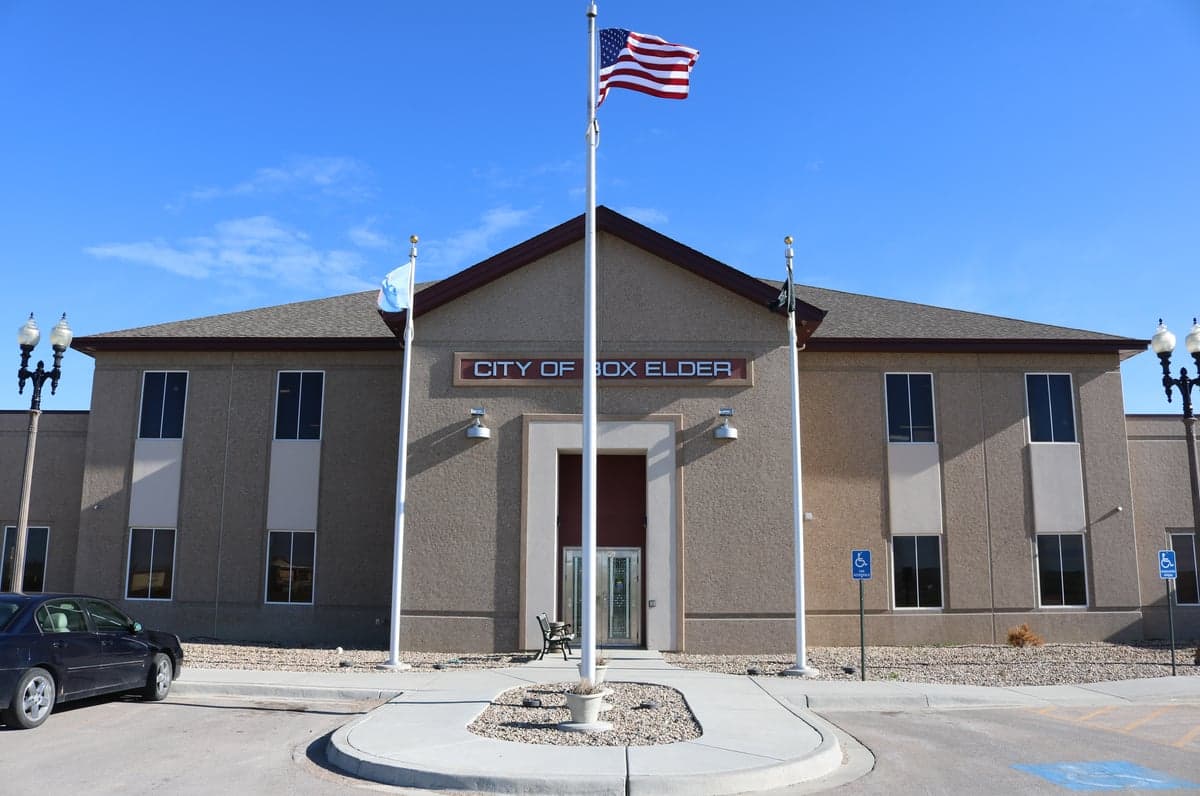
Photo: Wikipedia
Personal Sovereignty in Box Elder, SD
Viable for self-reliance. Generally workable, though some barriers may limit total independence.
What does Personal Sovereignty tell us?
Personal Sovereignty measures your capacity for self-reliance and independence with minimal government friction. Higher scores mean fewer barriers between you and the way you want to live... but it assumes you have the space you need and good neighbors.
What does this tell us?
Personal Sovereignty measures your capacity for self-reliance and independence with minimal government friction. Higher scores mean fewer barriers between you and the way you want to live... but it assumes you have the space you need and good neighbors.
State Policy
Energy independence: Importer (35% of energy produced in-state)
Personal Liberty
Homesteading

Personal Liberty Analysis
Box Elder, South Dakota, offers a personal sovereignty environment that is among the most favorable in the nation for those seeking to minimize government intrusion into daily life. Located in the western part of the state near the Black Hills, this community sits within a state that has no personal or corporate income tax, no inheritance tax, and a constitutionally protected right to keep and bear arms that is among the strongest in the country. For individuals and parents who prioritize self-reliance, limited government, and the ability to live according to their own values, Box Elder represents a strategic relocation option where state-level policies consistently defer to individual choice rather than bureaucratic mandates.
Tax burden and regulatory posture in South Dakota
The most immediate advantage for personal sovereignty in Box Elder is South Dakota's tax structure, which is deliberately designed to leave more money in the hands of residents. The state levies no personal income tax, no corporate income tax, no capital gains tax, and no inheritance or estate tax. This means every dollar earned stays with the individual or family, free from state-level confiscation. The primary revenue source is a 4.5% state sales tax, with local jurisdictions adding up to 2% more—Box Elder's combined rate is around 6.5%, which is moderate. Property taxes are relatively low compared to national averages, with the effective rate on owner-occupied homes hovering near 1.1% of assessed value. The regulatory posture is equally lean: South Dakota has a right-to-work law, minimal occupational licensing requirements compared to coastal states, and a state government that has consistently resisted adopting California-style environmental or labor regulations. For a prepper or survivalist mindset, this means fewer layers of bureaucracy between you and your ability to build, store, or trade resources on your own terms.
Self-defense and gun law specifics in Box Elder
South Dakota is a constitutional carry state, meaning no permit is required to carry a concealed firearm for any law-abiding adult 18 or older. Box Elder residents enjoy this right without the need for government permission, background checks beyond federal requirements, or waiting periods. The state preempts local firearm ordinances, so city or county governments cannot impose their own restrictions—what applies in Rapid City or Sioux Falls applies equally in Box Elder. Stand-your-ground laws are in effect, with no duty to retreat before using deadly force in any place where you have a legal right to be. Castle doctrine protections extend to vehicles and occupied structures. For those concerned about government overreach, South Dakota also passed a Second Amendment Preservation Act that prohibits state resources from being used to enforce federal gun laws deemed unconstitutional. Magazine capacity, firearm types, and ammunition are all unregulated at the state level. This legal framework gives Box Elder residents one of the highest degrees of personal defensive autonomy available anywhere in the contiguous United States.
Self-reliance and homesteading viability in the Black Hills region
Box Elder's location on the eastern edge of the Black Hills provides practical opportunities for self-reliance that are increasingly rare in modern America. Residential lots in the area commonly range from one-quarter acre to several acres, with many newer subdivisions offering half-acre or larger parcels that allow for substantial gardening, small livestock, and rainwater catchment systems. The Pennington County zoning code is generally permissive for agricultural uses on residential property, though homeowners' associations in some developments may impose restrictions—a factor to verify before purchasing. Off-grid feasibility is high: the region receives ample sunlight for solar panels, and well water is accessible on many properties outside city limits. South Dakota has no state-level restrictions on rainwater collection, and composting toilets or alternative waste systems are permitted with proper septic approvals. For those serious about food independence, the growing season runs roughly May through September, with cold-hardy crops extending that window. The nearby Black Hills National Forest offers public land for foraging, hunting, and timber gathering under state and federal regulations that are less restrictive than in many western states. Box Elder itself is not a fully off-grid community, but the surrounding unincorporated areas provide a realistic path toward reduced dependence on municipal infrastructure.
Personal liberties: parental rights, medical autonomy, and property rights
South Dakota has been at the forefront of protecting parental rights in education and healthcare decisions. The state's Parents' Bill of Rights, enacted in 2022, requires schools to obtain parental consent before administering any student health or mental health surveys, and it guarantees parents access to all instructional materials and medical records. No vaccine mandates exist for school attendance—South Dakota allows both medical and religious exemptions, and the state legislature has repeatedly rejected proposals to tighten these. Medical autonomy extends to COVID-19 policies: the state banned vaccine passports and prohibited employers from mandating vaccines as a condition of employment. For property rights, South Dakota follows the "Dillon's Rule" framework but has a strong tradition of limited government takings; eminent domain is rarely used for private economic development. Free speech protections are robust, with no state-level hate speech laws that could criminalize unpopular opinions. The state also has a "critical race theory" ban in public schools, which aligns with conservative concerns about ideological overreach in education. For parents who want to homeschool or enroll in private religious schools, South Dakota has minimal reporting requirements and no teacher certification mandates for private institutions.
When compared to other relocation destinations favored by the sovereignty-minded, Box Elder offers a combination that few places match: no income tax, constitutional carry, permissive zoning for self-reliance, and strong parental rights—all within a state that has consistently pushed back against federal overreach. The trade-offs are real: winters are harsh, the population is small (around 12,000), and the nearest major city is Rapid City, about 10 miles west. But for those who view personal sovereignty as the primary criterion for relocation, Box Elder ranks among the top-tier options in the continental United States, offering a legal and cultural environment where the default assumption is that you are free to live as you see fit—until you prove otherwise.

* Values derived from national, state, county, city and local statistics and may differ in a specific area. Last updated: 2026-04-19T08:22:07.000Z
Narrative content on this page is AI-generated and may contain mistakes. Verify any details that matter before acting on them.
ReloMaps may earn a commission from affiliate links at no extra cost to you.

