
Photo: Wikipedia
Personal Sovereignty in Bowling Green, OH
Viable for self-reliance. Generally workable, though some barriers may limit total independence.
What does Personal Sovereignty tell us?
Personal Sovereignty measures your capacity for self-reliance and independence with minimal government friction. Higher scores mean fewer barriers between you and the way you want to live... but it assumes you have the space you need and good neighbors.
What does this tell us?
Personal Sovereignty measures your capacity for self-reliance and independence with minimal government friction. Higher scores mean fewer barriers between you and the way you want to live... but it assumes you have the space you need and good neighbors.
State Policy
Energy independence: Importer (40% of energy produced in-state)
Personal Liberty
Homesteading

Personal Liberty Analysis
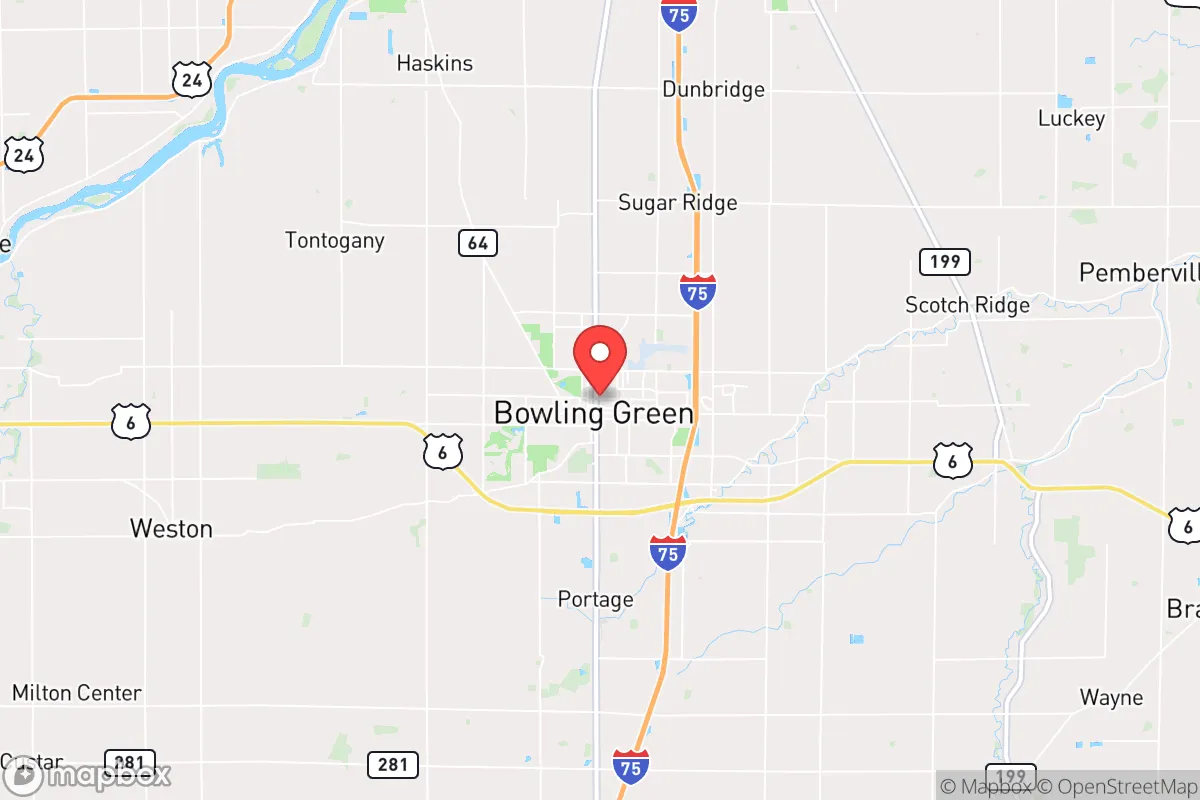
Bowling Green presents a mixed picture for personal sovereignty, where the influence of Bowling Green State University creates a more progressive local culture, but the surrounding Wood County and Ohio state laws provide a solid foundation for individual autonomy. The city itself leans left politically, but Ohio's preemption laws on firearms, its status as a right-to-work state, and its relatively business-friendly regulatory environment mean that state-level protections often override local overreach. For the strategic relocator concerned with government intrusion, the key is understanding where Bowling Green's municipal code diverges from the broader county and state framework.
Ohio's tax burden and regulatory posture in Wood County
Ohio's state income tax is a flat rate of roughly 3.5% after recent cuts, which is moderate compared to the Midwest but still a noticeable bite for self-employed or remote workers trying to maximize their retained earnings. Wood County adds a local income tax of 1.5% for residents, and Bowling Green itself imposes an additional 1.5% municipal income tax on residents and those who work within city limits, bringing the combined local rate to 3.0% on earned income. That's a significant local burden for a city of this size, and it directly reduces the capital you could otherwise allocate to supplies, land, or investments in self-reliance. Property taxes in Wood County run around 1.7% of assessed value, which is typical for Ohio but not cheap, and the county auditor's office has been known to reassess aggressively in growing areas. On the regulatory side, Ohio is a right-to-work state in practice if not by formal statute, meaning union membership cannot be forced as a condition of employment, which preserves some individual bargaining freedom. Business licensing and home occupation permits in Bowling Green are not overly burdensome, but the city does require zoning approvals for any home-based business that generates customer traffic, so running a small-scale operation like a repair shop or tutoring service from your property requires jumping through municipal hoops. The state's regulatory climate overall is middle-of-the-pack, with no standout protections for small-scale producers or homesteaders, but also no aggressive overreach beyond standard health and safety codes.
Self-defense rights and Ohio's firearm preemption laws
Ohio became a permitless carry state in June 2022, meaning any law-abiding adult 21 or older can carry a concealed firearm without a license, permit, or training requirement. This is a significant win for personal sovereignty, as it removes a bureaucratic gatekeeping step and reduces the risk of government overreach in the permitting process. Ohio also has strong preemption laws that prohibit local governments from enacting their own firearm ordinances, so Bowling Green cannot legally ban carry in city parks, restrict magazine capacities, or impose waiting periods beyond what state law allows. This preemption is critical because it prevents a college-town city council from chipping away at your rights through local ordinances. The state's castle doctrine and stand your ground laws are solid, with no duty to retreat in any place where you are lawfully present, and a presumption that a home intruder intends to cause harm. Wood County's sheriff's office is generally supportive of Second Amendment rights, and concealed carry license applications (still useful for reciprocity when traveling) are processed without unnecessary delays. The only notable local friction is that BGSU's campus remains a gun-free zone under state law, so if you live near campus or work there, you cannot carry on university property, which is a carve-out that limits your ability to defend yourself in that specific environment. For the prepper mindset, the bottom line is that Ohio's state-level framework gives you a strong foundation for self-defense, but you need to be aware of the campus exclusion zone and plan accordingly.
Lot sizes, zoning, and off-grid living feasibility near Bowling Green
Within Bowling Green city limits, standard residential lots average around 6,000 to 10,000 square feet, which is suburban density and not conducive to serious homesteading or off-grid living. City zoning restricts livestock, limits outbuildings, and requires connection to municipal water and sewer, so true self-reliance on a city lot is not feasible. The real opportunity lies in the unincorporated areas of Wood County and the surrounding townships, where you can find parcels of 1 to 5 acres within a 15-minute drive of downtown. These areas are zoned agricultural or rural residential, allowing chickens, goats, and even larger livestock with minimal permitting. Off-grid feasibility is mixed: Ohio's building code requires connection to approved septic systems, and while rainwater collection is not prohibited, it is not explicitly protected either, and the state's Department of Health can impose restrictions if you are using it for potable purposes without treatment. Solar panels are allowed without significant pushback, but net metering policies from the local utility (American Electric Power or Wood County Electric) are not particularly generous, so you are better off designing a system with battery storage for true independence. Wood County does not have county-wide zoning in all townships, which gives you more freedom to build, store supplies, and operate without bureaucratic oversight, but you still need to comply with state health codes for septic and well water. For the serious prepper, the strategy is to buy land just outside the city limits where you can establish a base with room for gardens, tool sheds, and fuel storage, while maintaining a smaller residence inside Bowling Green for access to jobs and infrastructure.
Parental rights, medical autonomy, and free speech in practice
Ohio has a parental bill of rights law that affirms parents' authority over their children's education, healthcare, and religious upbringing, and it requires schools to notify parents of any medical or mental health services offered to students. This is a meaningful protection against school-based overreach, and Wood County schools generally comply without the aggressive ideological pushback seen in more progressive districts. Medical autonomy is a mixed bag: Ohio did not impose broad vaccine mandates during the COVID era beyond healthcare workers, and there is no state-level vaccine passport system, but the state's health department retains significant emergency powers that could be activated in a future crisis. The Ohio legislature has introduced bills to limit those emergency powers, but as of 2026, the governor still holds authority to issue health orders that can restrict personal movement and business operations during declared emergencies. Free speech protections are strong under the Ohio Constitution, and Bowling Green's city council has not attempted to impose content-based restrictions on public expression, though the university campus has its own speech codes that can be more restrictive. Property rights are generally respected, with no county-wide rent control or forced inclusionary zoning, and eminent domain is used sparingly in Wood County. The biggest concern for the sovereignty-minded individual is the potential for future state-level emergency orders to override local protections, which is why having a rural buffer property outside municipal jurisdiction is a wise hedge.
Compared to other parts of the Midwest, Bowling Green offers a workable but imperfect environment for personal sovereignty. The state-level protections on firearms, parental rights, and preemption are genuine assets, and the ability to find affordable rural land within a short drive gives you a practical escape hatch from city ordinances. The downsides are the relatively high local income tax, the university's progressive influence on city politics, and the lingering risk of state emergency powers being used to restrict personal freedom. For a single individual or family willing to live just outside the city limits and engage with Wood County's rural governance structure, this area provides a solid base for self-reliant living without the extreme regulatory hostility found in states like California or New York. It is not a sovereignty stronghold like parts of the Mountain West or rural Appalachia, but it is a defensible middle ground where you can build a life with reasonable autonomy while maintaining access to jobs and infrastructure.

* Values derived from national, state, county, city and local statistics and may differ in a specific area. Last updated: 2026-05-14T18:54:49.000Z
Narrative content on this page is AI-generated and may contain mistakes. Verify any details that matter before acting on them.
ReloMaps may earn a commission from affiliate links at no extra cost to you.

